


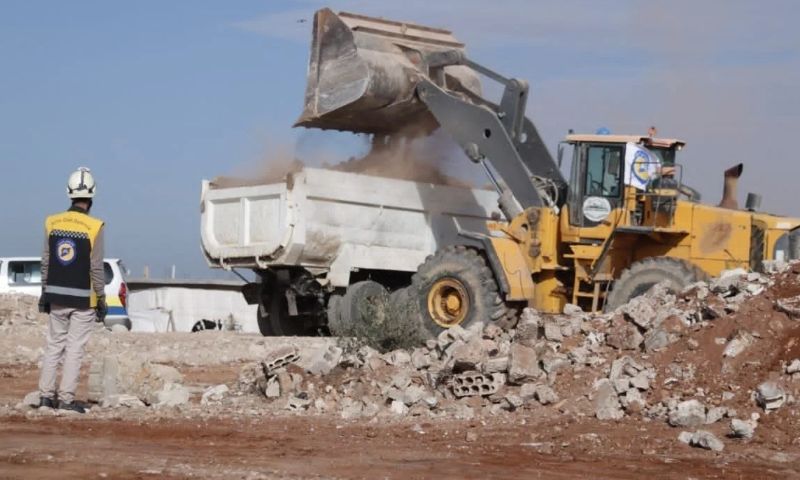
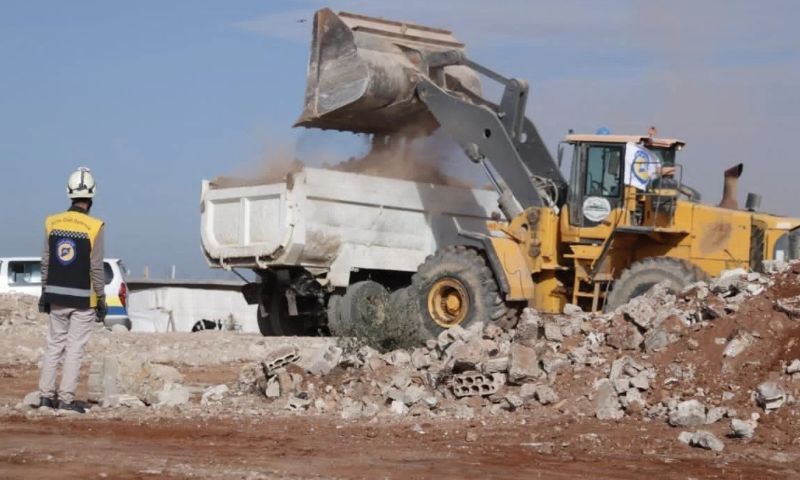
 Rubble removal work in Homs governorate, November 15, 2026 (Ministry of Emergency and Disaster Management)
Authorities in Homs governorate (central Syria), in coordination with Syria’s Ministry of Emergency and Disaster Management, have launched the Subul project to clear rubble and reopen roads at 75 sites. The project is part of efforts under Decree No. 59 to help displaced residents return to their towns and villages.
The governorate said on Wednesday, November 18, that the project would haul away rubble, level earthen barriers, and fill in trenches. It estimated the total volume of material at around 750,000 cubic meters and the cost at up to $3 million. Work began in al-Qusayr and is scheduled to last 90 days.
Clearing the rubble will give residents access to homes blocked by debris and allow them to return to damaged neighborhoods and begin repairs and rehabilitation.
The Ministry of Emergency and Disaster Management said it would follow the required legal procedures before removing debris from residential properties. Property owners must submit a written request and obtain approval from the local council of the city, town, or village where the property is located.
Before work began, the ministry’s mine clearance and explosive ordnance teams surveyed and assessed the sites to identify remnants of war and unexploded ordnance and protect staff and workers during the operation.
Enab Baladi’s correspondent in Homs confirmed that crews began work in al-Qusayr’s northern neighborhood and in the village of al-Buwaydah al-Sharqiyah. Later phases will cover Jousiyeh and its surrounding villages, followed by Rableh, before expanding to the remaining areas.
The correspondent said the work includes clearing and hauling away rubble, reopening blocked roads, removing earthen barriers, filling in trenches, and grading dumpsites.
She added that the plan covers 26 sites in the city of Homs, including Deir Baalba, al-Bayada, al-Shamas, Karm al-Zaytoun, Ashira, Baba Amr, al-Khalidiya, al-Waer, and Jouret Ash-Shayyah.
Decree No. 59, issued in March, provides for a committee chaired by the minister of emergency and disaster management. The committee is tasked with preparing infrastructure in devastated areas so residents can return, improving services in areas where internally displaced people live, and providing support to ease the effects of displacement.
The Ministry of Emergency and Disaster Management has removed about 3.5 million cubic meters of rubble across Syria out of an estimated 40 million cubic meters. It aims to remove more than eight million cubic meters by the end of 2027, the ministry’s Media and Communications Department told Enab Baladi.
The department reported a figure of about 43% for rubble cleared from main roads and public facilities in comparison with rubble in residential neighborhoods and areas.
Removing and hauling away rubble costs between $2.50 and $6 per cubic meter, depending on current prices and conditions in each area, according to the ministry.
The department said it could not estimate the overall cost of upcoming projects because expenses depend on the type of heavy equipment needed, whether it is available locally or must be brought in from elsewhere, fluctuations in fuel prices, and the distance between rubble sites and designated dumpsites.
if you think the article contain wrong information or you have additional details Send Correction


 A
A
A



 More Society