


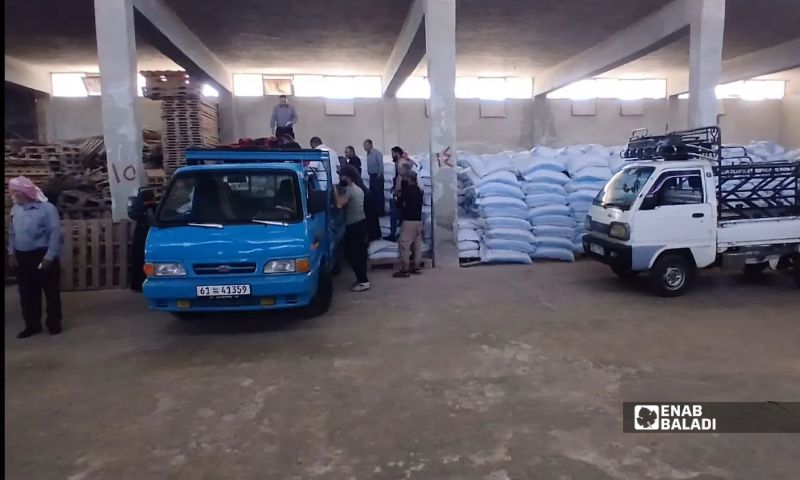
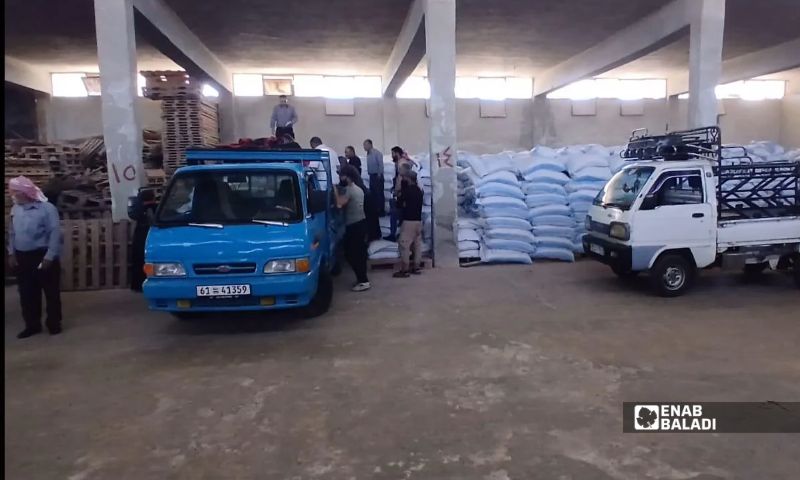
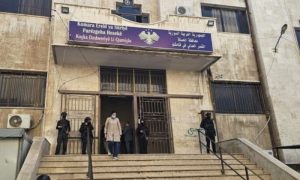
 Workers load bags of animal feed onto a vehicle at the Khan Arnabeh feed center in Quneitra governorate on April 30, 2026. (Enab Baladi / Abdullah Alwanny)
Livestock farmers in rural Quneitra governorate (southwestern Syria) say shortages at government feed centers have forced them to buy more expensive feed on the local market, leaving them with significant financial losses.
Farmers say the shortages at the Quneitra feed branch’s warehouses have also harmed their animals’ health.
Ali al-Hariri, who lives in the village of Ofania (northern Quneitra), supports his family with a single cow. He told Enab Baladi he used to buy three 50-kilogram bags of feed a week from the Khan Arnabeh feed center.
When feed was unavailable at the center, al-Hariri turned to private suppliers. The switch caused what he called a “problem.” He said his cow developed bloating and indigestion, the latter known locally as bashma, even though he followed health guidance and introduced the new feed gradually.
Al-Hariri said medication did little to improve the cow’s condition. Her daily milk output fell from 32 kilograms to 12.
Once the cow’s condition stabilized, he went back to buying feed from the government center. He said the center still did not always have the feed he needed and that interruptions in supply caused losses for farmers.
Staff at the center told al-Hariri that one reason for the shortage was a lack of yellow corn, a key ingredient in animal feed, particularly feed for dairy cows.
Al-Hariri said his family depends on the income from his cow. He has health problems and no other work. He currently pays 60 Syrian pounds (SYP) per kilogram (about $0.40) for feed from private suppliers, compared with SYP 45 per kilogram (about $0.30) at the government center.
Despite the higher price, al-Hariri said he considers buying from private suppliers a safer way to protect his cow from further health problems.
Ahmad Abu al-Majd, a farmer from Al-Mushrifah (southern Quneitra), called on government feed centers in the governorate to build up enough stock to meet farmers’ needs for at least six months. He said a reserve would help prevent repeated shortages and ensure farmers could buy enough feed.
Abu al-Majd, who keeps seven cows, said small allocations and unreliable supplies leave farmers with a difficult choice. They can pay higher prices to private suppliers to protect their herds or buy cheaper feed from government centers, where interruptions in supply can harm their animals’ health.
He also called for support for the livestock sector, including grants of animal feed for farmers through international organizations and associations that visit the governorate.
Awad Hassan Shabat, head of the farmers’ association in Ruwayhina (central Quneitra), said the livestock sector was deteriorating because it received too little support, including from aid organizations.
Shabat said five relief organizations had visited the area to hear residents’ requests. Residents asked for support for livestock farming, a primary source of income in the village. He said none of the organizations had responded.
He added that government warehouses did not supply enough feed, forcing farmers to pay steep prices on the local market.
Wahid Saadia, director of the Quneitra branch of the General Establishment for Feed, told Enab Baladi that the Khan Arnabeh and Suwaysah (southern Quneitra) feed centers each received just one truckload of feed in November. He attributed the shortage to a lack of ingredients needed to produce feed, including yellow corn and soybean meal.
Saadia said the establishment had begun receiving locally grown yellow corn from farmers and drying it after putting a dryer into operation in Raqqa governorate. He said the shortage affected all of the establishment’s branches across Syria.
Saadia said the price gap had increased demand for feed at government centers. In Quneitra, a metric ton costs SYP 60,000 (about $400) on the local market and SYP 45,000 (about $300) at the establishment’s centers.
Ali Ibrahim, secretary of the Quneitra Veterinary Association and a member of the Cattle Farmers Association, said a governorate-wide shortage of veterinary staff and the high cost of medicine and feed were among the main challenges facing livestock farmers.
Ibrahim told Enab Baladi in July that the biggest problem was the low price farmers received for milk as feed prices rose. He said difficulties finding buyers had allowed traders to control milk prices.
Ibrahim said the Cattle Farmers Association was seeking a direct contract with an organization or a large company in Damascus to buy milk produced in Quneitra without an intermediary and at a price that was fair to farmers.
The association began operating on July 22 under a May 24 decision by the Ministry of Social Affairs and Labor authorizing it to operate in all Syrian governorates.
if you think the article contain wrong information or you have additional details Send Correction


 A
A
A



 More Society