


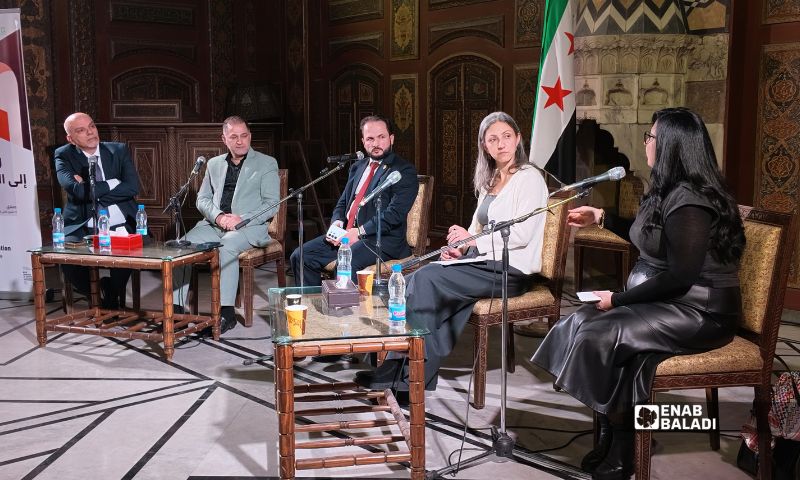
 A panel discussion titled “Media and Access to Information: Windows for Dialogue” at the National Museum in Damascus, November 12, 2026 (Enab Baladi)
Enab Baladi, Amir Hakouk
How can the media perform its watchdog role when the information it needs is withheld or difficult to obtain? This question puts the relationship between government institutions and the press to a test that goes beyond cooperation and communication, touching on the public’s right to know and journalists’ ability to follow matters of public concern and hold those responsible accountable.
The question provided the starting point for a panel discussion titled “Media and Access to Information: Windows for Dialogue,” held at the National Museum in Damascus on Thursday, November 12. Enab Baladi organized the event in cooperation with Rozana Media, Arta Radio and Al-Jumhuriya.
Representatives of independent media organizations and government bodies attended alongside journalists and media workers. Participants included Rozana Media representative Lujain Haj Youssef, Syrian Journalists’ Union executive board member Baraa Othman, Al-Jumhuriya Media Group representative Zeina Shahla, and Omar al-Haj Ahmad, director of press affairs at the Ministry of Information. Media professional Zaidoun al-Zoabi moderated the discussion.
The discussion covered access to information in Syria, relations between media organizations and government bodies, safeguards in the forthcoming media law, the distinction between journalists and content creators, and the mechanisms needed to improve working conditions in the media sector.
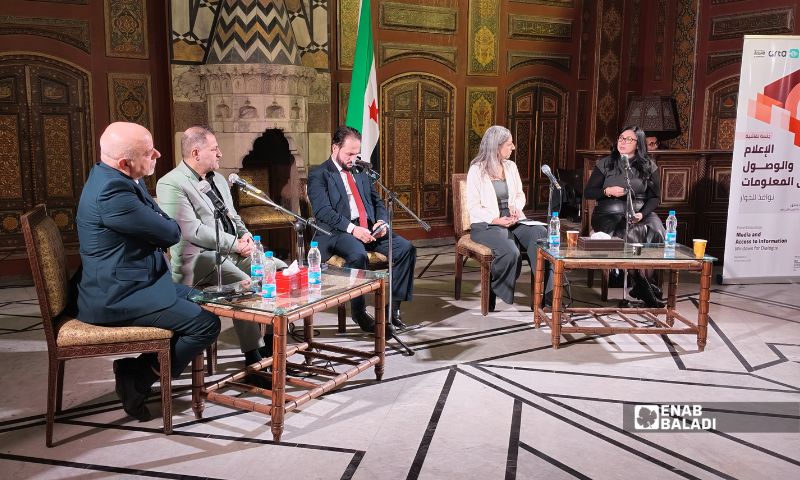
A discussion titled “Media and Access to Information: Windows for Dialogue” at the National Museum in Damascus, November 12, 2026 (Enab Baladi)
The difficulty of accessing information affects more than a journalist unable to complete an investigation or obtain an answer from an official body. It also affects society’s ability to understand issues that concern it, the credibility of information in circulation and, ultimately, public trust in government institutions.
During the discussion, independent journalists described unequal opportunities to access information among media organizations, depending on their relationships with government departments. Some outlets receive assistance in reaching officials and obtaining information, while others face difficulties even in securing information on matters of public concern.
Participants cited examples including the gasoline scandal and the case of Rania al-Abbasi’s children, highlighting the consequences of failing to disclose information and details about public issues, and the difficulty journalists face in following developments and outcomes.
In this context, Baraa Othman, an executive board member of the Syrian Journalists’ Union, argued that the absence of information means more than a journalist being unable to obtain it. It allows inaccurate information to replace the truth and leaves society vulnerable to rumors.
Othman said public and private institutions must recognize that journalists seek information to convey it to the public, and that access to it is a public right. Journalists must also receive prompt responses that reflect the demands of their work, he said.
Rozana Media representative Lujain Haj Youssef linked the availability of information to citizens’ trust in government institutions. She argued that withholding some information or making it available only to certain groups undermines public trust in the government and makes people more susceptible to believing platforms that publish false information, potentially affecting stability in Syrian cities.
The journalists’ contributions illustrated that independent media need not be a burden on government institutions. With access to information, they can help identify problems and draw attention to them before they worsen.
Speaking to Enab Baladi, Abdolrahman Omaren, project director of the German-Syrian School of Journalism, said the problem is not always that information is unavailable. Sometimes, responsibilities and authority within government institutions are unclear.
He explained that the person who holds the information may lack authorization to disclose it. Obtaining it might be quicker by asking the minister directly, he said, highlighting the need to designate those responsible for providing information and establish procedures for handling press inquiries.
Independent journalist Nisreen Alaa al-Din said difficulties accessing public information become more complicated when working on investigations requiring specific details. This delays reporting on issues affecting citizens’ lives or forces journalists to work with incomplete information.
She told Enab Baladi that this could push some journalists away from such work, affecting trust between them and their audiences.
Difficulties accessing information reflect shortcomings in communication between media organizations and government bodies. Responses to press inquiries do not always appear to follow consistent procedures. Instead, they often depend on a department’s or official’s willingness to cooperate with a particular outlet.
The absence of spokespeople in several government institutions, and uncertainty over who is authorized to speak or how long a response should take, emerged as factors that participants said hinder journalism.
Baraa Othman stressed that relations between government institutions and independent media should not be adversarial, particularly when reporting addresses failings, corruption or commercial interests.
He said officials have a duty to answer the questions and criticism journalists raise in their professional work. He stressed that neither side should prejudge the other, whether an institution’s attitude toward a journalist or the reverse.
The problem extends beyond a lack of response to unequal treatment of media organizations. Participants noted that some outlets receive assistance in attending events and conferences and conducting interviews, while others struggle to obtain similar opportunities.
Omaren called for equal access to information and fair treatment of media organizations. Access should not depend on whether a journalist is invited to events or on their relationship with the body from which they are requesting information, he said.
For his part, Omar al-Haj Ahmad, director of press affairs at the Ministry of Information, discussed measures the ministry is developing to reduce the extent to which service provision depends on individual officials’ discretion.
Speaking to Enab Baladi, he said the ministry is preparing an organizational structure and procedures for serving those who use its services. He pointed to the establishment of a dedicated department to follow up on information requests, evaluate services and survey users’ satisfaction.
Moayad Hayel Qablawi, chair of the People’s Assembly’s media committee, also outlined meetings held with government media offices. He said these included representatives of 23 ministerial media offices, among them those of the defense, interior and foreign ministries, as well as meetings with representatives of the remaining ministries, one of which was attended by about 40 people.
According to Qablawi, the meetings addressed journalism, government communication, and procedures for managing and circulating information within ministries, including response times, organizational frameworks and bureaucratic obstacles.
He noted that some media offices lack clarity about how quickly information should be released. He highlighted delays in obtaining information and official positions from the Ministry of Education, particularly on curricula, and stressed the importance of improving crisis management to ensure a clear position reaches the public.
These contributions suggest that addressing access to information requires more than affirming the importance of cooperation with the media. Responsibilities must be defined, response procedures standardized, and journalists’ rights protected from dependence on the personal attitudes of an official or department.
As difficulties accessing information persist, part of the discussion has turned to the forthcoming media law, which is supposed to regulate relations between journalists and government bodies and define media workers’ rights and the safeguards needed to carry out their work.
During the discussion, Omar al-Haj Ahmad, director of press affairs at the Ministry of Information, said the draft media law includes a chapter and provisions addressing the right to access information, its protection, the time frame for obtaining it, and journalists’ right to challenge a refusal to provide it, including by filing a case before the administrative courts.
He told Enab Baladi that the ministry has launched its own app, but its information request service has yet to be activated. An upcoming update will allow journalists to submit and track information requests within a specified time frame, with the option to challenge a failure to provide the information, he said.
On the drafting process, al-Haj Ahmad said the draft had been submitted to the People’s Assembly’s media committee. Workshops with relevant experts are planned to revise the wording and incorporate amendments and proposals, alongside open seminars and workshops with journalists, media organizations and stakeholders.
Asked why the draft has not yet been published, he said it is not secret, but that the ministry is working toward a well-developed version before opening it to discussion.
However, journalists’ contributions showed that the issue concerns more than when the draft will be published. It also involves the extent to which independent media organizations participate in drafting it, and how familiar media workers are with the provisions that will govern their work.
Lujain Haj Youssef said access to the media law and participation in drafting it are fundamental demands of media organizations. Building a new media sector requires partnership with those concerned, rather than limiting them to receiving the law once it has been prepared, she argued.
She added that improving knowledge of the law’s provisions and allowing room to discuss them are prerequisites for developing the journalistic environment and achieving greater media freedom and space to work.
Baraa Othman, in turn, referred to discussions with ministry representatives about the law. He stressed that it must include safeguards protecting journalists’ work and enabling them to perform their duties, while ensuring equal access to information for organizations and journalists, without discrimination between media organizations, journalists, influencers and foreign journalists.
Qablawi, meanwhile, raised the issue of exceptions that could limit information disclosure. He explained that the right to obtain information is not absolute and may be restricted to protect security, international relations, judicial and police investigations, individual privacy, commercial and industrial interests, patent rights, manuscripts and the rights of public administrations.
This presents the media law with a test: how to balance the public’s and journalists’ right to know against exceptions intended to protect other interests and rights, and how clearly to define those exceptions so they do not become a sweeping justification for withholding information.
Alongside access to information, the discussion addressed regulation of media work and the distinctions between journalists, content creators and influencers, as social media platforms gain prominence and a broader range of people produce media material for the public.
Qablawi warned of overlapping roles among these groups and the absence of clear legal definitions. Regulating the sector requires defining the nature of each group’s work and its associated responsibilities, he argued.
He referred to meetings with the Ministry of Justice’s legislation department, media offices and journalists to discuss needs, obstacles and the support required. He warned that rushing to prepare a media law could produce unsuitable outcomes.
Othman argued that journalists differ from content creators in their professional training and the ethics and conduct governing how they handle and publish information, as well as their accountability for deliberately misleading the public or publishing hate speech and incitement.
He proposed establishing a dedicated directorate for content creation to develop a document regulating the field, defining the criteria for issuing content creation credentials and the subjects those working in it may address.
The proposal opens a broader debate about the kind of regulation the sector needs: whether it should focus on protecting the profession and its standards or extend to defining who is entitled to practice different forms of media work, without restricting freedom of expression.
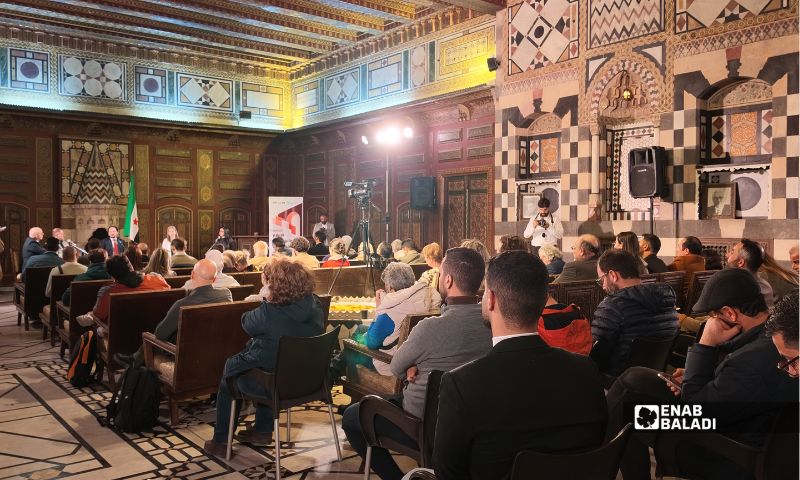
A discussion titled “Media and Access to Information: Windows for Dialogue” at the National Museum in Damascus, November 12, 2026 (Enab Baladi)
The discussion brought together representatives of independent media organizations, government bodies, the union and the People’s Assembly in an attempt to create space for dialogue that moves beyond presenting problems to exploring ways to address them, particularly as the issues raised require cooperation among several bodies.
Media professional and discussion moderator Zaidoun al-Zoabi told Enab Baladi that the meeting’s importance lay in bringing representatives of the executive and legislative authorities and the journalists’ union together with independent media and civil society in a transparent setting for dialogue.
He added that the discussion addressed the media law in ways intended to serve independent media organizations and the right to access information, with implications for media freedom, freedom of expression and the country’s stability. He expressed hope that the session would produce positive results and encouraged further meetings.
Independent journalist Nisreen Alaa al-Din said the discussion allowed journalists to raise their demands and follow up on how their rights would be secured. She expressed hope that the meetings would continue and participation would expand.
Between the Information Ministry’s assurances that the draft law contains safeguards for access to information, independent organizations’ demands to participate in drafting it, and relevant bodies’ acknowledgment of obstacles in government communication, the problem appears to extend beyond writing a new law. The challenge is to turn access to information from a declared principle into an everyday practice that does not vary according to the media organization or the official receiving an inquiry.
It also depends on government bodies’ willingness to treat journalists’ questions as part of the public’s right to know, rather than as a threat to institutions’ work.
Ultimately, the public is not outside this equation but bears the greatest share of its consequences. The absence of reliable information does not leave a vacuum for long; conflicting accounts and rumors fill it, at a time when Syria needs media capable of reporting facts, holding institutions accountable and highlighting failings.
Syrian Media: Mechanisms Hamper Access to Information as Law Is Drafted in the Shadows
if you think the article contain wrong information or you have additional details Send Correction


 A
A
A




 More Politics