


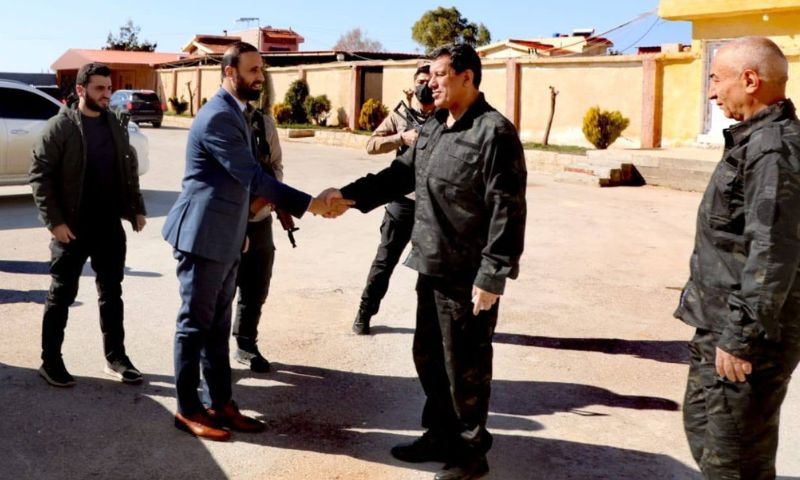
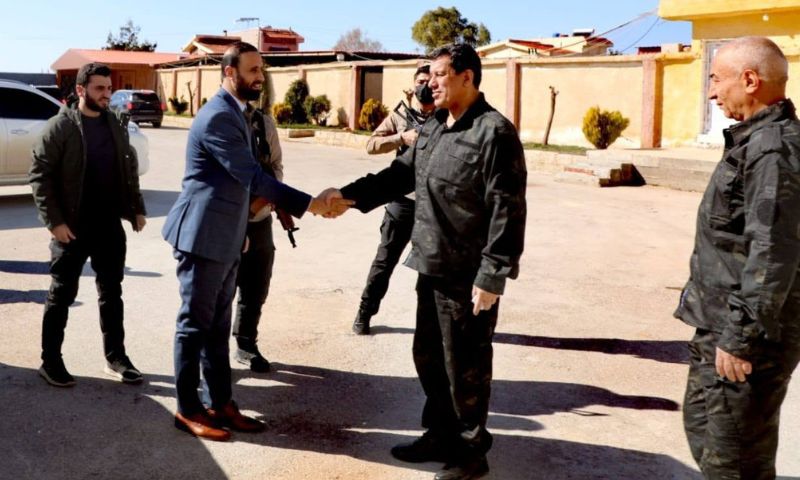
 Mazloum Abdi meets Ziad al-Ayesh, head of the presidential delegation overseeing implementation of the integration agreement, March 2, 2026 (SDF)
Syrian presidential adviser Mazloum Abdi’s announcement that forces from Afrin and Aleppo’s Sheikh Maqsoud neighborhood are undergoing military training ahead of their return and future deployment has renewed attention on the integration of formations formerly affiliated with the now-dissolved Syrian Democratic Forces (SDF) into Syrian state institutions. Abdi said the process would be completed by the end of 2026.
In an exclusive interview with Nuce tv. published on November 9, Abdi said the training was part of ongoing arrangements to return these forces to their areas. He noted that discussions with state institutions were continuing over the details of integration and unresolved issues.
His remarks coincide with information published by local media outlets close to the SDF about training for members of the Afrin Brigade and the Internal Security Forces, known as Asayish. These reports also described preparations for personnel previously stationed in Afrin and Aleppo’s Sheikh Maqsoud and Ashrafieh neighborhoods to undertake security duties in their areas once coordination procedures are completed.
These developments indicate that integration involves more than transferring fighters into new military formations. It also entails determining the security duties some personnel will undertake, where they will deploy, and which authorities they will report to administratively and militarily.
The publicly announced political process for integrating the SDF into Syrian state institutions began on March 10, 2025, when Syrian President Ahmed al-Sharaa and then-SDF commander Mazloum Abdi signed an agreement to integrate the forces’ civilian and military institutions into state institutions, including border crossings, the airport, and oil and gas fields.
The agreement included recognition of the Kurdish community as an integral part of the Syrian state and guarantees of its constitutional rights, alongside a ceasefire and efforts to implement the agreement’s provisions before the end of that year.
However, implementation faced difficulties over the nature of integration, particularly disagreements about whether fighters would join individually and be distributed among Syrian army formations, or whether existing military units would remain intact within the Defense Ministry’s structure.
Disputes also emerged over the future of security and administrative institutions, the relationship between former SDF military commanders and the army’s central command, and issues concerning crossings, natural resources and borders.
Over the following months, the understandings did not translate into comprehensive implementation measures, despite continued meetings and contacts between the two sides. Meanwhile, the SDF continued recruitment and military training, raising questions about its commitment to implementing the agreement within the specified timeframe.
In December 2025, negotiations between Damascus and the SDF accelerated, with government proposals circulating to incorporate the forces into the Syrian army as brigades and divisions, in an attempt to overcome disagreements over the structure of military formations after integration.
Implementation nevertheless stalled, and the approaching deadline was insufficient to resolve disagreements over integration mechanisms and military command.
The beginning of 2026 brought a shift in negotiations amid sweeping military changes in northeastern Syria. The Syrian army took control of large areas of Raqqa and Deir Ezzor governorates and parts of the al-Hasakah countryside, while the SDF withdrew to major cities, principally al-Hasakah and Qamishli.
These developments redrew the map of territorial control and pushed both sides to resume negotiations under different conditions on the ground from those surrounding the March 2025 agreement.
On January 29, 2026, the Syrian government and the SDF reached a new understanding to begin integrating the forces’ military, security, civilian and service institutions into state institutions, with more specific arrangements for force deployments and institutional management in northeastern Syria.
The understanding included arrangements for the Asayish to remain in Kurdish-majority cities, the entry of limited numbers of Interior Ministry Internal Security personnel into the security compounds in al-Hasakah and Qamishli, and the organization of military forces into brigades in the Jazira region and Ayn al-Arab/Kobani (Aleppo governorate, northern Syria).
The agreement also addressed the withdrawal of forces from front lines and paved the way for integrating government and service institutions, while negotiations continued over implementation details.
On February 6, a high-level delegation from the Syrian army’s Operations Authority conducted a field visit to al-Hasakah governorate, meeting SDF commanders to outline implementation of the agreement on the ground.
The visit reflected a shift toward military coordination in the field after negotiations had focused primarily on political meetings and general understandings.
These efforts included discussions of mechanisms for integrating military brigades, determining their deployment locations and coordinating between the two sides’ military commanders to enable a gradual transition to a unified military structure.
On August 21, 2026, Mazloum Abdi announced the completion of military, security and administrative integration into state institutions. On August 25, he announced the dissolution of the SDF, the Autonomous Administration and their affiliated military and civilian formations, affirming that they had ceased to exist as independent entities and had merged into state institutions.
The announcement followed rounds of meetings between Syrian government representatives and SDF leaders addressing arrangements for the next phase, including the future of military and security formations and civilian institutions.
However, the dissolution announcement did not mean that all implementation procedures were complete. Outstanding issues included the assignment of fighters and commanders, force deployment locations, the integration of security and administrative institutions, and matters concerning employees, resources and services.
On September 4, al-Hasakah Deputy Governor Ahmed al-Hilali said the remaining integration issues fell into three main tracks: military and security, administrative and civilian, and service and technical matters.
This division reflects that dismantling the SDF’s former military structure does not, on its own, complete integration. Unifying administrative and service authorities requires transferring institutions, employees and responsibilities into government structures and establishing mechanisms for oversight, funding and management.
The security track also involves unifying the authorities responsible for maintaining security and ending overlapping responsibilities between former formations and new government agencies, making implementation dependent on simultaneous operational and administrative understandings.
Al-Hasakah governorate has emerged as a key testing ground for implementing the understandings, given the multiple security and military formations that operated there over the years and the continued presence of Autonomous Administration institutions alongside state institutions.
During October, the city witnessed steps to reorganize its security arrangements, including the October 6 handover of positions held by the Counter-Terrorism Forces (HAT), formerly part of the SDF structure, to special task forces affiliated with Syria’s Internal Security Forces.
The handover was part of measures to integrate security formations, coinciding with the deployment of Internal Security Forces, General Security, military police, special forces and road security personnel in the city.
These developments were accompanied by public demands to end parallel security and administrative structures and unify the authorities responsible for security and services after years of multiple authorities operating within the governorate.
Media activist Mohammed al-Ahmed told Enab Baladi that developments in al-Hasakah over recent months reflected a transition from multiple forces and authorities toward the redistribution of duties and responsibilities. He noted that the process continued to leave residents with questions about which agencies would handle security in their areas.
He added that the handover of some security positions and the deployment of Interior Ministry formations did not mean all aspects of the parallel structures had ended. Institutional procedures still needed clarification, security agencies’ powers needed to be defined, and overlapping duties among integrated formations needed to be prevented.
Residents assess these developments through their impact on daily life, particularly freedom of movement, security and dealings with government institutions, he said. Unifying authorities should improve the performance of agencies and services rather than be limited to changes in names and military deployments.
Abdi’s latest remarks about training forces from Afrin (Aleppo governorate, northern Syria) and Sheikh Maqsoud come as integration moves toward defining local roles for formations formerly affiliated with the SDF, beyond simply registering their personnel with the Defense or Interior ministries.
Al-Ahmed said the step raised questions about the nature of the forces returning to their areas and whether they would undertake military duties within army units or local security duties. He noted that the reported remarks referred to training members of both the Afrin Brigade and Asayish, formations whose previous functions and responsibilities differed.
He added that the presence of personnel from Afrin and Sheikh Maqsoud outside their home areas over the past several years, followed by training in preparation for their return, raised questions about the relationship between the new military arrangements and their return to areas they had left, as well as which authority would oversee their work afterward.
In practical terms, implementing these arrangements requires defining powers, chains of command and reporting relationships with the Defense and Interior ministries, he said. It also requires establishing security responsibilities in the areas concerned to prevent multiple authorities from continuing to operate.
Political analyst Kamal Ali told Enab Baladi that Abdi’s remarks about completing integration by year-end reflected a desire to establish a timetable for the final phase of the understandings between Damascus and the SDF, after their relationship shifted from negotiating general principles to discussing the details of restructuring forces and institutions.
He said the process had gone through distinct phases, beginning with the March 2025 agreement before stalling over disagreements concerning the form of integration and military command. Changes on the ground in early 2026 then pushed the two sides to develop more specific understandings, culminating in the announcement of the SDF’s dissolution in August.
According to Ali, the current challenge concerns less the announcement that former formations have been dissolved than how their personnel and commanders will be incorporated into state institutions, how powers and responsibilities will be defined, and how all units will be brought under a single military and security authority.
He noted that training forces from Afrin and Sheikh Maqsoud could be understood as part of a transition toward redistributing roles. However, training alone was insufficient to conclude that all arrangements had been settled unless accompanied by clear decisions on administrative and military reporting relationships and the nature of their duties.
He added that meeting Abdi’s timetable depended on reaching final understandings on outstanding issues, particularly because military integration could not be separated from local administration, security, resources and service institutions.
While full details of the forces undergoing training and their future duties remain unclear, Abdi’s remarks establish the end of 2026 as a new deadline for testing both sides’ ability to turn agreements and political announcements into fully implemented arrangements that end the existence of multiple military and security structures in northeastern Syria.
if you think the article contain wrong information or you have additional details Send Correction


 A
A
A






 More Politics