


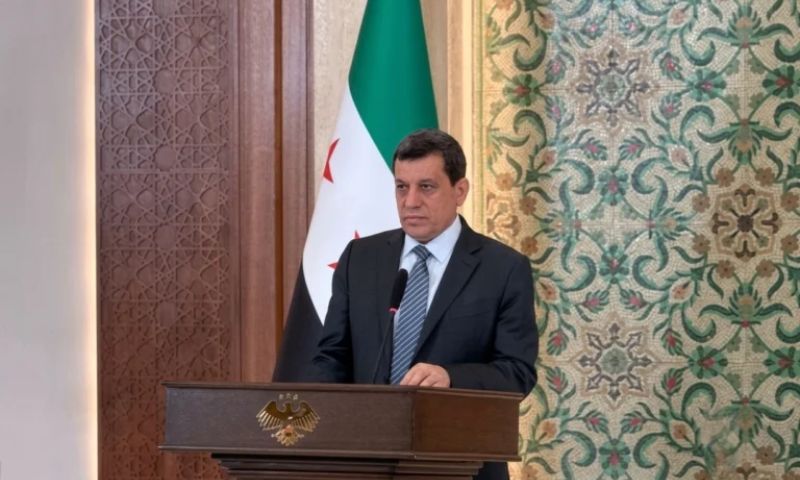
 Mazloum Abdi announces the dissolution of the SDF and the Autonomous Administration during a conference at the People's Palace in Damascus, August 25, 2026. (al-Ikhbariya)
Mazloum Abdi announces the dissolution of the SDF and the Autonomous Administration during a conference at the People's Palace in Damascus, August 25, 2026. (al-Ikhbariya)
Syrian Democratic Forces (SDF) commander Mazloum Abdi announced on Tuesday, August 25, the dissolution of the SDF, the Autonomous Administration, and all military and civilian formations affiliated with them, confirming their full integration into Syrian state institutions.
The announcement came during a press conference held by Abdi at the People’s Palace in Damascus, following meetings and talks with Syrian government officials on completing the implementation of agreements signed between the two sides.
Abdi said that “circumstances have changed today” and that the country has entered “a new phase defined by peace and building a new Syria.”
He added that following an agreement with Syrian President Ahmed al-Sharaa and the completion of the integration of SDF forces into Syrian army brigades, “today we announce the end of the mission of the Syrian Democratic Forces, and we responsibly announce their dissolution as an independent military force.”
He added that this stage should mark the beginning of “a genuine transition from battlefields to the fields of construction, and from an era of weapons to an era of peace,” saying that Syria stands before a new phase defined by peace, stability, and reconstruction.
Abdi said, “Today we stand and begin to open a new page defined by peace, stability, and building the homeland,” adding that the goal is to “build a united Syria that protects the future of its people and ensures a dignified life for its children in the future.”
He stressed that the next stage should include all Syrians, saying they want to “build a new Syria, a Syria for all its people, Kurds, Arabs, Turkmen, and Assyrians.”
Regarding cultural rights and education in Kurdish, Abdi said he had “found President al-Sharaa receptive regarding the right to education in the mother tongue.”
Earlier on Tuesday, al-Ikhbariya cited official sources as saying that Abdi would announce the dissolution of the SDF that evening, before Abdi confirmed the announcement during the press conference in Damascus.
The announcement comes as part of negotiations between the Syrian government and the SDF over implementing an agreement signed by the two sides on January 29, which includes arrangements for integrating SDF-affiliated institutions and forces into Syrian state institutions.
Media sources in Hasakah (northeastern Syria) told Enab Baladi that the meetings ended after two rounds of negotiations and resulted in understandings, without officially specifying at the time the nature of those understandings.
Hawar News Agency, which is close to the SDF, also reported that President Ahmed al-Sharaa met Newroz Ahmed, a member of the Women’s Protection Units leadership, to discuss issues related to the units’ role and arrangements for the next phase, as part of talks on implementing the January 29 agreement.
These developments coincided with information reported by North Press, which is close to the SDF, about a planned meeting between al-Sharaa, Foreign Minister Asaad al-Shaibani, Abdi, and Ilham Ahmed to discuss Kurdish-language education and the possibility of developing it, as well as the position Abdi would assume within the Syrian government and an assessment of how fully the agreement had been implemented.
On August 4, President Ahmed al-Sharaa received SDF commander Mazloum Abdi at the People’s Palace in Damascus, in the presence of Foreign Minister and Expatriates Asaad al-Shaibani and Deir Ezzor Governor Ziad al-Ayesh.
According to the Syrian Arab News Agency (SANA), the meeting discussed completing the implementation of the January 29 agreement with the SDF and following up on the process of integration into state institutions.
The integration process between the Syrian government and the SDF dates back to the January 29 agreement, which stipulated a ceasefire and the start of a gradual process to integrate SDF-affiliated forces and institutions into Syrian state institutions.
The agreement included transferring the administration of border crossings, oil and gas fields, prisons, and camps housing members of the Islamic State organization to the state.
It also stipulated the integration of civilian institutions into state institutions, guarantees for the civil and educational rights of Kurds, and the return of displaced people.
The agreement also included removing non-Syrian personnel linked to the Kurdistan Workers’ Party (PKK) from Syria.
if you think the article contain wrong information or you have additional details Send Correction


 A
A
A
A
A
A


 More Politics