


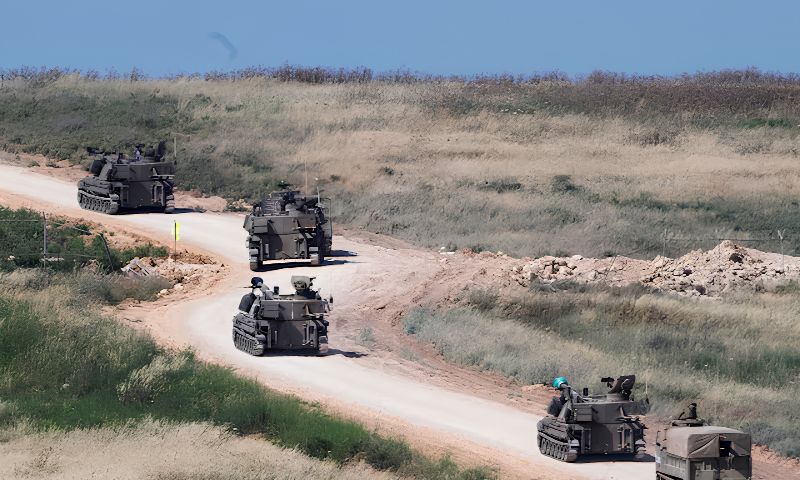
 Israeli armored vehicles enter southern Lebanon, May 27, 2026 (Reuters).
The Israeli military announced on Monday, November 16, that it had targeted a weapons shipment traveling from Syria to Lebanon, claiming it was intended for Hezbollah.
Israeli military spokesperson Ella Waweya said the Israeli Air Force had struck a shipment of military equipment overnight on Monday in the Janta area along the Lebanese-Syrian border, which she said was intended for Hezbollah.
In a post on X, Waweya said the area had frequently been used to transport military equipment. She claimed that Hezbollah continues to exploit various areas of Lebanon to carry out what she described as “terrorist activities involving weapons smuggling and the movement of militants.”
She explained that the shipment was intended to strengthen Hezbollah’s operational capabilities to carry out what she described as “terrorist attacks against Israelis and Israeli military forces.”
Waweya added that the Israeli military “will not allow Hezbollah to target Israeli citizens or military forces, will remain deployed in the area in accordance with existing understandings, and will continue its operations to eliminate threats while remaining committed to the ceasefire agreement,” according to her statement.
The Syrian Ministry of Interior announced that it had thwarted two attempts to smuggle weapons into Lebanon within less than a month.
On July 16, the ministry said it had foiled an attempt to smuggle a large shipment of advanced weapons across the Syrian-Iraqi border.
It noted that preliminary investigations showed the shipment was intended to pass through Syrian territory into Lebanon for Hezbollah.
Internal Security Forces in Tartous (western Syria), in coordination with the General Intelligence Directorate, also intercepted an attempt to smuggle a shipment of weapons and ammunition into Lebanese territory.
Internal Security officials said the entire shipment had been seized, including automatic rifles, rocket-propelled grenades (RPGs), firearm magazines and various types of ammunition prepared for smuggling.
Meanwhile, the Lebanese army announced on August 4 that it had seized 122 mm Grad rockets smuggled from Syria into Lebanon during an operation conducted by a military unit in the mountainous outskirts of Arsal.
In a statement published through its official channels, the army said the military unit had confiscated the rockets and a pickup truck used to transport them.
It also arrested two Lebanese nationals suspected of belonging to a smuggling network. Raids conducted to locate other members of the network resulted in the seizure of ammunition and military equipment.
The army added that the seized items had been handed over to the relevant authorities and investigations had begun under judicial supervision, while efforts to pursue other suspects continued.
The operation took place one day before a security meeting between the two countries on August 5 in Beirut, attended by a Syrian Interior Ministry delegation headed by Brigadier General Mulham al-Shantout, Syria’s Assistant Minister of Interior for Security Affairs, and Lebanese Minister of Interior and Municipalities Ahmad al-Hajjar.
The Syrian Ministry of Interior said the meeting addressed key issues of mutual concern and ways to strengthen security cooperation between the two countries.
The United States asked Israel to suspend a planned strike on the al-Masnaa-Jdeidet Yabous border crossing between Syria and Lebanon, following an evacuation warning issued ahead of the anticipated attack, according to the Israeli Public Broadcasting Corporation.
According to sources cited by the broadcaster, the US request included allowing Syrian security agencies to address activities associated with the crossing.
On April 5, the broadcaster reported that the request was accompanied by Syrian assurances that authorities were working to prevent weapons smuggling into Lebanon.
The Israeli military claimed that Hezbollah was using the crossing and the nearby road for military purposes. It said it had been preparing to strike the site before the US suspended the operation at its request, described as having “political implications.”
Israeli military spokesperson Avichay Adraee had previously warned people near the al-Masnaa crossing on the Syrian-Lebanese border, as well as travelers using the M30 road, to evacuate the area ahead of the planned strike.
if you think the article contain wrong information or you have additional details Send Correction


 A
A
A



 More Politics