


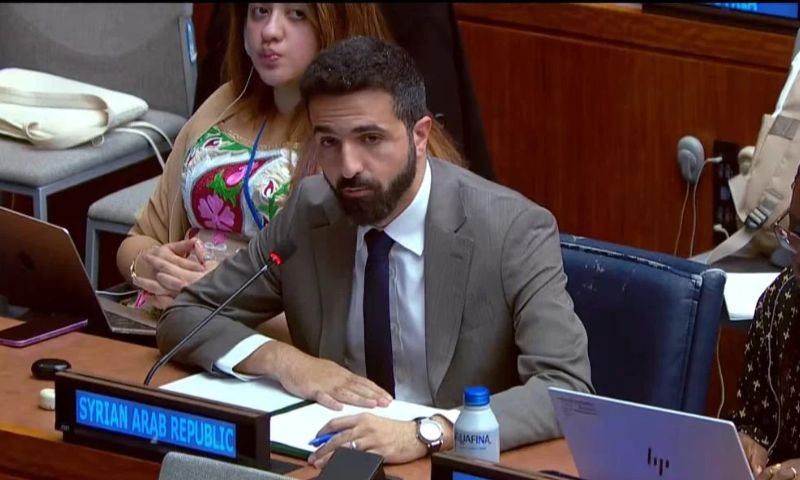
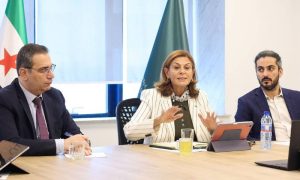
 Syria’s permanent representative to the United Nations, Ibrahim Olabi, addresses the UN General Assembly’s Fourth Committee, November 11, 2026 (Syria’s Permanent Mission to the United Nations/X)
Syria’s permanent representative to the United Nations, Ibrahim Olabi, said Syrian communities continue to be affected by Israeli actions, including the abduction of Syrian civilians, the targeting of journalists and damage to agricultural land.
Addressing the UN General Assembly’s Fourth Committee early on Wednesday, November 11, during discussions on the agenda item “Comprehensive review of the whole question of peacekeeping operations in all their aspects,” he said Israeli forces continue to establish new positions within the area of operations of the United Nations Disengagement Observer Force (UNDOF) in Syria and maintain those established since liberation.
According to Olabi, maintaining stability is not the responsibility of one party alone, and those who jeopardize and disregard it must face greater accountability. He said the international community increasingly recognizes that Israeli violations are not isolated incidents on the ground, but practices that undermine arrangements designed to prevent escalation and challenge the authority of the United Nations.
Syria has chosen stability and the prevention of escalation over confrontation, which would only bring the region further tension and crisis, Olabi said, citing its historical responsibility as a source of regional security and stability. He stressed Syria’s commitment to UNDOF’s mandate and respect for the 1974 Disengagement Agreement, without relinquishing any of its people’s rights or its sovereign rights.
He said Syria has demonstrated, through both its statements and actions, its commitment to de-escalation and constructive engagement with the international community.
He said Israeli violations place additional burdens on UNDOF, whose primary mission is to maintain stability.
He called for continued efforts to ensure respect for international law and compliance with existing agreements, and to support mechanisms that prevent renewed tensions and conflict.
Concluding his remarks, he stressed that Syria has not abandoned its people’s legitimate and inalienable rights and has chosen respect for international law over chaos and uncertainty. He said Syria would continue to fulfill its obligations and looked forward to the international community continuing to meet its responsibilities.
Olabi’s remarks came as southern Syria experiences repeated Israeli army incursions accompanied by arrests, violations against civilians and obstruction of journalists.
In the latest incident, Wadi al-Ruqad, below the town of Jamlah in the Daraa countryside (southern Syria), witnessed Israeli military movements on Tuesday evening, November 10, including the targeting of a patrol near the Syrian border.
The movements coincided with intensive drone activity over the valley, before Israeli military vehicles advanced into the area and raided several civilian homes and dwellings used for raising sheep deep inside the valley.
Enab Baladi’s correspondent in Daraa reported that the raids focused on houses belonging to residents and farmers from the villages of Abdin and Maarriya. Most local residents had already left the area and been displaced by recent events, the correspondent said, but the advancing forces searched specific homes and disturbed their contents.
Enab Baladi’s correspondent in Quneitra (southwestern Syria) reported that an Israeli patrol advanced to the entrance of Jubata al-Khashab on November 10 and searched passersby, while Israeli forces set up a checkpoint on the outskirts of Taranja village in the northern Quneitra countryside.
The correspondent added that Israeli artillery fire targeted the Joret al-Lawz area on the outskirts of Beit Jinn in western Damascus countryside (southwestern Syria), amid continuing escalation in southern and western areas.
The correspondent reported that Israeli forces reached the outskirts of Jamlah, indicating continued military movements and their expanding reach in the area, amid concern among residents and farmers.
These movements come amid an unprecedented rise in Israeli violations inside Syrian territory. The Sijil Center documented 395 Israeli violations in Syria during October, the highest monthly total recorded in 2026, exceeding March’s total of 321.
According to the report, issued on November 2, violations in October averaged approximately 12.74 per day, followed by March at 10.35 per day. The cumulative number of violations since the beginning of the year rose to 2,427.
The violations recorded during the month included 126 incursions, 122 incidents of aircraft activity, 44 checkpoints, 36 raids and 41 cases of detention, in addition to two killings.
Quneitra governorate recorded the highest number of violations, with 285, followed by Daraa with 74, Damascus countryside with 29 and Damascus with seven.
The center also documented two incidents in which Israeli forces killed Syrian civilians, noting that these were the first such incidents since April.
These movements form part of a series of repeated Israeli incursions into the countryside of Daraa, Quneitra and Damascus, involving raids on civilian homes, arrests and the bulldozing of land, in continuing violation of the 1974 Disengagement Agreement.
if you think the article contain wrong information or you have additional details Send Correction


 A
A
A


 More Politics