


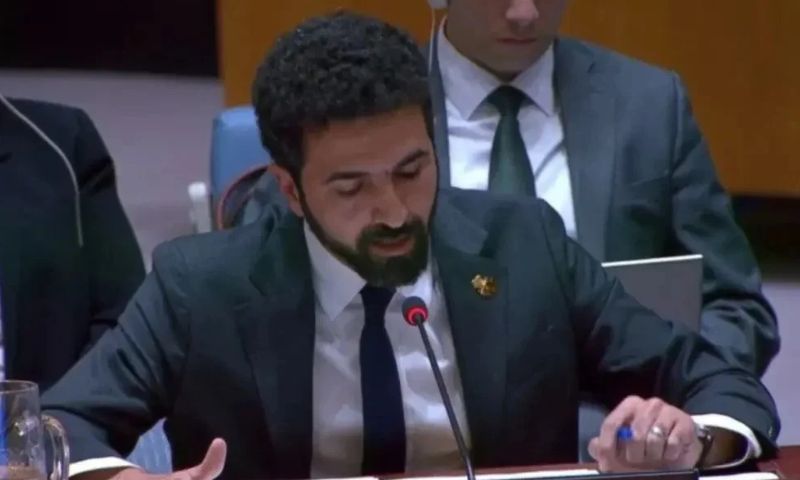
 Syria’s Permanent Representative to the United Nations, Ibrahim Olabi, October 15, 2026 (al-Ikhbariya)
Syria’s Permanent Representative to the United Nations, Ibrahim Olabi, October 15, 2026 (al-Ikhbariya)
Syria’s Permanent Representative to the United Nations, Ibrahim Olabi, reaffirmed Damascus’s commitment to combating crimes against humanity, holding perpetrators accountable, and securing justice for victims. He stressed that Syria’s new phase is founded on establishing justice and ensuring violations are not repeated, rather than seeking revenge.
Syria’s mission to the United Nations said on Thursday, October 15, that Olabi delivered Syria’s statement during the Sixth Committee’s discussion of agenda item 79, “Crimes against humanity.” Addressing the committee, which handles legal affairs, he outlined the Syrian government’s efforts to address the legacy of violations and strengthen accountability.
In his statement, Olabi recalled what he described as Syrians’ painful experience under the former regime and the effects of crimes and grave violations on civilians, social and economic structures, and state institutions.
He said Syrians had chosen justice over revenge, noting that the Syrian government had taken steps to address violations, including establishing the National Commission for Transitional Justice and the National Commission for Missing Persons, to secure justice for victims and address the consequences of past crimes.
He added that the authorities had begun proceedings to hold those involved in the most serious crimes accountable, covering both past violations and those committed during the transitional period. He said these measures reflected a commitment to ending impunity.
Olabi’s remarks come as Syria faces a backlog of cases involving violations committed since 2011, particularly arbitrary detention, enforced disappearance, killing, and torture. The country also faces challenges in determining the fate of missing people, establishing responsibility, and providing reparations to victims and their families.
On May 17, 2025, Syrian President Ahmed al-Sharaa issued Decrees Nos. 19 and 20, establishing the National Commission for Transitional Justice and the National Commission for Missing Persons, in a step aimed at addressing accountability and determining the fate of missing people.
The National Commission for Transitional Justice is tasked with addressing the legacy of violations and securing justice for victims. The National Commission for Missing Persons focuses on searching for missing and forcibly disappeared people and determining their fate in cooperation with the relevant authorities.
Olabi’s address to the international community places Damascus’s stated commitment to accountability within a broader context, linked to national institutions’ ability to translate pledges into clear judicial and legal measures that safeguard victims’ rights and address violations on the basis of individual responsibility under the applicable legal frameworks.
Internationally, Olabi said Syria seeks to contribute to drafting an international convention on the prevention and punishment of crimes against humanity, drawing on its experience and the violations it has witnessed in recent years to spare other peoples similar tragedies.
He explained that Syria had put itself forward for membership in the bureau of the Preparatory Committee for the United Nations Diplomatic Conference of Plenipotentiaries on Prevention and Punishment of Crimes against Humanity and was elected a vice-chair at the committee’s first session.
Olabi said Syria’s election reflected member states’ confidence in Damascus’s commitment to participating constructively in negotiations. He affirmed his country’s readiness to take an active role in the next stages to help ensure the success of the conference, scheduled to be held in New York.
He expressed Syria’s hope that the proposed convention would address the protection of hospitals, health facilities, and children, in light of the violations against civilians and civilian facilities during the country’s years of war.
Olabi warned that continued Israeli attacks on Syrian territory were perpetuating Syrians’ suffering and undermining efforts toward national recovery and rebuilding state institutions, at a time when the government is working to strengthen justice, accountability, and stability.
He cited the Independent International Commission of Inquiry on the Syrian Arab Republic’s concern over escalating Israeli military activity and the entrenchment of Israel’s presence in southern Syria, including incursions, raids, and the detention of civilians, among them children. He noted that some of these acts could amount to war crimes.
Olabi called for international political support for Syria to be translated into practical steps to end Israeli attacks and safeguard the country’s sovereignty, unity, and territorial integrity. He stressed that combating crimes against humanity is a moral and humanitarian responsibility requiring collective political will and respect for national sovereignty.
His remarks coincided with human rights reports addressing Israeli operations on Syrian territory since the fall of the former regime. The Syrian Network for Human Rights documented 453 Israeli ground incursions into Syrian territory, the killing of 69 people, and 162 cases of arbitrary detention between December 8, 2024, and October 6, 2026.
The Syrian representative stressed that confronting crimes against humanity requires more than national measures. It also requires international cooperation and political will to ensure accountability and support respect for international law and state sovereignty.
Olabi’s positions form part of Syria’s efforts at the United Nations to present its approach to legal and human rights issues, as the country faces challenges in determining the fate of missing people, holding those responsible for violations accountable, rebuilding institutions, and strengthening stability.
if you think the article contain wrong information or you have additional details Send Correction


 A
A
A
A
A
A



 More Politics