


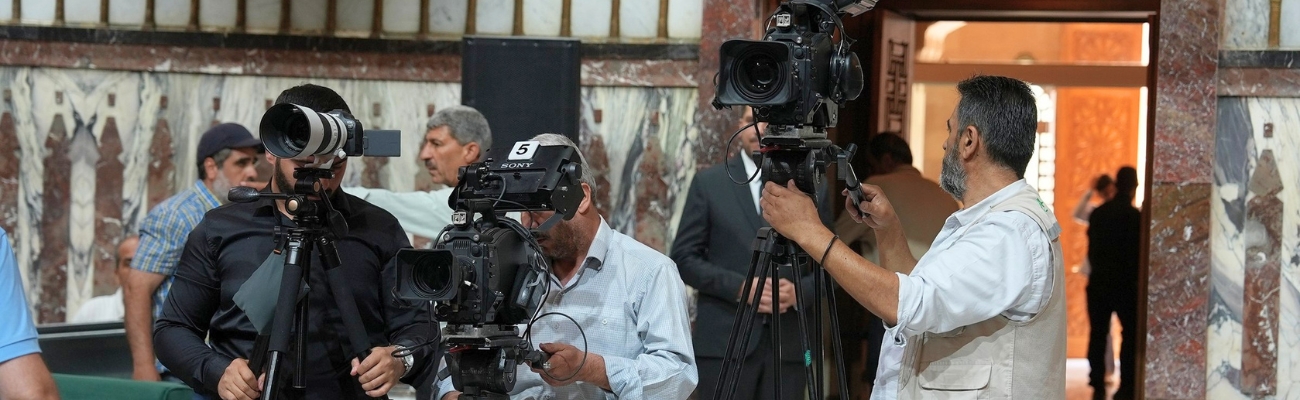

 Photographers from state media cover the conference announcing the final third of the People's Assembly, July 1, 2026 (General Authority for Radio and Television).


 A
A
A
A
A
A
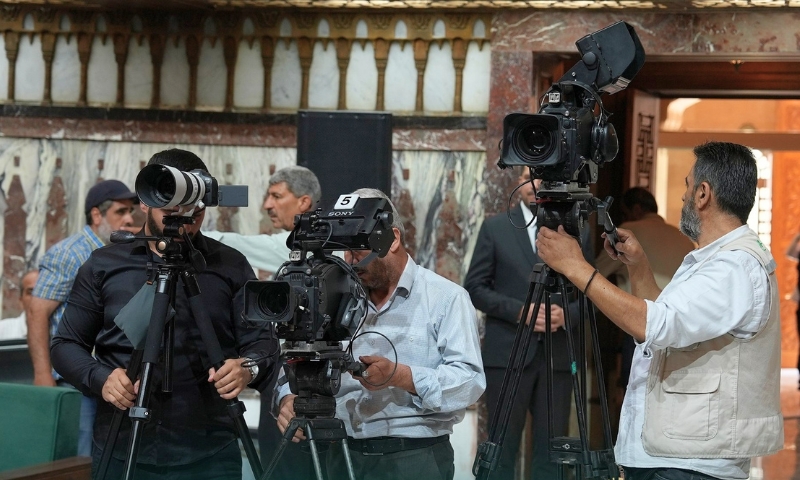
Amir Huquq | Mohammad Deeb Bazzet | Mowaffak al-Khouja
Following the fall of the former regime, Syrian media entered a new phase concerned not only with expanding the space available for journalists to work, but also with redefining the rules that will govern that space in the future.
As preparations begin for a new media law, the drafting process appears to be an early test of the relationship that will emerge between the state and the media, and of how far participation will extend in defining journalists’ rights and the limits governing media institutions.
The shape of Syrian media is still taking form amid attempts to regulate the sector and develop its institutions, widely varying day-to-day experiences in how official bodies deal with media outlets, and questions over whether the country’s recent opening will become a set of stable rules protecting press freedom and professional and ethical standards, or remain tied to mechanisms and practices that can change.
In this report, Enab Baladi examines the process of preparing the new media law and who is participating in drafting it. It then documents journalists’ experiences in communicating with official institutions and accessing information, before examining the state of media freedoms and the future of the sector in Syria, seeking to understand what has actually changed and what still remains at the level of promises and indications rather than established practice and clear rules.
In the Shadows
Who Is Writing the New Media Law?
The debate over Syria’s new media law does not begin with its articles or provisions, but with the question that precedes them: Who is participating in drafting it?
Media directorates affiliated with the Ministry of Information in Syria’s various governorates have concluded workshops and meetings devoted to discussing and preparing the draft law. The consultations appear to be an essential step toward creating a new legislative framework for a sector that has undergone major changes during the transitional period.
However, the composition of participants in these workshops has drawn criticism from journalists and media workers, who spoke of a dominant presence by state media and its employees, along with media figures close to the government, compared with weaker representation of independent journalists, experts, and independent media institutions.
While there appears to be little disagreement over the idea of consultation itself, another question extends beyond the format of the workshops to the substance of the law: Who is writing the new media law, and who has the right to participate in shaping it?
According to Enab Baladi correspondents in Syria’s governorates, local media directorates organized discussions of the media law around three themes:
The professional and institutional environment, including regulation of television channels and agencies and the legal and field protection of journalists.
Digital media and content creators, including regulation of digital news platforms and influencers in a way that protects their rights and clarifies their responsibilities.
Digital and community safety, including clear distinctions between freedom of expression and cybercrime to ensure a safe environment for everyone without restricting freedoms.
Protecting Journalism and Criminalizing Violations
Journalist Ahmad al-Halabi, who attended one of the media law workshops in Damascus, said discussions focused on what participants wanted from the law, foremost among them protecting journalism, criminalizing violations, and permitting freedom of expression and criticism within the boundaries allowed for journalistic work.
Speaking to Enab Baladi, al-Halabi called for a “modern” media law suited to Syrian realities, one that regulates cooperation with the Interior Ministry on cybercrime and violations of rights and standards while keeping pace with the rising ceiling of freedoms, criticism, and public demands over time.
He hopes experts from countries that have preceded Syria in this field will be consulted, along with activists, influencers, academics, and employees of public and private media institutions, to produce legislation capable of keeping pace with the speed at which news now circulates.
He said the goal is to reach a “unique and modern version” that regulates these changes and fits the new media environment.
Necessary Consultations, but for Whom?
The idea of holding workshops itself does not appear to be the main point of disagreement among those interviewed. Rather, the dispute concerns who participates and how accurately those participants represent Syria’s media landscape.
Yara Bader, director of programs and development at the Syrian Center for Media and Freedom of Expression, said holding consultations and workshops in the governorates before drafting a new media law is an “important and positive step,” because media legislation should not be written in isolation from the journalists and institutions to which it will apply.
However, she said the value of these consultations depends on one fundamental condition: diversity among participants and genuine representation of the media landscape, rather than the number of meetings held or governorates covered.
Bader said a problem arises when attendance leans heavily toward state media or particular groups of journalists while independent media, experts, unions, and professional initiatives are absent or weakly represented.
Imad al-Tawashi, vice president of the Syrian Journalists Association, viewed the step more positively, saying that beginning work on a new law represents an “important legislative opportunity” to develop the media environment, keep pace with ongoing changes, and safeguard freedom of the press and expression.
According to al-Tawashi, however, the association hopes consultations will be expanded to include, in a balanced manner, unions and professional associations, independent journalists, private media institutions, experts, and academics.
Jaber Bakr, a Syrian researcher and head of the Syria file at the SKeyes Center for Media and Cultural Freedom at Lebanon’s Samir Kassir Foundation, questioned how the meetings were prepared in the first place.
He said he was not prepared to participate, like many other Syrian media workers, journalists, and experts, leaving them, as he described it, “outside the context,” without knowing what was happening or what was being prepared.
Bakr described the preparations as resembling “secret preparations for something we do not know,” saying this was “not a positive sign, not reassuring, and not comfortable.”
“The way the media law is being prepared is not a positive sign, not reassuring, and not comfortable.”
Jaber Bakr
Head of the Syria file at the SKeyes Center, Samir Kassir Foundation

A workshop for journalists in Daraa (southern Syria) on the Syrian media law, July 22, 2026 (Daraa Governorate).
Who Has the Authority to Draft the Law?
Behind the question of participation lies another: Who should draft a media law in the first place? Should it fall under a framework resembling a law for state media while applying to all types of media?
Bader distinguished between the authority empowered to draft and issue the law and those who should participate in determining its substance. In her view, an official body can undertake legal drafting and legislative procedures, but a media law is not an administrative matter belonging exclusively to a ministry or government institution because it regulates a public right concerning freedom of expression, access to information, journalists, media institutions, and society as a whole.
Bader therefore believes legal drafting should be preceded and accompanied by broad participation from journalists, independent and state media, experts, academics, rights organizations, and professional bodies, along with the public and, to the greatest extent possible, political groups and currents.
She places particular importance on the presence of independent media because they operate under conditions, funding models, management structures, and editorial systems that differ from those of government media. They also face issues concerning licensing, access to information, source protection, legal liability, and editorial independence.
Al-Tawashi expressed a similar view, saying the law’s success and durability depend on a “broad and direct participatory process” that is not limited to the Ministry of Information or official frameworks.
He said participation by working professionals at various stages of the drafting process would improve the quality and applicability of the legal text while strengthening its professional and public acceptance.
Bakr, meanwhile, said the problem begins with the absence of a genuine journalists’ union representing those working in the profession.
He said the law should be developed through a process involving unions and professional bodies, but Syria, in his view, does not have unions in the literal sense of the term, adding that the General Union of Journalists has not assumed this form.
A union, as Bakr sees it, emerges from the collective desire of members of a profession to defend themselves and provide services to their members. It does not wait for government approval or a license to represent its professional constituency.
When the Absence of Independents Becomes Part of the Problem
The concerns voiced by those interviewed extend beyond attendance to the possible effect that participation could have on the substance of the law.
Bader said the danger of selective participation is that it can create bias in identifying problems before producing bias in proposed solutions. If most participants come from one media environment, she said, the issues and priorities raised will naturally be more closely tied to that environment’s experience than to others.
She does not, however, believe it would be accurate to conclude in advance that the law will be “for state media only” before seeing its text.
Bader said the real test will be the draft itself: How will it define journalists and media institutions? How will licensing be regulated? What limits will be placed on administrative authority? What guarantees will protect media independence and sources? How will the right to obtain information be regulated? What safeguards will apply in cases of arrest and prosecution?
Al-Tawashi also supported expanding participation, saying the presence of independent journalists, private institutions, experts, and academics alongside professional associations and unions would ensure representation reflecting the diversity of Syria’s media landscape.
Bakr said selective invitations and the absence of independent journalists raise the question of whether “this garment is being tailored to fit them,” arguing that the participants, in his words, represent the authorities.
He said the exclusion, in his view, was not limited to journalists inside Syria but also affected journalists abroad or in different areas who were not asked whether they were interested in participating.
How Should Allegations of Exclusion Be Viewed?
Criticism of the workshops places responsibility on the Ministry of Information to clarify participation criteria, particularly as journalists and media workers say they were not invited or were excluded.
Bader said such criticism should be treated as an indication of a problem with trust or participation mechanisms, rather than opposition to the idea of the law itself.
She nevertheless stressed the need for precision, explaining that the center she represents cannot say it was excluded because it received an invitation but was unable to participate due to work circumstances.
If, however, large numbers of journalists and independent institutions say they were not allowed to participate, Bader said the organizers should clarify the criteria used to select invitees, who took part, what comments were submitted, and how those comments will be incorporated into the drafting process.
Bader summarized the appropriate response to accusations of selectivity as greater transparency and a broader circle of participation.

The “Media Freedoms in Syria” forum organized by the Syrian Journalists Association, May 10, 2026 (Enab Baladi).
What Comes After the Workshops?
The workshops that have concluded may not be the decisive stage in the law’s development. The value of previous participation could change depending on what happens before the final text is adopted.
Bader proposed publishing the draft before it is sent to the People’s Assembly, allowing sufficient time for public discussion, opening a process for written comments from journalists and media institutions, and holding specialized sessions with independent media, experts, academics, and rights and professional organizations.
She also called for publication of a summary of consultation outcomes, identifying which proposals were accepted, which were not, and why. She also called for guarantees protecting the independence of journalistic work and confidentiality of sources, clear rules governing restrictions on freedom of expression, and safeguards for the right to obtain information.
Al-Tawashi called for “institutionalizing the participatory process” and presenting the draft to the journalistic community for comment before its final adoption, saying the Syrian Journalists Association was ready to contribute its professional and legal expertise and capabilities.
“The participatory process must be institutionalized, and the draft media law must be presented to the journalistic community for comment before its final adoption.”
Imad al-Tawashi
Vice president of the Syrian Journalists Association
Bakr said the fundamental starting point is for Syrian journalists to reorganize themselves within an independent journalists’ union capable of protecting journalists, representing them, and defending their rights before the courts and the People’s Assembly.
Between calls to broaden participation, institutionalize it, and build independent union representation, the future of the new media law depends not only on what the body responsible for drafting it writes, but also on who is allowed to participate in determining what should be written.
Enab Baladi contacted the Ministry of Information’s Media Law Committee to ask about the workshops preparing the draft law, the working mechanism being followed, and the ministry’s response to journalists’ criticism.
The response was that the authorized body could not comment because it was waiting for all matters to become clear, particularly as the process of writing and participation was still underway and there was nothing yet on which to base a statement.

A workshop for journalists in Daraa (southern Syria) on the Syrian media law, July 22, 2026 (Daraa Governorate).
Restricting the Right to Access Information
Problems Affect Official Communication With the Media
The expected law is not the only factor defining the relationship between the media and official institutions. That relationship is tested every day through simpler details, beginning when a journalist sends a question to the relevant authority and ending with whether an answer arrives at all.
Obtaining a response from the relevant body is a fundamental part of preparing a journalistic report, particularly in cases concerning the work of official institutions, their decisions and procedures, and the effects these have on public affairs.
As these institutions expand their press offices and media directorates across Syria’s governorates, which are supposed to communicate with journalists, experiences on the ground remain uneven.
Journalists who spoke to Enab Baladi described cases of rapid responses, but also cases in which answers were delayed, requests were passed between multiple bodies, or no response arrived before publication.
These differing experiences raise questions about how successfully such offices are performing their role. Have they become a more effective link between journalists and official institutions, or does the absence of a unified mechanism for handling media requests mean access to information varies from one institution to another?
This also raises another question: Is response time affected by the nature of the issue, the institution involved, or the media outlet, and what procedures could regulate this communication so journalists receive clear answers within an appropriate period?
Delayed Responses and No Unified Mechanism
A journalist who spoke to Enab Baladi said the most significant problem in communicating with some press offices is slow response times.
She asked not to be identified out of concern that criticizing how some official bodies deal with journalists could affect how those bodies treat her in the future, including her ability to obtain statements or assistance in accessing information.
She said some inquiries can remain unanswered for days or be referred from one office to another before reaching the relevant body. While preparing one report, she encountered a delay in obtaining an answer after one press office referred her to another, which failed to respond despite repeated attempts to contact it.
She said such cases affect the completion of journalistic material connected to current events, where a reporter may not have a long period in which to wait for an answer from the relevant authority.
She also noted differences in procedures among official institutions. On one occasion, she said, she was asked to present a press card issued by the journalists’ union before being allowed to communicate with an expert, even though she had previously obtained a statement from the same person through the same press office.
According to the journalist, differences in procedures mean access to information sometimes depends on the internal working mechanism of each institution rather than on clear and unified rules for dealing with the media.
Direct Impact on Journalistic Work
The journalist said delays in official responses affect the course of journalistic work, particularly on urgent issues or those requiring the relevant authority’s position before publication.
She explained that the absence of an official response does not lead her to publish unverified information. Instead, she relies on available sources and documents, notes in the article that the relevant body was contacted but had not responded by publication time, and updates the material later if an answer arrives.
According to the journalist, the problem is not limited to delaying publication. It can also mean the absence of the official institution’s perspective or explanation of decisions and procedures connected to the issue, potentially leaving readers with an incomplete picture.
Assessing the performance of press offices, she said no general judgment can be made about all bodies because reasons for delays may differ between institutions. They may result from information being unavailable, lengthy internal procedures, or the absence of a decision authorizing a response.
But she said the main standard remains the outcome, explaining that a press office loses part of its function when it cannot secure an answer within a reasonable period or facilitate a journalist’s access to the official or specialist capable of providing information.
She called for press offices to serve as effective links between media outlets and officials by providing responses, data, and documents whenever possible, or by explaining the reasons for delays and setting an expected time for a response rather than leaving requests pending.

Information Minister Khaled Zaarour and the director of the General Authority for Radio and Television inspect departments at the official al-Ikhbariya channel, August 6, 2026 (General Authority for Radio and Television).
What Do Journalists Need?
A second journalist who spoke to Enab Baladi also asked not to be named out of concern that doing so could affect her professional relationship with official institutions. She said one of the main difficulties she faces is failing to obtain requested information from some ministries, directorates, and their media offices without knowing why they do not respond.
She said some bodies initially reply by telling a journalist that they have received the questions or will refer them to the relevant authority, after which communication stops without a deadline for a response, forcing the journalist to follow up more than once.
In some cases, she has to publish the article while noting that she contacted the relevant body and received no answer.
She said informing a journalist in advance that a certain subject cannot be answered, or apologizing for being unable to provide information, would be more effective than leaving a request open with no clear deadline. It would save the journalist’s time and allow them to decide how to handle the article.
She also called for a clear mechanism for handling journalists’ requests, including informing them whether a body has agreed to answer or is declining to provide information, instead of leaving requests without follow-up.
She said the continued absence of responses limits media outlets’ ability to provide a balanced picture of the performance of official institutions, particularly when the requested information is directly connected to those institutions’ work.
She questioned the purpose of some press offices if they do not respond to media inquiries, saying a media office is supposed to serve as a link between an institution and a journalist and facilitate access to information and officials, rather than become another obstacle that is difficult to bypass.
She proposed a clear policy for dealing with journalists’ requests, alongside a unified mechanism for communication with media outlets, and said the way journalists are treated should not depend on the media organization for which they work.
Good Responses, Depending on Media Affiliation
By contrast, another journalist who spoke to Enab Baladi asked not to be named to avoid linking his comments to the government-sector media outlet where he works. He said obtaining information generally does not present major difficulties because of his outlet’s position.
He said press offices and media directorates respond quickly to many journalists in most cases.
He explained that a delayed answer or the absence of one can lead to an article being canceled entirely rather than published in an incomplete form that could create an inaccurate understanding of the information or issue being covered.
He said the speed of a response is connected to the nature of the journalistic material itself, as most articles do not require a long period for the relevant body to provide an answer. Setting a clear deadline for responding to journalists’ inquiries, he said, could help organize the work of both sides.
The journalist stressed the importance of facilitating reporters’ access to officials or bodies capable of providing information, allowing accurate and reliable information to reach the public rather than leaving journalists caught in a cycle of referrals between different offices and authorities.
Assessing press offices and media directorates, he described their performance as generally good, noting that the Ministry of Information organizes courses and seminars for their employees to develop their skills and improve how information and press services are provided to media outlets.
These contrasting experiences show that the problem is not the same for all journalists or institutions. However, the absence of a unified and clear mechanism for handling media requests leaves considerable room for experiences to differ from one body to another.
While the Ministry of Information says it is working to develop media directorates and strengthen government communication with the media, questions remain over how these measures are reflected in journalists’ daily work.
The Ministry of Information Also Does Not Respond
Enab Baladi contacted the Ministry of Information seeking an official response on how press offices and media directorates operate, how journalists’ requests are handled, whether there is a defined response period for inquiries, complaints over delayed responses or inability to obtain information, and the procedures used to address these problems and improve the performance of these bodies.
By the time this report was prepared, Enab Baladi had received no response from the ministry to the questions it submitted.

A press conference by the spokesperson for the National Independent Committee for Investigation and Fact-Finding into the events on the Syrian coast, March 11, 2025 (Ministry of Information).
After an Improvement in the Rankings
Unannounced Restrictions and Fears of Backsliding
If the expected law represents an attempt to establish a new framework for media work, any assessment of that framework cannot be separated from the conditions under which journalists are working today.
Syria’s media sector is following an uneven path between an opening that gives media outlets more room to work compared with conditions under the former Syrian regime, and what some describe as attempts at unannounced restriction despite the facilitation measures announced by the Syrian government.
In the months following the fall of the regime, Syria recorded improvements in rankings concerning press and media freedom as well as political rights and civil liberties. The change is linked to the fundamental shift in Syria’s political system after years of repression under the regime of ousted Syrian President Bashar al-Assad and a closed media environment dominated by its official institutions and by platforms and television channels that followed the same line and supported its policies.
Freedom House and Reporters Without Borders Rankings
Syria’s score improved by five points in 2025 compared with the previous year, when it had been among the lowest-scoring countries on Freedom House’s 100-point Freedom in the World scale measuring political rights and civil liberties.
Despite this improvement, Syria remains classified as “Not Free” by Freedom House, which said the country is recovering from decades of dynastic authoritarian rule.
Syria also improved in the 2026 World Press Freedom Index published by Reporters Without Borders, rising 36 places to rank 141st globally, compared with 177th in 2025. This moved it out of the dangerous “black zone” and out of the list of the world’s 10 worst countries for press freedom.
Despite these improved rankings, media workers continue to express doubts and fears about current or future closure and restrictions that could move Syria away from the broad space of freedoms journalists and media workers hope to see.
Syrian President Ahmed al-Sharaa told a gathering of journalists and activists that the level of freedom of expression in Syria today is broad, but that at the same time there is a state of media disorder resulting from the absence of clear rules.
“Anyone who has something on their mind talks about it in the media. They may attack people on a sectarian basis without being held accountable, and this could affect an extremely sensitive security situation. They publish without knowledge,” the Syrian president said, adding that “the thirst for transparency and the exercise of freedoms must have a framework.”
Three Ministers During the Transitional Period
Syria’s media sector has had three information ministers so far during the transitional period. Mohammed Yaqoub al-Omar moved from the Salvation Government into the caretaker administration following the fall of the regime, followed by the appointment of Hamza al-Mustafa, during whose tenure government platforms and outlets were launched, including the al-Ikhbariya and al-Souriya television channels, al-Thawra al-Souria newspaper, and Damascus Radio. The current minister is Khaled Zaarour.
Journalist Ghassan Yassin said the period immediately following the fall of the former Syrian regime saw “good” activity by the Ministry of Information, but described the recent period as a “phase of stagnation,” particularly since Zaarour became information minister, saying the ministry has become almost inactive.
Yassin said the change at the beginning of the “liberation” was clear and that, with a new government emerging after a revolution, its approach would naturally be different from that of the former regime because the various forces that brought down the regime had their own experiences over the preceding 14 years.
Concerns Among Journalists
After a period of “optimism” lasting through the first months, some anxiety returned because of what Yassin described as an unclear tendency to control the media landscape.
He said there is an unannounced intention to silence voices that differ from the government’s official voice, adding that media workers can sense this intention in some situations. He said it warrants concern and continued attention, while stressing that “there is nothing official in this regard so far.”
He said “some of these indications concern the arrest of some journalists,” according to his account, or “the creation of an unofficial platform, Syria Shift, whose employees nevertheless conducted job interviews inside the Ministry of Information.”
He described the platform’s content performance as “catastrophic and giving an indication of how some of those leading media in the government think, which is also worrying.”
“Some of those managing Syria’s media landscape do not like the presence of strong voices that differ from their vision. Therefore, there is a tendency toward restriction.”
Ghassan Yassin
Syrian journalist
At the same time, Yassin said there is hope that the planned media law, which is expected to be prepared and adopted by the People’s Assembly, could produce fair legislation for the media that protects journalists and freedom of opinion and reflects the “new Syria” that emerged from the revolution. He said that Syria aspires to a modern media law and media freedom governed by legal rules but without a ceiling on that freedom.

Information Minister Khaled Zaarour meets directors of media directorates to discuss upcoming work plans and media development, August 19, 2026 (Aleppo Media Directorate).
What Will Syria’s Media Sector Look Like in the Future?
Although Yassin said Syria’s media landscape “still falls short of expectations” and that what has happened should have produced a situation “far better than the current reality,” he believes the next stage could bring changes if the media law is completed or the ministry is dissolved and replaced by another institutional structure.
Yassin said he had information indicating an intention to abolish the Ministry of Information by the end of this year and move toward a different institutional model, such as a government communications department. Enab Baladi was unable to confirm this information through an official body.
According to Yassin, media work in Syria is connected to several factors that could shape its future, including the form of the political system that will continue through the transitional period. He said major changes are not expected over the next five years, as established by the Constitutional Declaration.
Media work is also connected to capital and to those who own the money behind media institutions, whether established or to be established in the future, such as television channels or digital platforms.
Yassin said the orientations of financial backers will be present, directly or indirectly, in the editorial line of any institution.
“This is a risk the government has not yet paid attention to, and the point is not prohibition,” Yassin said. Rather, he called for regulating the issue more institutionally without interfering in editorial policy.
Social Media Helps Regulate the Landscape
Yassin said it would be difficult to control Syria’s media landscape in the sense of “repressing it” for several reasons. Chief among them, he said, is that about half of Syria’s population lived outside the control of any regime for 10 years and became accustomed to freedom of expression and to using social media “in the best possible way.”
The clearest example of Syrians’ ability to use social media, in Yassin’s view, was their reaction to the death of Mohammad Ghamira. He pointed to “an overwhelming wave of anger that swept social media” after the incident, creating pressure on the government.
if you think the article contain wrong information or you have additional details Send Correction
النسخة العربية من المقال
-
Follow us :


 More In-Depth
 Most viewed
- Saudi Arabia Requests Syrian Military Support Against Houthis
- Al-Sharaa Meets Mohammed bin Salman in Riyadh to Discuss Closer Ties
- Suwayda Rally Shows Solidarity with Israel on October 7 Anniversary
- Regional Signals and Calculated Escalation: What Is Behind Attacks on Syria’s Energy Infrastructure?
- Syrian Security Announces Arrest of Suspect in Girl’s Kidnapping in Rural Aleppo