


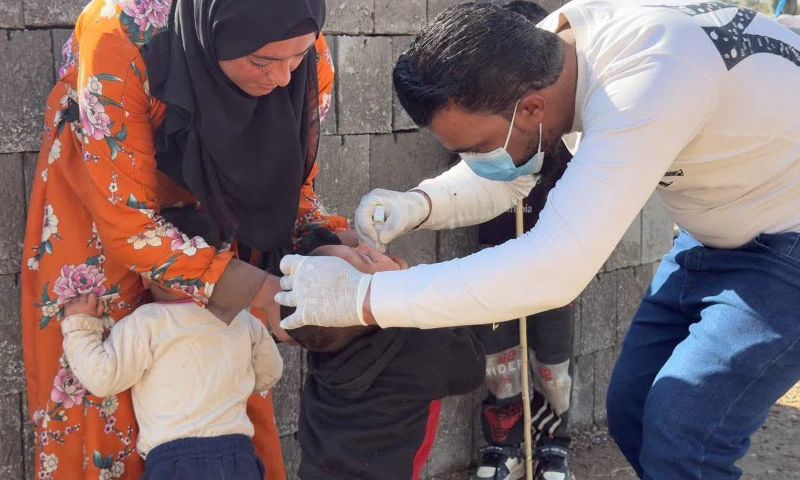
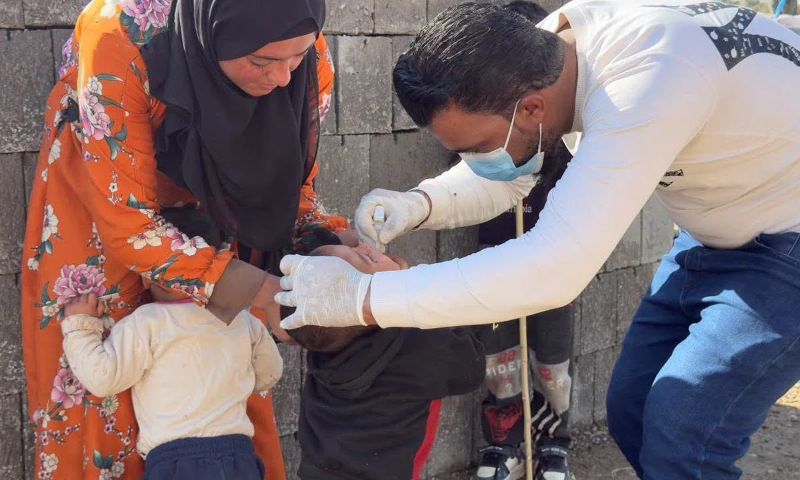
 A polio vaccination campaign launched by the Deir Ezzor Health Directorate, November 16, 2026 (Syrian Ministry of Health)
Syria’s Ministry of Health is preparing to vaccinate more than 371,000 children under five against polio in Deir Ezzor governorate (eastern Syria) after three cases were confirmed there and health authorities classified the situation as an outbreak of circulating vaccine-derived poliovirus type 1 (cVDPV1). The campaign is tentatively scheduled to begin on November 30.
Yasser Farrouh, director of the ministry’s Communicable and Noncommunicable Diseases Department, told the state-run Syrian Arab News Agency (SANA) on Thursday, November 19, that the ministry was considering an earlier start. The campaign will cover the entire governorate, with an expanded follow-up round planned for late December.
Farrouh said all three confirmed poliovirus infections in Syria were recorded in Deir Ezzor, with the latest confirmed on November 12. He said the ministry had enough vaccine doses and was ready to carry out the campaigns.
Farrouh said confirmed polio cases and suspected cases of acute flaccid paralysis were concentrated in rural eastern Deir Ezzor, particularly in the al-Mayadin district and the Dhiban subdistrict, including the towns of Suwaydan Jazira, al-Jardhi and Dhiban.
From the start of 2026 through November 15, Deir Ezzor recorded 63 suspected cases of acute flaccid paralysis, including 23 in the al-Mayadin district. Across Syria, health authorities recorded and investigated 366 suspected cases of acute flaccid paralysis.
According to Farrouh, the first warning came on October 11, when a 13-month-old child in Suwaydan Jazira was reported to have symptoms of acute flaccid paralysis. Further suspected cases were reported in al-Jardhi, Suwaydan Jazira and Dhiban.
The VACSERA reference laboratory in Cairo isolated the virus on November 7. On November 10, the US Centers for Disease Control and Prevention (CDC) confirmed a genetic link and community transmission of cVDPV1, prompting authorities to classify the situation as an outbreak. The third infection was confirmed on November 12.
As it prepared for the governorate-wide campaign, the Ministry of Health launched the second round of emergency polio vaccinations in the al-Mayadin district on November 15 in cooperation with the World Health Organization (WHO) and the United Nations Children’s Fund (UNICEF).
The three-day round reached 54,382 children, according to figures released by the ministry. More than 107 vaccination teams took part, going door to door to reach children in areas with limited access.
The first round, held in October, reached more than 34,000 children in affected areas, according to a joint statement from the ministry, WHO and UNICEF.
Farrouh said the ministry had required public and private hospitals and health centers to report any case of acute flaccid paralysis immediately and within 24 hours. It also trained medical and nursing staff in Deir Ezzor and worked with UNICEF to send a five-truck convoy carrying solar-powered refrigerators, freezers and other vaccine storage equipment.
The ministry is considering expanding the late December round to cover between six and 14 governorates, depending on its assessment of outbreak risk. It aims to inform at least 80% of Deir Ezzor residents about the campaign and its dates before it begins.
Circulating vaccine-derived poliovirus type 1 (cVDPV1) is a strain that has evolved from the weakened type 1 virus used in the oral polio vaccine.
In rare cases, the weakened virus can continue to spread in communities with low vaccination coverage and undergo genetic changes that allow it to cause paralysis.
WHO says gaps in community immunity allow these strains to keep circulating. High vaccination coverage protects children by limiting the spread of both wild and vaccine-derived poliovirus.
In 2013, Syria reported about 25 confirmed cases of wild poliovirus type 1, mainly in Deir Ezzor, according to WHO figures cited in the Arabic report. The virus had last been detected in Syria in 1999. In 2017, Syria recorded about 74 confirmed cases of vaccine-derived poliovirus type 2, again concentrated in Deir Ezzor, according to Ministry of Health figures.
if you think the article contain wrong information or you have additional details Send Correction


 A
A
A


 More Society