


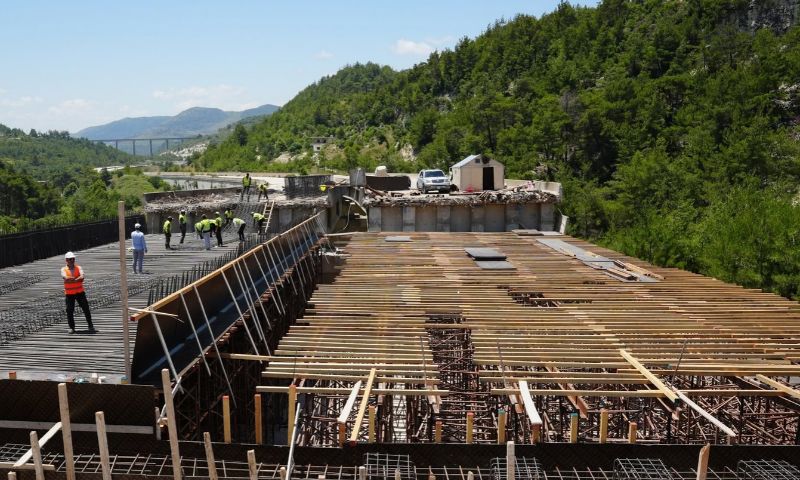
 Work to repair road defects on the Ariha-Latakia Highway (M10), July 20, 2026. (Ministry of Transport/Facebook)
Syria is preparing to rehabilitate several major roads connecting the north and south of the country, following the completion of contract procedures for a project worth more than $198 million.
Moaz Najjar, director of the General Establishment for Road Transport, told Enab Baladi that contract procedures for rehabilitating key sections of the country’s central and strategic road network had been finalized. The project covers the Damascus-Homs and Homs-Aleppo highways, the Saraqib-Idlib road link, and the Nasib-Damascus highway, at a total cost of $198.99 million, funded by the state budget.
The project is part of preparations to implement a three-year plan to develop Syria’s road infrastructure, announced by the Ministry of Transport on October 23.
Transport Minister Yarub Badr previously discussed technical and logistical preparations and the steps needed to begin implementation during a meeting with Mohammed Sultan Al Jaber, chairman of Qatar’s Al Jaber Group, and Naji Berri, director of Loubar Trading Company, following the approval of a consortium formed by the two companies.
According to Najjar, the project covers four main routes extending over a total of 463 kilometers, forming a key part of the country’s central road network and connecting southern, central and northern governorates:
These routes have four traffic lanes and are among the country’s busiest roads for passenger travel, freight transport and movement between governorates.
Najjar said the project’s total value is $198,994,861, distributed across three main contracts:
Najjar explained that the project involves rehabilitating existing roads and improving traffic safety through a range of technical and service-related works, including:
He added that all work would be carried out in accordance with the ministry’s approved technical standards and specifications, as well as the specific contractual requirements of each project.
The contracts have implementation periods ranging from 400 to 500 days, according to Najjar, with the timelines distributed as follows:
Najjar noted that contract-signing procedures are still being completed for some sections ahead of implementation.
Najjar explained that the consortium comprising Loubar Trading Company and Qatar’s Al Jaber Group was selected through a domestic and international request for proposals.
He said Loubar Trading Company holds an excellent-grade classification issued by the Ministry of Public Works and Housing, while Qatar’s Al Jaber Group is an established regional company operating in the contracting sector.
Najjar added that supervision of the projects had been assigned to IDS Consulting following a technical and financial evaluation of submitted bids. However, the supervision contract is still undergoing signing and approval procedures.
Regarding measures to ensure that the companies complete the work to a high standard and within the agreed deadlines, Najjar said the contracts include technical and financial guarantees.
These include performance guarantee deductions equivalent to 5% of the contract value, as well as penalties and deductions in cases of delays or failure to comply with approved technical specifications.
To maintain traffic flow during construction, Najjar said a flexible traffic management plan would be adopted, allowing work to proceed on individual sections or lanes, with temporary diversions equipped with the necessary road safety measures.
The director of the General Establishment for Road Transport expects the project, once completed, to reduce travel times between major governorates and lower transportation, freight and logistics costs.
He said these improvements could benefit domestic trade and affect commodity prices, while also improving road safety and reducing accidents on major international highways.
The project follows years of varying levels of damage to large sections of Syria’s road network as a result of the war, accompanied by declining routine maintenance and increasing traffic loads on many major routes.
if you think the article contain wrong information or you have additional details Send Correction


 A
A
A






 More Society