



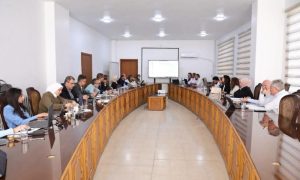
 Launch of a training program for the labor force survey in Damascus, October 27, 2026 (Planning and Statistics Authority).
Syria’s Planning and Statistics Authority said the 2026 Labor Force Survey will target a representative sample of 37,800 households across the country, with 2,700 households in each governorate, to provide data reflecting national labor market conditions. The survey covers cities, towns, and villages across Syria.
In a statement published on Tuesday evening, October 27, the authority explained that the survey includes individuals aged 15 and over, the age group used to measure the labor force. Specialized field teams are collecting data using electronic tablets to complete survey questionnaires digitally, accelerating fieldwork while strengthening quality control and data accuracy.
The survey aims to modernize the statistical system and provide accurate data and reliable indicators on labor market conditions, workforce characteristics, and human capital.
It also seeks to determine the size of the labor force, examine its demographic and economic distribution, identify the causes of unemployment, and anticipate future needs. These findings are intended to help align educational outcomes with labor market requirements and develop training programs, contributing to better human capital planning and future employment opportunities.
According to the authority, the survey is particularly significant this year because it resumes an exercise suspended due to the war. It follows the latest international statistical standards established by the 21st International Conference of Labour Statisticians (ICLS-21) of the International Labour Organization (ILO). This approach is intended to strengthen Syria’s national statistical system and establish the survey as an annual exercise conducted in accordance with internationally recognized standards.
The authority explained that the ongoing survey is the first since the war-related suspension. It is being implemented in coordination and cooperation with the Ministry of Social Affairs and Labor, in partnership with the ILO and the European Union.
Field data collection is expected to be completed before the end of 2026. The data will then undergo verification, quality control, statistical processing, and cleaning before preliminary results are announced in late January or early February 2027, followed by the publication of the final survey report.
The Planning and Statistics Authority stressed the importance of verifying that field researchers comply with official identification requirements, including:
The authority urged residents to verify these requirements before providing information and to report any suspected impersonation to the relevant authorities.
It emphasized that all data and information provided by survey participants would be treated as strictly confidential under applicable laws and regulations. The information will be used exclusively for statistical and planning purposes, helping guide investments, develop employment policies, and support evidence-based decision-making.
The authority also stressed the importance of cooperation from selected households, urging them to respond to field researchers and provide accurate and transparent answers. It noted that reliable statistical data forms an essential foundation for developing public policies and identifying development priorities.
It added that providing accurate answers is not merely a statistical procedure but a national responsibility that helps build a realistic picture of the labor market and supports planning for decent employment opportunities and a better development outlook for future generations.
Web science and data management specialist Mohammad Tawfiq Nahlawi previously told Enab Baladi that data science experts classify statistical surveys as intangible strategic assets that underpin development policies while reducing their risks and costs.
According to Nahlawi, Syria’s labor force survey is among the most important of these assets because it provides a clear picture of the distribution of human capital, labor force participation rates, and skills gaps resulting from years of demographic and economic disruption.
Nahlawi stressed that data is the “silent engine” of recovery and reconstruction, explaining that international companies and investors do not invest capital in environments they know little about. Instead, they first seek reliable indicators of labor market efficiency, operating costs, and the availability of skills.
He added that surveying according to the ILO’s latest statistical standards gives its findings additional value by allowing regional and international comparisons. This would help reintegrate Syria into the system of reliable, standardized government statistical data.
However, Nahlawi noted that the value of this strategic asset depends on its continuity, as data, like other assets, quickly becomes outdated unless it is regularly updated.
He recommended maintaining regular surveys and developing continuous statistical time series, describing this as the only way to provide economic planners and decision-makers with a reliable guide for allocating resources effectively. The Planning and Statistics Authority has committed to this approach by preparing and conducting several standardized surveys in cooperation and coordination with international partners.
if you think the article contain wrong information or you have additional details Send Correction


 A
A
A






 More Society