


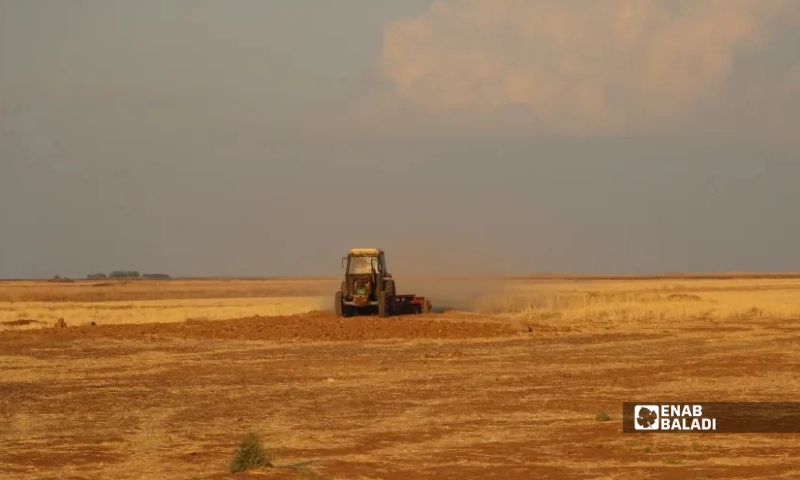
 A farmer plows his land in the al-Hasakah countryside, October 3, 2026 (Enab Baladi)
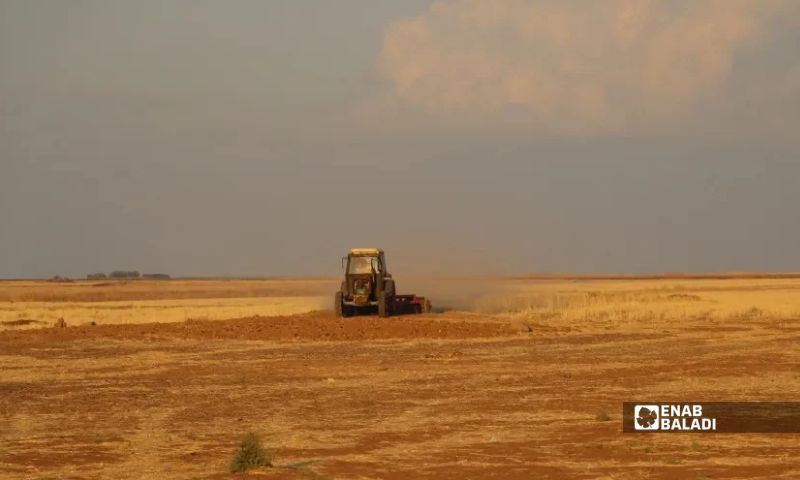
A farmer plows his land in the al-Hasakah countryside, October 3, 2026 (Enab Baladi)
As preparations begin for the winter agricultural season in al-Hasakah governorate (northeastern Syria), farmers are focusing on securing wheat, barley, and other winter crop seeds amid rising seed prices and multiple costs they must bear before their crops reach the harvesting and marketing stages.
These burdens come as many farmers in the governorate are still waiting to receive payments for the previous agricultural season, despite the high production recorded in al-Hasakah during the 2025-2026 season. This leaves farmers needing to secure enough liquidity to purchase seeds and begin plowing; at the same time, a large proportion of the governorate’s farmland relies on rainfed agriculture, with costs affected by rainfall levels and timing.
According to prices circulating in al-Hasakah markets at the start of the season, a ton of soft wheat costs about $375, with an additional $25 for seed sorting and disinfection, locally known as “treatment.” A ton of durum wheat costs $400, with another $50 for sorting and treatment.
A ton of black barley costs about $275, speckled barley $260, and white barley $250. Cumin costs about $3 per kilogram and coriander $1.70 per kilogram, while a ton of sesame costs about $800, lentils $700, and broad beans $500.
Ahmed al-Mulla, a seed trader in al-Hasakah city, told Enab Baladi that seed prices vary depending on the crop, variety, and quality, noting that durum wheat is more expensive than soft wheat in terms of both the seed price and sorting and treatment costs.
Al-Mulla added that seeds are not offered for sale immediately after being purchased from farmers. They first undergo sorting to remove unsuitable grains and impurities, before being disinfected with specialized materials to protect them against certain diseases and pests that can be transmitted with the seeds to the soil and crops.
He explained that seed “treatment” is an essential step for farmers seeking to reduce the risk of infection during the early stages of plant growth, but it also adds another cost to the price per ton. He noted that sorting and treatment fees vary depending on the type of seed, the materials used, and the nature of the work.
At current prices, a farmer cultivating rainfed land and requiring about 20 kilograms of wheat seed per dunum pays around $7.50 for soft wheat seed alone. The cost rises to about $8 per dunum after sorting and treatment are included. If durum wheat is used, seed costs reach about $9 per dunum, based on the listed prices.
Al-Mulla said rising seed prices cannot be separated from the cost of other agricultural inputs. Farmers must also pay for plowing, fuel, irrigation for irrigated land, harvesting, transportation, and other expenses that gradually accumulate throughout the season.
Mousa Ramadan, a farmer from the southern al-Hasakah countryside, told Enab Baladi that rising seed prices coincide with the start of plowing and preparations for the new season, leaving farmers facing successive financial obligations at a time when many farmers in the governorate have yet to receive payments for last season’s crops.
Ramadan explained that at the beginning of the season, farmers need to secure seeds and cover the cost of plowing their land, followed by other expenses during the different stages of cultivation. He said delays in receiving payments make it more difficult to secure the capital needed for the new season.
“The rise in seed prices alone is a burden on farmers, but the problem becomes greater when the cost of plowing, fuel, and other inputs is added, while payments from last season remain outstanding for many farmers,” he added.
Ramadan believes the continuation of these conditions could push some farmers, particularly those with limited financial means, to reduce the areas they cultivate or purchase seeds on credit, meaning they would begin the new season with an additional financial burden.
Ahmed al-Jabr, a farmer from the northeastern al-Hasakah countryside, said seed costs represent only part of the total expenditure per dunum and cannot be assessed separately from the costs of plowing, harvesting, irrigation, and other expenses.
Al-Jabr told Enab Baladi that rainfed land requires an average of about 20 kilograms of wheat seed per dunum, meaning farmers begin the season by paying for seeds before accounting for any other expense. He added that plowing one dunum costs about $4, after which further expenses related to tending the land, harvesting, and transporting the crop accumulate.
The financial burden is greater for farmers who rent land, according to al-Jabr. Agricultural costs do not end with securing production inputs, as tenants must give the landowner a share of the harvest ranging from 20% to 40% of production, depending on the land and the terms of the agreement.
He explained that these percentages make calculating the season’s economic feasibility more complicated, particularly if rainfall is lower than expected or the costs of harvesting and agricultural services increase.
“A farmer does not pay only for seeds. The costs begin with plowing and continue through cultivation and harvesting. On rented land, part of the production goes to the landowner, so any increase in the price of an agricultural input directly affects the income of farming families,” al-Jabr said.
High seed costs at the beginning of the new season come after an exceptional year for wheat production in al-Hasakah in 2026.
Around 1.16 million tons of wheat were marketed in al-Hasakah governorate during the 2026 season, making it the leading Syrian governorate in wheat production and marketing. The Syrian Grain Establishment received around 2.75 million tons of wheat nationwide, compared with estimated domestic demand of about 2.55 million tons, leaving a surplus of nearly 200,000 tons.
Abundant rainfall during the previous season helped improve land productivity and reduced the need for irrigation across large areas of rainfed farmland, affecting both crop volumes and production costs.
However, according to farmers who spoke to Enab Baladi, high production in one season does not necessarily mean lower burdens for farmers in the following season. Farmers begin a new production cycle with different expenses, starting with securing seeds, followed by preparing and tending the land, harvesting, and marketing the crop.
With large areas of al-Hasakah farmland dependent on rainfall, the success of the agricultural season also remains tied to precipitation levels and their distribution during the different stages of crop growth, as well as farmers’ ability to secure production inputs at the appropriate time.
According to al-Mulla, seed prices at the beginning of the season remain an initial indicator of the level of costs farmers will face in the coming months, while rainfall conditions will be a decisive factor in determining final production levels and the economic viability of the season for farmers.
if you think the article contain wrong information or you have additional details Send Correction


 A
A
A
A
A
A



 More Economic Reports