


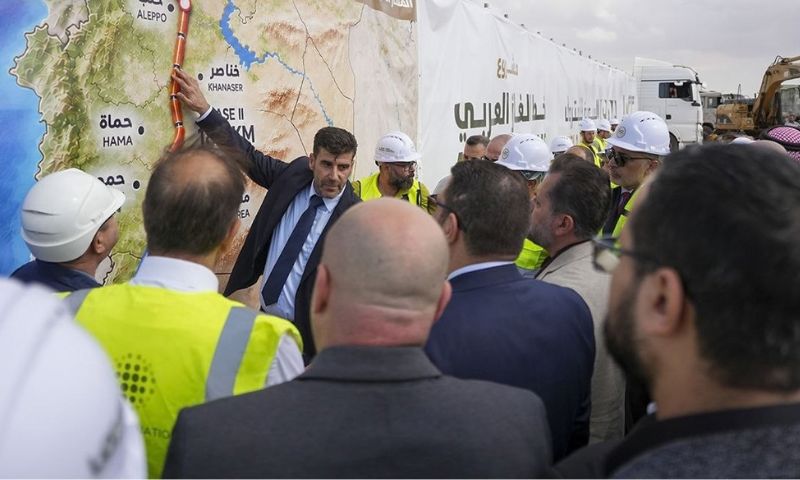
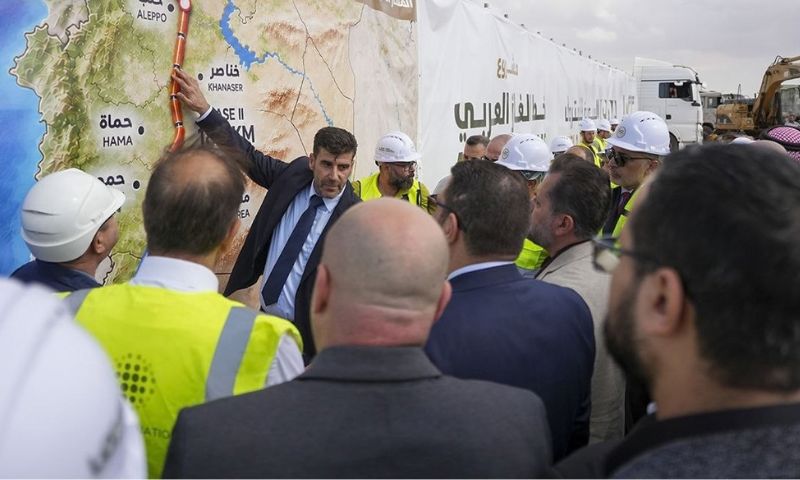
 Inauguration ceremony for the second part of the second phase of the Arab Gas Pipeline project in Furqlus, eastern Homs countryside, September 29, 2026 (Syrian Petroleum Company)
Inauguration ceremony for the second part of the second phase of the Arab Gas Pipeline project in Furqlus, eastern Homs countryside, September 29, 2026 (Syrian Petroleum Company)


 A
A
A
A
A
A
The Syrian Petroleum Company announced on September 29 the launch of work on the second part of the second phase of the Arab Gas Pipeline project, spanning 186 kilometers with a diameter of 36 inches.
The Syrian Petroleum Company said through its official channels that this phase completes the Arab Gas Pipeline network extending from the Jordanian border to the Turkish border, bringing its total length to approximately 566 kilometers, with the pipeline ready to operate in both directions.
The phase adds an operational gas storage capacity of around eight million cubic meters within the pipeline. It also includes the construction of a gas compression station equipped with three compressors, providing a transmission capacity of up to 11 million cubic meters per day, with the possibility of increasing it in the future to around 22 million cubic meters per day.
According to the company:
Hisham al-Saleh, deputy executive vice president for the gas sector at the Syrian Petroleum Company, said the completed section represents the final link in the Arab Gas Pipeline connecting Jordan and Turkey through Syria. He noted that the project adds 186 kilometers of pipeline to approximately 380 kilometers of existing lines.
According to al-Saleh, this brings the network’s total length to around 566 kilometers, with a transmission capacity of up to 11 million cubic meters of gas per day.
The project includes installing three compressors in the Furqlus area of eastern Homs countryside, allowing gas to be transported in both directions between Turkey and Jordan. It also adds an estimated storage capacity of around eight million cubic meters to Syria’s gas network, providing:
Al-Saleh noted that the gas network linked to the project currently allows connections between Syria, Lebanon, Jordan, and Turkey, strengthening Syria’s position as a regional corridor for transporting gas and energy.
The Arab Gas Pipeline consists of three phases, according to information published by the Kuwait-based Arab Fund for Economic and Social Development on its official website.
The first phase involved constructing a pipeline from the Egyptian city of al-Arish to Taba and then to the Aqaba power station in Jordan. The approximately 265-kilometer pipeline has a diameter of 36 inches and cost around $280 million.
Financing for this phase came from the Arab Fund through a loan worth 17 million Kuwaiti dinars, as well as from the Kuwait Fund and Egypt. Construction was completed in 2004, and the Aqaba thermal power station has been supplied with Egyptian natural gas since then.
The second phase involved building a gas network within Jordanian territory, extending from the Aqaba power station to the Syrian border to supply the Samra, Rehab, and al-Manakher power plants.
A group of Egyptian and Jordanian investors and banks financed this phase, which was completed in mid-2007.
The third phase includes a gas network inside Syrian territory extending from the Syrian-Jordanian border to the Syrian-Turkish border and onward to Lebanon.
This phase is divided into four sections:
According to the Arab Fund, work on the first and fourth sections has been completed. The Arab Fund contributed to financing the second section through a loan worth 10 million Kuwaiti dinars. Under the third section, the Homs-Aleppo segment, as currently announced by the Syrian Petroleum Company, gas will initially be transported between the two cities using Syria’s domestic gas network.
if you think the article contain wrong information or you have additional details Send Correction







 More Economic Reports