


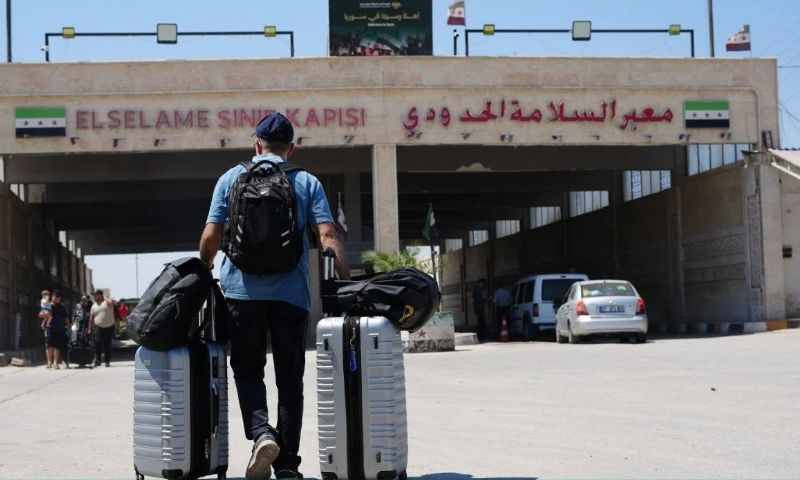
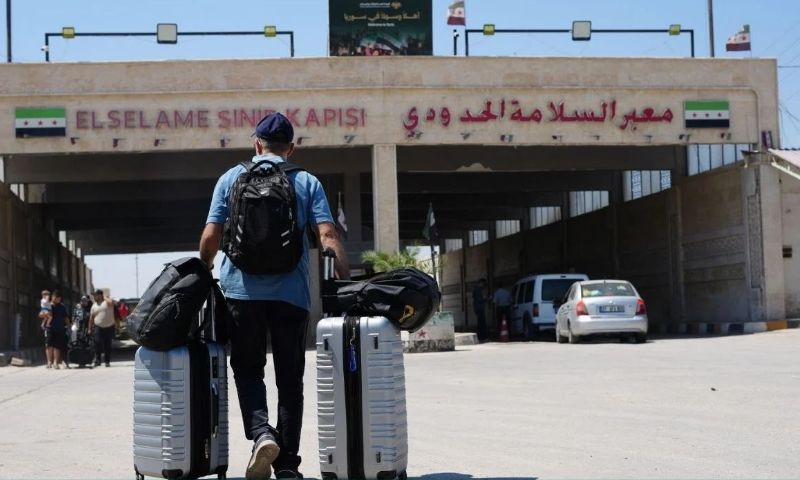
 Syrians return through the al-Salama border crossing with Turkey, September 6, 2026. (General Authority for Ports and Customs)
Syrians return through the al-Salama border crossing with Turkey, September 6, 2026. (General Authority for Ports and Customs)
Syria has seen a growing number of Syrians return to their home areas since the fall of the Assad regime in December 2024.
The UN Refugee Agency, UNHCR, said the number of refugees who had returned from abroad reached 1,795,641 as of September 1, according to ReliefWeb, a platform run by the UN Office for the Coordination of Humanitarian Affairs, OCHA.
Syrians are returning at a time when measures and pressures are increasingly pushing some host countries toward sending Syrians back, whether by tightening residency policies or making continued residency conditional on new requirements. Some countries have also launched voluntary return programs while increasing the financial assistance allocated to returnees.
The scale and nature of these pressures vary from one country to another, as do the circumstances and motivations of Syrians who return.
The growing number of returns raises questions about their impact on the Syrian economy, the labor market’s ability to absorb returnees, and whether the country can benefit from their experience and skills under current economic conditions.
The return of refugees does not necessarily mean they can contribute to economic recovery, given the limited incomes and savings of most returnees. This restricts their ability to establish large businesses, while attracting expatriate capital requires economic conditions that encourage Syrians abroad to return and invest in the country.
Economist Majdi al-Jamous believes the return of Syrian refugees is not currently producing a clearly positive effect on the economy because Syrian workers’ productive capacity remains weak compared with consumption levels. He said returnees generally have limited incomes and most lack enough savings or capital to establish businesses capable of contributing to economic recovery.
Speaking to Enab Baladi, al-Jamous said the return of skilled professionals could benefit the labor market. At the same time, returning families place additional pressure on infrastructure and services, including schools, hospitals, and sewage networks, while infrastructure remains weak and the government has so far been unable to create an attractive investment environment or move effectively into a reconstruction and building phase.
He added that the absence of an appropriate legal and regulatory environment, the weakness of the financial sector, and the lack of basic financing for businesses, along with bureaucracy and difficult licensing procedures, all limit returnees’ ability to establish new enterprises.
Al-Jamous said most businesses that returnees could establish under current conditions would be small or micro-enterprises. He added that there is a wide gap between what the Syrian economy needs for recovery and the level of production these businesses can achieve, meaning they cannot serve as a major economic driver of recovery.
He also said the “spread of tribalism” and ongoing conflicts, along with a failure to rely on qualified professionals in economic management, have contributed to weakening the investment environment. He argued that building an economy capable of recovery requires giving economic management its proper role and relying on expertise rather than loyalties.
Al-Jamous said Syria has so far been unable to attract expatriates with capital, investors, or people with professional and scientific expertise. He said those who have found better conditions in their countries of refuge tend to remain there, while people facing different circumstances are the ones who return.
He added that the problem is not limited to returnees’ lack of savings, but also includes the absence of a financial sector capable of providing loans. This deprives new businesses of one of the basic factors of production, capital.
He said the weakness of the banking sector and difficulty obtaining financing, alongside complicated licensing procedures and the absence of incentives, make establishing businesses more difficult.
Al-Jamous said a strong financial sector is associated with a strong economy. He added that local producers already face major difficulties because of high production costs and the opening of markets to Turkish, Gulf, and Iraqi products, which has reduced their ability to compete with imports.
According to al-Jamous, creating an environment capable of attracting foreign investment and encouraging the return of expatriate capital, establishing large projects, increasing job opportunities, reviving and properly managing the financial sector, and restoring the banking system could make refugee returns more beneficial to the economy. Returnees could contribute through their experience, professional skills, or employment in sectors that need workers, particularly during reconstruction.
However, he said current conditions, including declining job opportunities, disorder in hiring across the public and private sectors, and the withdrawal of some businesses, factories, and productive sectors from the market, limit the economy’s ability to absorb returnees.
The labor market is among the sectors most likely to be affected by the scale of refugee returns, given limited employment opportunities, a growing number of job seekers, and local wages that are lower than those in countries of refuge.
Economist Alaa Baladia believes the return of Syrian refugees will have a direct effect on the labor market.
Baladia told Enab Baladi that the voluntary returns taking place now may not carry the hoped-for economic significance. However, large-scale and organized returns would put the labor market to a real test, as limited employment opportunities could increase competition for jobs and expand the informal sector, with possible consequences for wage levels.
At the same time, Baladia said skilled and experienced returnees could fill gaps in sectors suffering from staff shortages, particularly medicine, education, reconstruction, and various industries.
However, the large gap between wage levels in Syria and countries of refuge, along with the widening technological gap, may limit the economy’s ability to attract and retain these skilled workers, according to the economist.
Baladia said benefiting from returnees’ experience will not happen automatically. It requires creating new jobs, stimulating production, and developing the working environment to accommodate the experience and work methods Syrians acquired in countries of refuge.
According to UNHCR data, Damascus received the largest number of Syrian returnees from abroad, with 293,609, followed by Aleppo in northern Syria with 255,418 and Idlib in northwestern Syria with 250,046.
Another 227,454 people returned to Rural Damascus, 225,202 to Homs in central Syria, and 190,059 to Hama in central Syria. Daraa in southern Syria received 149,682 returnees, while 72,770 returned to Deir Ezzor in eastern Syria.
The remaining returns were recorded in Latakia on Syria’s Mediterranean coast, with 37,606, Quneitra in southwestern Syria with 30,601, Raqqa in northern Syria with 30,352, al-Hasakah in northeastern Syria with 17,521, Tartous on the Mediterranean coast with 11,016, and Suwayda in southern Syria with 4,305.
if you think the article contain wrong information or you have additional details Send Correction


 A
A
A
A
A
A




 More Economic Reports