


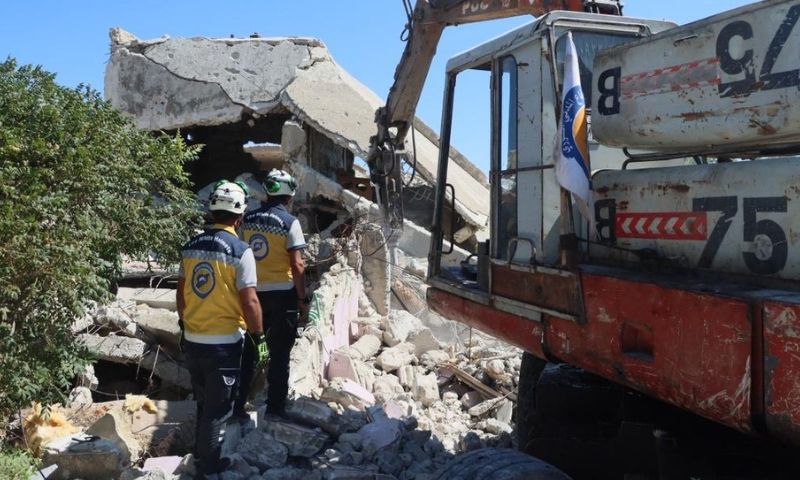
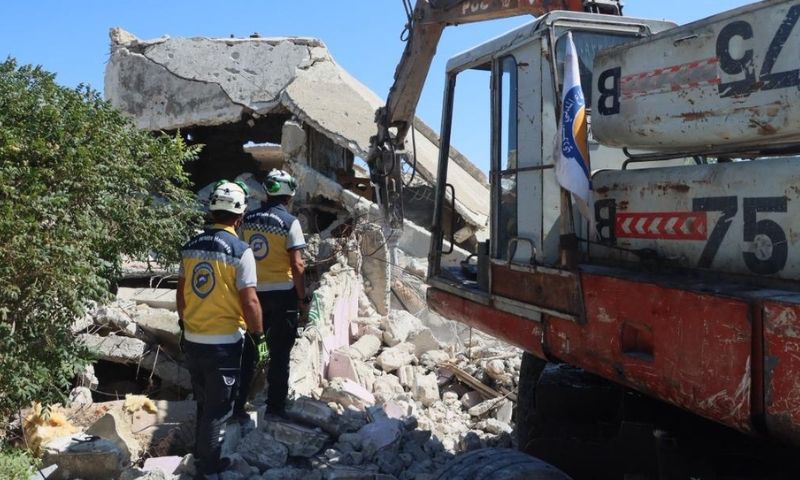
 Rubble clearance in the villages of Kabina and Akko in the Latakia countryside (western Syria), September 3, 2026 (Ministry of Emergency and Disaster Management)
Enab Baladi, Ghena Jabr
The economic effects of war extend beyond the destruction of buildings and infrastructure to include the costs of clearing rubble and recovering damaged resources.
In Syria, rubble scattered across cities and towns poses an urban, environmental, and economic challenge amid vast reconstruction needs, limited funding, and weak production capacity and purchasing power.
This raises questions about how to manage rubble and recover usable materials to ease some of the burden of reconstruction and turn debris into a resource for economic recovery.
World Bank estimates published in October 2025 put the cost of rebuilding Syria’s damaged physical assets at about $216 billion, within an estimated range of $140 billion to $345 billion.
The scale of these needs makes finding ways to reduce costs and use local resources an essential part of economic recovery efforts, according to economic researcher Mohammed al-Salloum.
Speaking to Enab Baladi, al-Salloum pointed to the importance of the “circular economy,” which involves recovering usable materials and returning them to production rather than treating them as worthless waste.
According to estimates by the relevant Syrian authorities cited by al-Salloum, Syria has about 50 million cubic meters of rubble, with a target of clearing the country of debris by mid-2028.
Figures published at the end of September 2026 indicate that about three million cubic meters were removed during the first eight months of the year.
Mohammad Bakr, a member of the Economic Sciences Association, said conventional rubble removal imposes economic and environmental burdens through the costs of demolishing buildings, hauling away debris, and allocating disposal sites, as well as pollution from vehicle and bulldozer exhaust.
Bakr told Enab Baladi that the cost of removing and transporting rubble varies between governorates depending on the distance between debris sites and designated disposal areas. Sorting and recycling, he said, could turn this waste from a financial burden into an economic resource.
He estimated that more than 90% of the material in destroyed buildings could be recovered and recycled.
The economic challenge involves more than clearing rubble. It also means carrying out the work at the lowest possible cost while recovering usable materials for reconstruction projects.
Depending on the buildings destroyed and the condition of the demolition materials, rubble contains iron, other metals, concrete, bricks, and stone. Some of these materials can be recovered and reused.
According to al-Salloum, clean concrete can be crushed, sorted, and subjected to the necessary tests to produce aggregates for road layers, fill, and some construction applications. Metals can be separated and sold to smelting plants, subject to quality and market requirements.
Al-Salloum said one of Syria’s main opportunities lies in linking rubble clearance to reconstruction projects rather than treating them as separate processes. Reusing recovered materials in road rehabilitation, land leveling, and some infrastructure work could reduce the need to extract new raw materials, lower some transport and supply costs, and ease pressure on natural resources.
He explained that recycled materials cannot replace new construction materials in every application. Their use in structural components requires rigorous testing and technical standards to ensure structural safety.
Directing recovered materials toward uses suited to their properties would therefore allow the development of a local production chain connecting rubble management with the supply of reconstruction materials.
He added that the potential benefits extend beyond construction to other economic activities, including transport, crusher operation, machinery maintenance, industrial sorting, metals trading, laboratory testing, and the manufacture of construction products.
This would create direct and indirect jobs and give local businesses opportunities to participate in recovery, rather than limiting participation to large companies or overseas suppliers.
Al-Salloum cautioned, however, that assessments of these projects’ economic impact should account for the actual scale of activity, the level of automation, the types of investment, and the share of added value retained within the Syrian economy.
He noted that the sector’s success depends on more than establishing crushing and sorting plants. It also requires sustained commercial demand for recycled materials and their ability to compete with conventional construction materials.
Bakr said an integrated plan to remove, sort, and recycle rubble on site could turn the process into an economic activity that attracts investment and creates direct and indirect jobs for engineers, skilled workers, heavy machinery operators, truck drivers, and service providers.
Turning rubble into an economic resource faces several challenges, particularly high fuel and transport costs, limited funding, fluctuating construction material prices, and weak purchasing power. These factors could undermine the economic viability of recycling projects unless they are based on careful cost and market studies.
Some damaged sites may also contain contaminated debris or hazardous materials, requiring surveys, testing, and safe separation before rubble can be processed and reused.
Al-Salloum said a decentralized rubble-processing system, with sorting and crushing plants near demolition sites wherever technical and environmental conditions permit, could shorten transport distances, reduce costs, and ease pressure on roads. Population density and the environmental effects of dust, noise, and truck traffic would also need to be considered.
On financing, Bakr said the private sector could play a central role in rubble removal and recycling, arguing that investment in this field could generate attractive returns.
He proposed partnerships with the private sector, particularly real estate developers, by designating reconstruction areas and assigning companies to carry out demolition, rubble clearance, and processing.
He said the proposed model involves equipping work sites with demolition, crushing, grinding, and sorting machinery, then processing rubble to recover usable materials, including iron, aluminum, and copper. Scrap metal would be sold to smelting plants, while processed materials would be used to manufacture building blocks.
Al-Salloum called for clear partnership models between public authorities and local investors based on sharing risks and returns. These could include contracts to operate processing plants, joint investment in equipment and infrastructure, and long-term contracts to supply recycled materials to public projects.
He stressed the importance of transparent pricing rules for processing services and recovered materials, alongside defined oversight and accountability mechanisms, to reduce the risk of monopolies over processing sites or resources recovered through recycling.
He said demand for recycled materials could be supported during the sector’s early development by using them in public projects whose technical specifications permit it, particularly fill, road layers, and some infrastructure work. Their use should be subject to independent laboratory testing, certificates of conformity, and regular quality monitoring.
Al-Salloum stressed the importance of reviewing legislation governing rubble removal, real estate ownership management, and investment to define the responsibilities of public authorities, operators, and contractors and protect property owners’ rights.
He added that tax and customs incentives for recycling equipment, suitable processing sites, and energy supplies provided under clear arrangements could encourage investment. These measures should be tied to measurable performance indicators, including the volume of rubble processed, material recovery rates, environmental compliance, and locally generated added value.
He cautioned that accelerating rubble clearance must not infringe on owners’ rights or complicate procedures for proving ownership. He stressed that land use and rubble collection and processing sites must be subject to clear legal procedures that reduce disputes and ensure transparency.
He concluded that rubble recycling cannot replace the substantial funding Syria needs for reconstruction. It could, however, offer a practical way to reduce some costs, increase reliance on local resources, and generate added value within the Syrian economy.
The Ministry of Emergency and Disaster Management has removed about 3.5 million cubic meters of rubble in Syria out of an estimated 40 million cubic meters. It aims to remove more than eight million cubic meters by the end of 2027, according to information its Media and Communications Department provided to Enab Baladi.
The department said the proportion of rubble removed from main roads and public facilities was about 43%, compared with rubble within neighborhoods and residential areas.
The ministry said rubble removal and transport currently cost between $2.50 and $6 per cubic meter, depending on conditions in each area.
The department explained that it could not estimate the total cost of upcoming projects because multiple variables affect implementation. These include the types of heavy machinery available locally or the need to bring equipment from other areas, recurring fluctuations in fuel prices, and the distance between rubble sites and designated disposal sites.
if you think the article contain wrong information or you have additional details Send Correction


 A
A
A



 More Economic Reports