


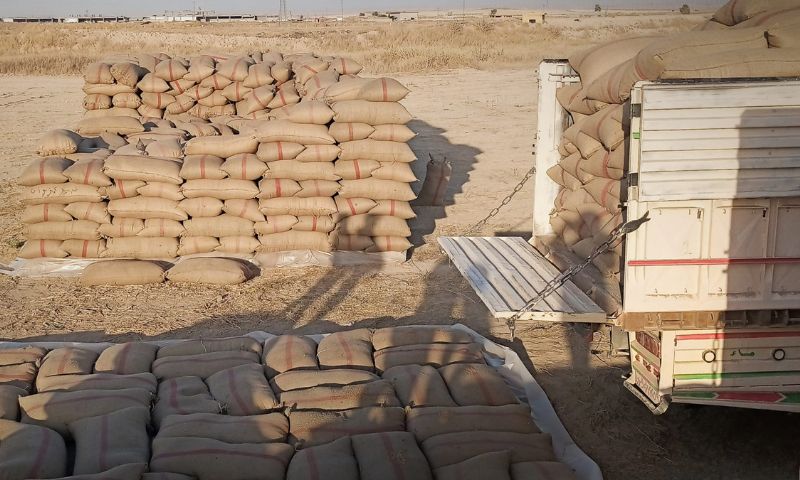
 Wheat deliveries in Hasakah (northeastern Syria), June 30, 2026 (SANA)
Syria’s Agricultural Cooperative Bank issued a new circular on Wednesday, October 21, setting out procedures for paying farmers for this season’s wheat crop.
The circular cancels previous circulars and payment procedures, based on a letter issued by the Central Bank of Syria on October 20.
The new procedures vary by governorate, with deadlines and daily withdrawal amounts set in some areas to speed up payments.
Farmers previously told Enab Baladi that the Syrian government had delayed paying them for their wheat despite the harvest season having ended and the next planting season approaching. They said they had financial obligations and debts incurred to cover the costs of growing wheat, and that the payment delays had increased their economic pressures.
Under the circular, Agricultural Cooperative Bank branches must pay farmers the full amounts owed for their wheat in the governorates of Homs, Damascus, Hama, Tartous, Latakia, Daraa, Suwayda (southern Syria), Idlib (northwestern Syria), and Quneitra (southwestern Syria). They must obtain the cash needed from Central Bank branches in those governorates.
In Deir Ezzor (eastern Syria), the bank’s branches must pay farmers all outstanding wheat payments, with daily withdrawals of approximately 200 million Syrian pounds, subject to increase. All remaining payments in the governorate must be completed within 15 working days.
The bank instructed its Deir Ezzor branches to follow their existing payment queues to ensure farmers’ rights are respected.
According to another previous Enab Baladi report, Syrian farmers were still waiting to be paid for wheat delivered to the state the previous season, while debts accumulated and they struggled to secure supplies for the next season. The government attributed the delays to cash shortages and difficulties related to printing the new currency and transporting cash.
The Agricultural Cooperative Bank instructed its Aleppo branch to pay farmers the full amounts owed for their wheat, with daily withdrawals of approximately 300 million Syrian pounds from the Central Bank branch, subject to increase.
Withdrawals must be arranged so that all remaining wheat payments in the governorate are completed within 20 working days. The branch must follow its existing payment queue to ensure farmers’ rights are respected.
In Hasakah and Raqqa (northern Syria), farmers owed 5 million Syrian pounds or less must receive their payments in full.
Farmers owed more than 5 million Syrian pounds will receive their payments in two installments starting this month. Branches must follow their existing payment queues to ensure farmers’ rights are respected.
The Agricultural Cooperative Bank issued the circular based on a Central Bank letter emailed on Tuesday, October 20. That letter cancels this season’s crop payment procedures set out in an earlier letter from the Central Bank governor, numbered “944/17/S,” issued in June.
The Agricultural Cooperative Bank instructed all branches covered by the circular to “follow the payment procedures set out in it until the end of the current season.”
Syria’s Ministry of Economy and Industry, before a decree split it into two ministries, had set this season’s wheat purchase price at 46,000 Syrian pounds (approximately $325) per ton. The Syrian presidency added a bonus of 9,000 Syrian pounds (approximately $63.50) per ton for farmers delivering their crops to grain collection centers within Syria.
The General Establishment for Seed Multiplication also plans to produce 67,000 tons of seed during the next agricultural season, alongside a contingency plan to produce 15,000 tons in Hasakah governorate. The aim is to meet at least 65% of Syria’s seed needs, the establishment’s director, Ammar al-Mohammad, said in a press statement.
In August, an Agricultural Cooperative Bank circular outlining payment procedures for the 2025-2026 grain season raised concerns among farmers in several governorates. It allocated part of their payments to electronic transfers through the Sham Cash app, despite the continued widespread reliance on cash, particularly in agricultural areas.
Under that circular, 25% of farmers’ net payments was transferred to their Sham Cash accounts, while the remaining 75% was paid under the bank’s existing instructions.
The bank instructed its branches to reopen farmers’ current accounts and prepare files containing the information needed for the transfers, including Sham Cash account numbers and the amounts to be transferred. Branches were also required to complete the details of eligible farmers and submit the files using the prescribed template.
At the time, the circular said the measure was necessary because the Central Bank lacked sufficient cash to pay the full value of that season’s grain purchases.
The latest Agricultural Cooperative Bank circular, giving branches a maximum of 15 to 20 working days to pay farmers, comes as the Syrian pound has weakened against the US dollar since the Finance Ministry announced on August 31 that government spending had exceeded revenue by approximately $1 billion in the first half of 2026.
On Wednesday, October 21, the exchange rate stood at 141 Syrian pounds to the dollar for buying and 141.75 new Syrian pounds for selling. Continued depreciation could erode the value of farmers’ outstanding wheat payments.
if you think the article contain wrong information or you have additional details Send Correction


 A
A
A





 More Economic Reports