


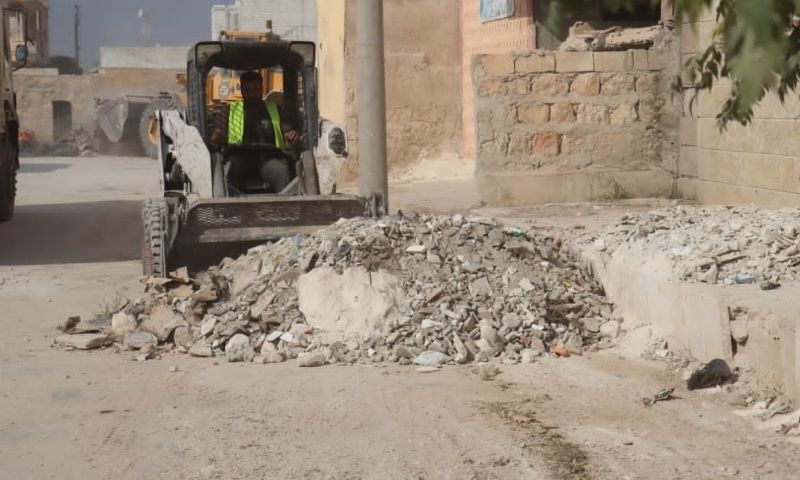
 Rubble removal work in damaged areas of Idlib governorate (northwestern Syria), October 21, 2026 (Ministry of Emergency and Disaster Management)
Syria’s Ministry of Emergency and Disaster Management has removed approximately 3.5 million cubic meters of rubble out of an estimated 40 million nationwide. It aims to remove more than eight million cubic meters by the end of 2027, the ministry’s media and communications department told Enab Baladi.
The department said the proportion of rubble removed from main roads and public facilities had reached approximately 43%, compared with rubble inside neighborhoods and residential areas.
The department said rubble removal projects had not yet begun in the governorates of Homs (central Syria), Daraa (southern Syria), Deir Ezzor (eastern Syria), Damascus countryside (surrounding the capital), Damascus and al-Hasakah (northeastern Syria).
It said projects in Homs, Daraa, Deir Ezzor and Damascus countryside were included in the ministry’s plans. However, their launch had been delayed beyond the target dates because of challenges in completing technical and logistical requirements and securing the resources needed for implementation, depending on conditions in each area.
According to the ministry, the main reasons for the delays include the need for additional arrangements to ensure safe working conditions and the safe management, transport and processing of rubble. Collection sites also vary in their capacity and accessibility.
Removal operations also face difficulties associated with explosive remnants of war and unexploded ordnance. Sites must undergo an initial survey before rubble can be transported away, while a shortage of equipment dedicated to surveying, particularly tracked and armored vehicles, limits the ability to carry out these operations in some areas.
The department said the types of munitions present and the prevalence of tunnels further complicated the work.
Property ownership issues are another obstacle to launching projects in some areas, as owners who are missing or deceased cannot be reached. The department said work on private property requires the owner’s written consent or a written request from the owner, along with the necessary supporting documentation.
The department added that some areas require advance coordination because of the scale of destruction and because their future is tied to urban planning and reconstruction processes. This coordination is intended to ensure that removal work does not conflict with urban planning requirements and that records of ownership and property rights are preserved, while accounting for safety requirements and the potential reuse of rubble.
The Ministry of Emergency and Disaster Management aims to remove more than eight million cubic meters of rubble during the remainder of 2026 and through the end of 2027. Upcoming projects will focus on the governorates of Idlib, Aleppo, Daraa, Damascus countryside, Hama (central Syria), Homs, Deir Ezzor and Latakia (western Syria).
According to the department, the ministry determines priority areas using several criteria. These include the extent of damage and recovery needs, the number of residents willing and able to return once suitable conditions are in place, the availability of basic services and the possibility of restoring them, as well as costs, available funding and spending efficiency.
The cost of removing and transporting rubble ranges from $2.50 to $6 per cubic meter, depending on current prices and conditions in each area, according to the ministry.
The department said it was not possible to estimate the total cost of upcoming projects because of the many variables affecting implementation. These include the types of heavy machinery required, whether that machinery is available locally or must be brought from other areas, recurring fluctuations in fuel prices, and the distance between rubble sites and designated disposal sites.
Removal operations face additional field and logistical challenges, including difficulty reaching some sites because of narrow or rough roads and the distances between damaged areas. Work sites also vary in their readiness and their equipment and operational needs, while weather conditions present further challenges, according to the department. Explosive remnants of war and unexploded ordnance pose additional risks, requiring coordination with specialized mine and ordnance clearance organizations to survey sites before projects begin.
Implementation also requires coordination among the relevant authorities, including municipalities and local councils, to designate disposal sites and organize the transport, sorting and processing of rubble, ensuring worker and resident safety and efficient implementation.
To address these challenges, the ministry’s damage assessment and recovery department is developing a national methodology for rubble removal. It is intended to align with international and humanitarian standards and practices and regulate work at particularly sensitive sites while preserving evidence, rights and property.
The media and communications department said the ministry was completing the preparations needed to launch projects and gradually expand rubble removal, helping create conditions for residents to return and basic services to be restored.
It said rubble removal was an essential step in preparing damaged areas for recovery. Implementation requires addressing technical, field and property-related challenges alongside project preparations, serving the public interest while protecting citizens’ rights.
On October 13, the Syrian Network for Human Rights (SNHR) released a report outlining a combined legal and policy framework relevant to rubble removal. It explained that international law does not impose a general, absolute obligation to preserve rubble.
The report derived a guiding principle from this framework: decisions about where, when and how rubble is removed should be based on evidence and risk assessments and accompanied by adequate documentation.
It explained that this principle does not amount to a blanket ban on rubble removal. However, protecting life and safety must take priority when delays pose a real threat to lives or explosive remnants require immediate action.
The report proposed a balancing assessment based on five variables:
It also proposed classifying sites into five categories:
SNHR stipulated that, before any non-emergency mechanical removal takes place, a minimum set of measures proportionate to the site’s classification must be implemented.
if you think the article contain wrong information or you have additional details Send Correction


 A
A
A






 More Society