


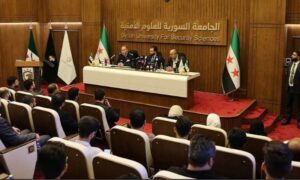
 A discussion forum on the water sector at the Ministry of Energy pavilion during the Damascus International Fair, Sept. 2, 2026. (Ministry of Energy)
A discussion forum on the water sector at the Ministry of Energy pavilion during the Damascus International Fair, Sept. 2, 2026. (Ministry of Energy)
Obada Mobayed, director of Water Sector Regulation at the Ministry of Energy, said Syria faces a water deficit estimated at around two billion cubic meters, while storage levels in dam reservoirs remain below 50%, placing the country among those suffering from water scarcity and below the water poverty line.
Mobayed told Enab Baladi that Syria consumes around 18 billion cubic meters of water annually, of which 16 billion cubic meters come from renewable water resources, including rainfall and permanently flowing rivers.
He added that the deficit of around two billion cubic meters is covered through nonrenewable water resources, primarily groundwater and base reserves in natural and artificial lakes.
Mobayed said replenishing the quantities withdrawn from depleted groundwater reserves is extremely difficult and could take years.
Regarding dam reservoirs, Mobayed said storage levels remain below 50% in the southern region and fall below 20% in Daraa and Quneitra governorates in southern Syria, despite rainfall.
He said improvements in reservoir levels depend on the amount of rainfall and water inflows from rivers originating outside the country, as well as losses caused by evaporation, seepage into the ground, and human consumption across various activities.
Mobayed made the remarks on the sidelines of the Damascus International Fair during a seminar held at the Ministry of Energy pavilion titled “The State of the Water Sector and Recovery Priorities.”
Syria’s annual per capita water availability ranges between 500 and 600 cubic meters, according to Mobayed, while the water poverty threshold is 1,000 cubic meters per person annually.
Mobayed said these figures place Syria among countries suffering from water scarcity and below the global water poverty line.
Several Syrian governorates and regions suffer from unequal water distribution, particularly in rural areas.
In this context, Mobayed acknowledged that water distribution is unequal, especially in rural and devastated areas, attributing the problem to damaged infrastructure and services.
He cited the Qaboun and Jobar districts in Damascus as examples, saying they do not receive adequate quantities of water because of infrastructure destruction and weaker services compared with other urban areas, particularly elsewhere in the capital.
The situation is no different in agricultural areas, according to Mobayed. Farmers located near rivers receive greater quantities of water than those farther away, particularly farmers who do not own wells.
Mobayed said addressing the problem requires implementing irrigation projects covering different areas, limiting the unregulated expansion of irrigation networks, and developing drinking water networks, adding that the relevant authorities are working on these measures.
According to Mobayed, agriculture alone consumes around 88% of Syria’s water resources.
He said illegal well drilling and excessive water extraction have caused severe groundwater depletion.
This depletion has caused some springs to dry up in Daraa, Homs, and parts of Syria’s coastal region, he said.
For his part, Abdullah al-Qateh, director of Integrated Management at the General Commission for Water Resources, told the official al-Ikhbariya channel last August that work was underway to redraft Water Legislation Law No. 31 of 2005.
Al-Qateh said amendments would cover several provisions to bring them in line with current conditions and address violations and encroachments on surface and groundwater sources, creating a deterrent against violations including illegal well drilling.
Mobayed said Syria has around 500,000 hectares of irrigated agricultural land, and that rationalizing water consumption under a clear plan could increase the area to one million hectares using the same quantity of water, without increasing pressure on groundwater or wasting it, while also preserving renewable water resources.
He said other countries, including Saudi Arabia, have adopted more water-efficient methods such as drip and sprinkler irrigation, while some Syrian farmers continue to rely on flood irrigation, which consumes large quantities of water and can harm some crops.
Mobayed added that planning agricultural crops and irrigation methods should be coordinated among the ministries of Agriculture, Energy, and Local Administration and Environment, with the aim of achieving greater returns from every cubic meter of water.
According to Mobayed, Saudi Arabia has achieved high levels of water efficiency in agricultural, industrial, and other forms of production, despite consuming around eight billion cubic meters of water annually.
if you think the article contain wrong information or you have additional details Send Correction


 A
A
A
A
A
A





 More Society