


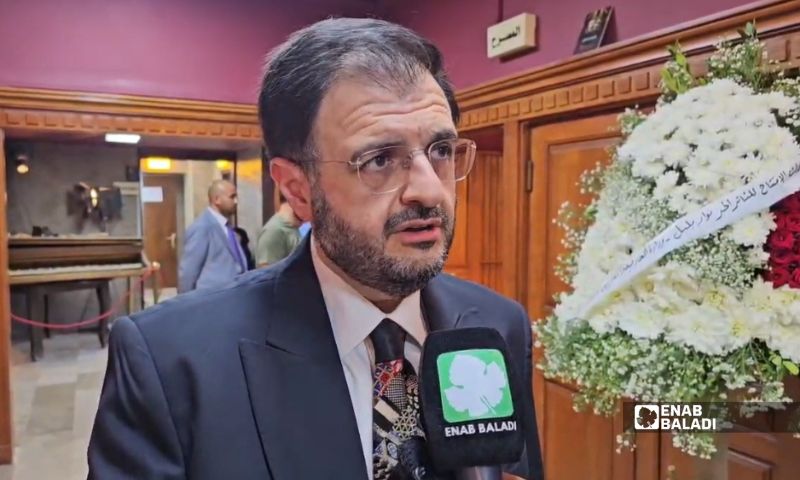
 Syrian Minister of Communications Abdul Salam Haykal, September 18, 2026. (Enab Baladi)
Syrian Minister of Communications Abdul Salam Haykal, September 18, 2026. (Enab Baladi)
Complaints are growing among residents across Syrian governorates over weak and uneven telecommunications and internet services, both on mobile networks and fixed internet connections. Some areas suffer from poor coverage, while others face slow internet speeds or repeated outages.
According to monitoring by Enab Baladi correspondents in several governorates, including Damascus and its countryside, Aleppo, Raqqa, Deir Ezzor, Daraa, and Latakia, the problem is not limited to one governorate. Most areas of Syria are experiencing declining service quality, including weak coverage, complaints of slow and intermittent internet, and the high cost of alternatives.
Minister of Communications and Information Technology Abdul Salam Haykal told Enab Baladi that achieving full coverage across Syrian territory will take about three years.
He explained that the ministry has improved network capacity and speeds and that work is continuing to expand networks.
Haykal noted, however, that the nature of the telecommunications sector means service levels vary depending on location and time. As a result, asking when “internet in Syria” will improve in general does not reflect the differences between one area and another.
The remarks come as part of a broader plan announced by the ministry to rebuild the telecommunications sector. Haykal said last February that the government was working to rebuild the sector from the ground up to improve internet quality and provide faster, more stable service.
Telecommunications and internet problems in Syria are not the same in every area, even within a single city. A subscriber in one neighborhood may have an acceptable connection and stable speeds, while another neighborhood may suffer from a weak signal or outages. Service quality can also vary within the same area from one street to another or at different times.
The communications minister said these disparities do exist and that the ministry is working to address them gradually, explaining that service improvements across Syria cannot be achieved all at once.
Service may improve in one area while remaining weak in another. Some areas have seen improvements, while service has deteriorated elsewhere because residents have returned and placed greater pressure on infrastructure, according to the minister.
Even when coverage is good outdoors, this does not necessarily mean it will be equally strong inside buildings.
The problem is particularly evident in large or enclosed buildings, such as hospitals, universities, theaters, and some residential complexes.
Haykal discussed a Distributed Antenna Systems project, known as DAS, for which the ministry has opened investment opportunities.
The project involves installing additional antenna systems at locations with weak coverage, using shared infrastructure that can serve more than one operator. This would help improve connectivity inside buildings rather than relying solely on external towers.
According to the minister, several companies have applied to participate in the project, and the ministry is working to issue the necessary licenses. Negotiations with telecom operators would then begin to install the additional antennas and provide coverage inside the targeted sites.
The plan to improve services is not limited to expanding mobile coverage. It also includes developing the infrastructure that carries internet and telecommunications traffic between different areas.
Among the ministry’s previously announced projects is “Silk Link,” which includes the construction of a unified national backbone network connecting Syrian regions, along with a route for international connectivity.
At the level of extending fiber connections to homes and businesses, the ministry is working on the “BARQ Net” project to deliver internet directly to subscribers through fiber-optic connections.
A new mobile operator is also entering the market. In June, the Ministry of Communications selected Zain Group for the second license to operate mobile telecommunications services in Syria. The regulatory authority said the commercial launch is expected within no more than six months of the license being granted, with commercial operations beginning in early 2027.
The authority says the project aims to expand coverage, improve service quality, and introduce 5G technology as part of a broader effort to modernize Syria’s telecommunications infrastructure.
if you think the article contain wrong information or you have additional details Send Correction


 A
A
A
A
A
A





 More Society