



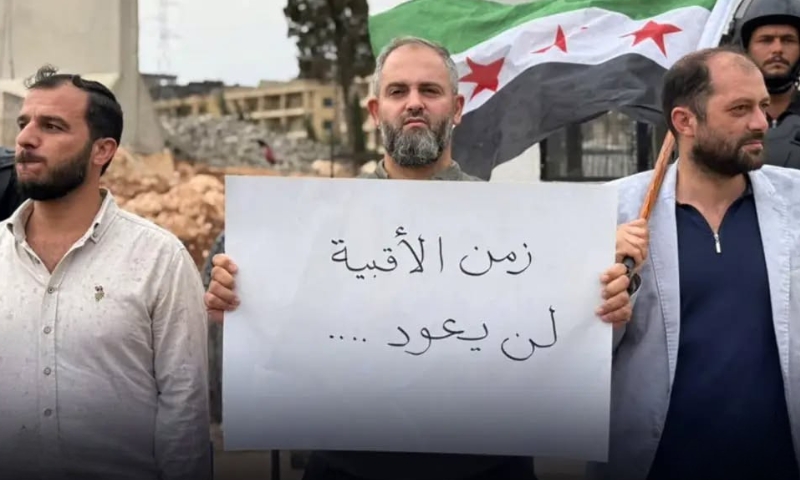
 Journalists and activists protest outside the Internal Security building in Aleppo, calling for action over detained media workers, August 29, 2026 (Al-Watan Online)


 A
A
A
A
A
A
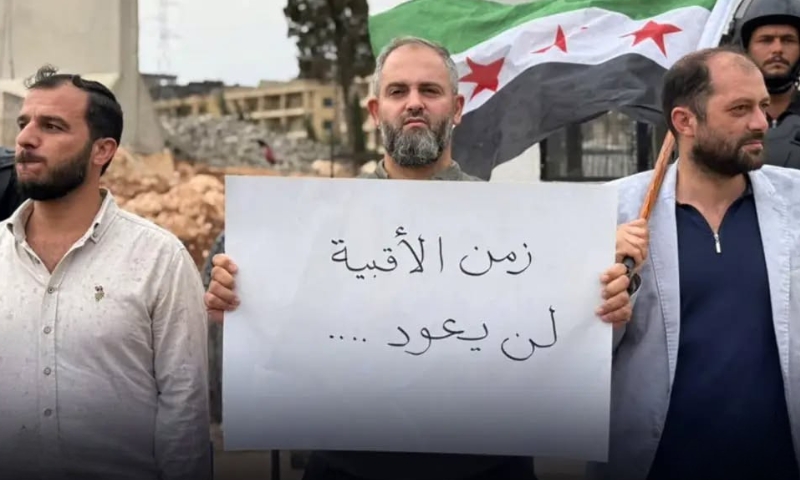
Amir Huquq | Odai al-Haj Hussin | Mohammad Deeb Bazzet | Mowaffak al-Khouja
With the fall of Bashar al-Assad’s government in December 2024, the issue of detention in Syria did not end. Instead, it entered a new phase, raising questions about how state institutions treat detainees, whether they comply with legal procedures, and whether practices associated for decades with the former government’s security agencies and prisons remain present in different forms.
During the transitional period, detention cases emerged that raised questions about what happens from the moment a person is deprived of liberty, through the conditions of detention and interrogation, to the detainee’s right to know the reason for the arrest and have access to a lawyer, as well as the family’s right to know the person’s location and fate.
These questions returned to the forefront after the death of Mohammad Ghamira last August, following his detention at al-Haffa Police Station in the Latakia countryside over a financial complaint. The Ministry of Interior said an investigation found that he had been slapped inside the station before his health deteriorated and he died in hospital.
In this investigation, Enab Baladi examines the current reality of arrest and detention in Syria through testimonies from former detainees and relatives of people in custody, as well as cases documented in several governorates. It also provides a legal examination of the procedures that are supposed to accompany arrest and interrogation, assesses the extent to which law enforcement bodies comply with them, and explores detainees’ right to a defense, procedures for notifying their families, and the reforms needed in the detention and justice systems to prevent violations from recurring.
Inside Police Stations: Testimonies on Detention and Interrogation
A detainee’s experience does not begin at the cell door. It starts from the moment of arrest, including the way the person is taken into custody, interrogated and treated, followed by the conditions of detention during the investigation.
Although these stages are supposed to be governed by clear legal procedures, testimonies collected by Enab Baladi from four former prisoners describe different experiences inside police stations in Aleppo, Quneitra and Rural Damascus. The former detainees spoke of overcrowding and difficult detention conditions, as well as, according to their accounts, beatings and torture methods during interrogation.
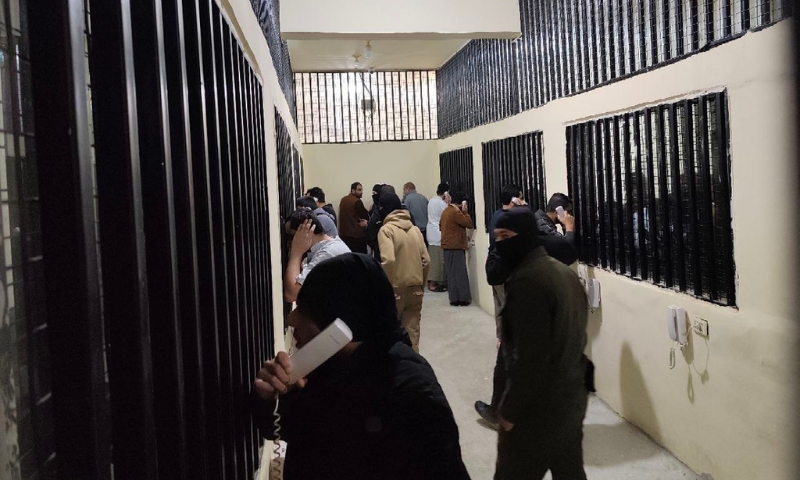
Families visit inmates at al-Aqtan Prison in Raqqa governorate, February 2, 2026 (Ministry of Interior)
Overcrowding Inside Cells
Two former prisoners, who asked not to be named for security reasons and out of fear of repercussions for speaking about detention conditions, described the period they spent together at a police station in Aleppo after they were arrested on allegations of resisting a patrol.
One of them said conditions in the cell were “very bad,” explaining that it held around 50 detainees at the same time, creating severe overcrowding.
He added that the large number of detainees affected sleeping arrangements. According to his account, newly arrived prisoners were forced to sleep next to the toilet because there was not enough space inside the cell.
He said the cell had lighting and fans, but described the living conditions as difficult because of the high number of detainees compared with the available space.
As for food, he said meals provided to detainees were acceptable and included potatoes with rice, while other meals consisted of rice and chicken.
Beatings During Interrogation
In addition to detention conditions, the two prisoners said they were beaten during interrogation.
One said the beatings included being struck with a hose and kicked, adding that he saw the other detainee being beaten in front of him.
According to his account, he was forced to remain in place and not lower his head while the person detained with him was being beaten, forcing him to watch the incident directly.
The second prisoner said he was also subjected to what he described as “falqa,” beating on the soles of the feet, during interrogation, adding that beatings were among the methods of treatment they faced during detention.
Methods Reminiscent of Saydnaya Prison
At another police station in Quneitra, southwestern Syria, a young man who asked Enab Baladi not to publish his name for security reasons said that during more than six months in investigative detention he was subjected to what he described as torture methods resembling those used at Saydnaya Prison, according to his account.
He said he was subjected to “shabah,” or suspension torture, flogging, electric shocks, “falqa,” kicking and beatings with a stick after another person filed a complaint against him. He said the police station did not verify the allegation before detaining him.
He added that the station refused to allow him to appoint a lawyer and did not show him a judicial warrant justifying his detention. He said practices associated, in his account, with the “prison mentality” under Bashar al-Assad’s rule continue to exist today.
“During more than six months in investigative detention, I was subjected to torture methods including shabah, flogging, electric shocks, falqa, kicking and beatings with a stick, based on an allegation the police station had not verified. The ‘prison mentality’ under Bashar al-Assad’s rule remains in place today.”
Former prisoner who said he suffered violations at a police station in Quneitra
The fourth prisoner said he was subjected to what he described as arbitrary arrest at a police station in Yabroud (Rural Damascus) following a report filed against him by another person.
According to his account, while in detention he was subjected to “shabah,” sprayed with water, kicked and beaten with hands. He said the treatment broke some of his teeth and caused bruises and fractures across parts of his body, in addition to discoloration covering his entire body.
He told Enab Baladi that the severe torture was intended to force him to confess to an act he had not committed.
After the accusation against him could not be substantiated, he left the police station and went to the Syrian Ministry of Interior, where he filed a complaint against the station. He accused its personnel of detaining him without a judicial warrant, torturing him without charge or evidence, and denying him the right to appoint a lawyer. He said the complaint produced no result.
The accounts of the four prisoners overlap in their claims that they were detained without being shown a judicial warrant, were not allowed to appoint a lawyer during the investigation, and were subjected, to varying degrees and in different forms, to practices they described as violations.
Alongside these testimonies, monitoring conducted by Enab Baladi in several governorates, including Damascus and its countryside, Quneitra, Aleppo, Hama and Latakia, found differences in detainees’ experiences concerning the manner of arrest, detention conditions, interrogation methods and treatment inside police stations, based on the cases tracked.
“Any violation or misconduct by Ministry of Interior personnel will be dealt with firmly in accordance with the applicable laws and procedures, and every offender will receive a just penalty, whoever they may be, once the investigations are completed.”
Syrian Interior Minister Anas Khattab after the Mohammad Ghamira incident
Limited Information About Detainees’ Fate
The consequences of detention do not stop with the person in custody. Families also experience anxiety during this period, particularly when the information they receive is limited to confirmation that a relative is being held by the authority that detained them, without details about the case, the investigation or how long the procedures may take.
Enab Baladi spoke with relatives of prisoners to examine what information reached families during detention and whether they were able to see and communicate with those being held.
A relative of a prisoner at a police station in Damascus declined to reveal his identity for security reasons and out of concern for his detained family member. He said the station contacted the family after their son was detained and informed them that he was being held there, allowing them to learn the location of his detention.
However, the communication did not include detailed information about the reasons for the detention, the nature of the investigation or the procedures their son was undergoing.
He added that he was unable to see him during the investigation after being told that a meeting would not be possible until the investigation was completed.
According to his account, family members were not directly mistreated, but their inability to see the detainee, obtain additional information about him or appoint a lawyer left them anxious throughout that period.
The mother of a prisoner at Adra Central Prison told Enab Baladi that her son was accused in theft and fraud cases, and said treatment of prisoners’ families was “inconsistent” and “dependent on the mood” of the personnel on duty. She said visiting times were not fixed and that she was sometimes prevented from visiting for various reasons.
She said she was not informed of the dates of her son’s court hearings, describing this as “unlawful government conduct.”
In Aleppo, the sister of a prisoner held at a city police station said the station informed her that her brother was in its custody after his arrest, allowing her to know where he was being held. She said, however, that the information available to her during the investigation remained limited.
According to her account, she had no clear picture of the details of the case or how long the procedures might take. She described the station personnel’s treatment of the family as “normal” and said she had not been directly mistreated.
For her, the main problem was not how she was personally treated, but the limited information available during the investigation. Knowing where the detainee was being held did not necessarily mean knowing what was happening to him or when the investigation would end, even though more than three months had passed since his arrest. Visits were not allowed during this stage, according to her account.
The absence of such information leaves families uncertain about detainees’ situation, whether they will be allowed to visit or contact them, and when that might become possible.
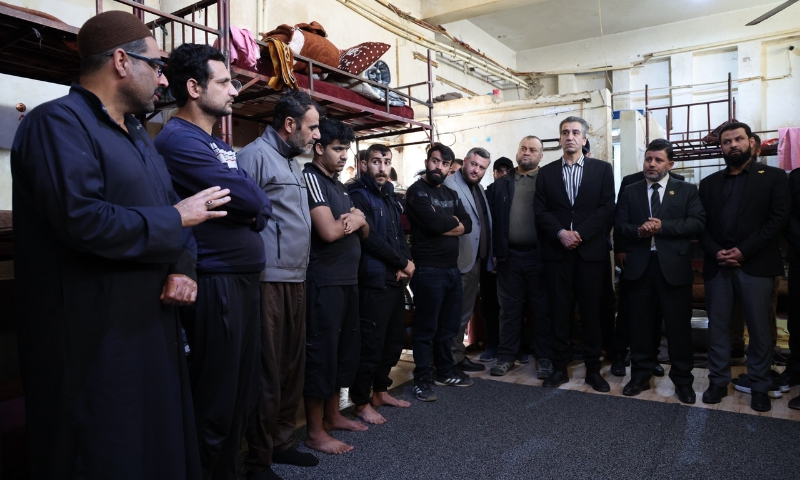
Syria’s Attorney General Hassan al-Turba visits a prison in Hasakah, April 21, 2026 (Ministry of Interior)
Law Enforcement Procedures: A “Wide Disparity”
Law enforcement bodies, including security and police forces, disregard a number of legal procedures when detaining defendants and suspects, ranging from arbitrary arrests and cases in which detainees’ whereabouts are not disclosed to, in some cases, preventing defendants from appointing lawyers to defend them.
Enab Baladi documented cases it described as arbitrary detention in which arrest warrants were not presented, while other detainees remained in detention facilities beyond the legal period without being brought before the judiciary.
These cases raise questions about the legal procedures applied in Syria and the extent to which law enforcement bodies follow them, issues Enab Baladi discussed with lawyers and specialists.
Enab Baladi contacted the media offices of the Ministries of Interior and Justice to ask about the applicable legal procedures, seek their response to these cases and ask what measures they have taken to monitor and stop such violations. Neither ministry had responded by the time this investigation was prepared.
Lawyer and legal expert Dr. Mohammad Sheikh Ibrahim said there was what he called a “wide disparity” between the legal framework as it is supposed to operate and its practical implementation during the pretrial stage, based on the laws in force in Syria and extending to the 2025 Syrian interim constitutional declaration.
Legal Detention Periods
Sheikh Ibrahim explained that judicial police, including police and security forces, are generally entitled to hold a detainee for 24 hours. In misdemeanor cases, the total period of pretrial detention is seven days and may be extended by a reasoned decision from an investigating judge, provided the total does not exceed 60 days unless the case has been referred to court or a new judicial decision justifies continued detention.
In felony cases, the initial period of pretrial detention is 15 days and may be extended by a reasoned decision from an investigating judge, provided that the combined periods of detention do not exceed six months.
Sheikh Ibrahim said the Syrian model is rigid in its approach to detention by the judicial police, allowing extensions without strict requirements governing the continuation of detention and, in practice, without judicial oversight or an effective legal provision controlling it.
He believes the solution lies in ensuring that imprisonment does not continue without judicial approval based on clear and specific conditions that cannot be subject to broad interpretation.
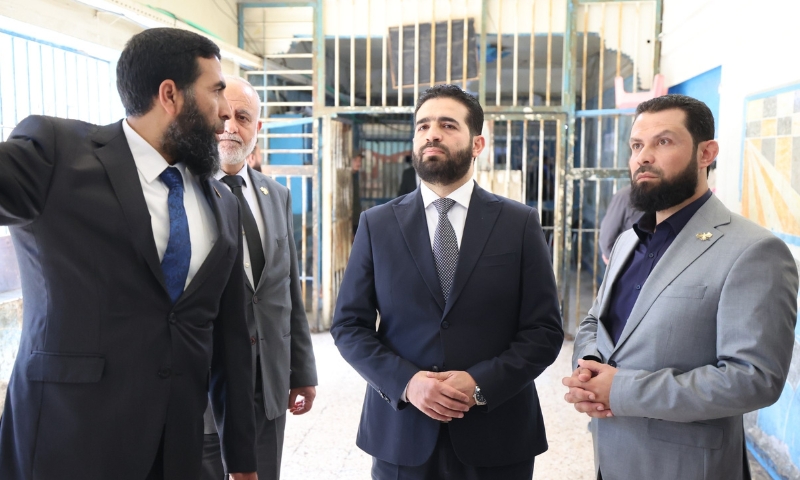
Interior Minister Anas Khattab visits Damascus Central Prison, June 8, 2026 (Syrian Ministry of Interior)
“Arbitrary” Arrest
The Syrian Network for Human Rights documented 141 cases of arbitrary arrest carried out by Syrian government forces during the first half of 2026, including two children and two women. It said 12 detainees, including one child, were later released during the same period.
In a statement published on July 2, the network said 19 of those cases, including the two children, were documented during the second quarter of 2026.
The network defines arbitrary arrest as depriving a person of liberty without a valid legal basis or in a manner inconsistent with safeguards provided under international law.
In a similar context, Enab Baladi documented cases in which security forces detained people without presenting an arrest warrant, which constitutes one form of arbitrary detention carried out outside the legal framework.
Flagrante Delicto as an Exception
As a general rule, judicial police may not detain a person without a warrant issued by the public prosecution or judiciary, except in cases defined by law as flagrante delicto, according to Sheikh Ibrahim. In such cases, police and security personnel may immediately arrest and take a suspect into custody, but must notify the public prosecution within 24 hours and hand over the detainee together with the official report.
Even in cases of flagrante delicto, homes may not be searched without judicial authorization, except in one situation, when a felony is committed inside the home, Sheikh Ibrahim said.
According to Sheikh Ibrahim, Syrian law limits warrantless arrests to cases of flagrante delicto and restricts judicial police when dealing with urgent situations in which waiting for authorization from prosecutors or the judiciary would create a risk from delay.
Modern legislation expands the authority for temporary detention when the original conditions for issuing a warrant are met and a delay could allow a suspect to escape or evidence to be lost, without requiring flagrante delicto.
However, such expanded authority is accompanied by immediate and strict judicial oversight. The detainee must be brought before the competent judge within a very short period, otherwise the detention becomes invalid.
The duration of detention is also subject to periodic review and may only be extended through a reasoned decision for a specified period.
For this reason, Sheikh Ibrahim believes Syrian lawmakers should move away from rigid rules and the absence of effective oversight guarantees. He argues that lawful detention should be expanded when necessary while subsequent judicial oversight is strengthened, rather than the reverse.
Subsequent Procedures Are Invalid
Detention without presenting a warrant issued by a competent authority, or without bringing the detainee before the competent judge within the legal time limit, is absolutely invalid and renders all subsequent procedures invalid, Sheikh Ibrahim said. Any confession or evidence obtained as a result should therefore be disregarded.
He believes such detention constitutes “a crime in itself,” falling under the offense of deprivation of personal liberty and potentially rising to the level of enforced disappearance, which is prohibited under the 2006 International Convention for the Protection of All Persons from Enforced Disappearance.
“European standards, particularly Article 5 of the European Convention on Human Rights, stress that detention is lawful only if its reasons are presented immediately and the detainee is brought before a judge within a very short period. Otherwise, the detention is considered arbitrary and requires compensation.”
Dr. Mohammad Sheikh Ibrahim
Lawyer and legal expert
Sheikh Ibrahim believes failure to present a warrant is not merely a procedural violation, but a fundamental infringement of the right to liberty and personal security that requires invalidation, compensation and criminal accountability.
Preventing Defendants From Appointing Lawyers
Regarding cases in which defendants are prevented from appointing lawyers to defend them, Sheikh Ibrahim stressed that such a measure is unlawful, saying there is no provision in Syrian law that permits it.
He said that even in state security crimes, the law does not permit an absolute ban.
In his view, preventing a lawyer from being appointed on the grounds that the defendant is still under investigation violates the right to a defense and renders the investigation invalid. It may also create disciplinary liability for the officer, personnel and prison director, and can be used as an indication of torture and arbitrary detention before international courts.
He described preventing a detainee from appointing a lawyer while in judicial police custody as more than an administrative violation, calling it a “compound violation” that undermines the integrity of the investigation from its foundation, opens the door to invalid confessions, and exposes those responsible to criminal accountability for unlawful deprivation of liberty or even enforced disappearance.
Sheikh Ibrahim said the Ministry of Interior issued a circular on a lawyer’s “silent attendance,” recognizing the lawyer’s right to attend judicial police interrogations but requiring the lawyer to remain silent and not intervene without permission.
Although the ministerial circular may appear to be a step forward, it remains only a formal safeguard unless the lawyer’s presence becomes effective and meaningful, and unless the lawyer’s absence results in the absolute invalidity of everything that follows, according to the legal expert.
Lawyer and human rights activist Abdalnasir Alomar Houshan, however, believes that a lawyer’s absence during the initial stage of security investigations does not, under his interpretation of the procedures, eliminate the detainee’s right to a defense. Rather, he said, it is connected to the nature and confidentiality of that stage.
He explained that the purpose is not to deprive detainees of their fundamental right to a defense, but to protect the course of justice and the confidentiality of information. He said leaking the name of a witness or suspect at this stage could harm efforts to establish the truth or undermine the entire investigation file, adding that such restrictions are lifted once the case moves into the ordinary, public judicial stage.
“The absence of a lawyer during the initial stage of security investigations does not mean that the detainee’s right to a defense has been eliminated. Rather, it is connected to the nature and confidentiality of this stage.”
Abdalnasir Alomar Houshan
Lawyer and human rights activist
“Sawtak Wasal”: Complaints That Went Nowhere
Some detainees’ families complain that they do not know the fate of their relatives, where they are being held or the reasons for their detention.
One prominent example is journalist Murad Mahalli, who has been held in Ministry of Interior prisons for more than eight months without being referred to the judiciary. Another is journalist Mahmoud al-Khatib, whose family and friends said he has been missing after being abducted more than a year and a half ago, without information about his location or the party that abducted him.
Journalists and activists held a protest outside the Internal Security Command building in Aleppo in late August, demanding that the fate of the two journalists be disclosed, that their rights be respected and their right to legal protection guaranteed, and that the fate of detainees and victims of enforced disappearance be revealed in accordance with the principles of justice and the rule of law.
Meanwhile, the Ministry of Interior introduced an electronic application called “Sawtak Wasal,” or “Your Voice Has Been Heard.” The ministry said the application’s purpose is to facilitate inquiries about travel bans, track detainees’ status, and submit and follow up on complaints through simple and secure steps.
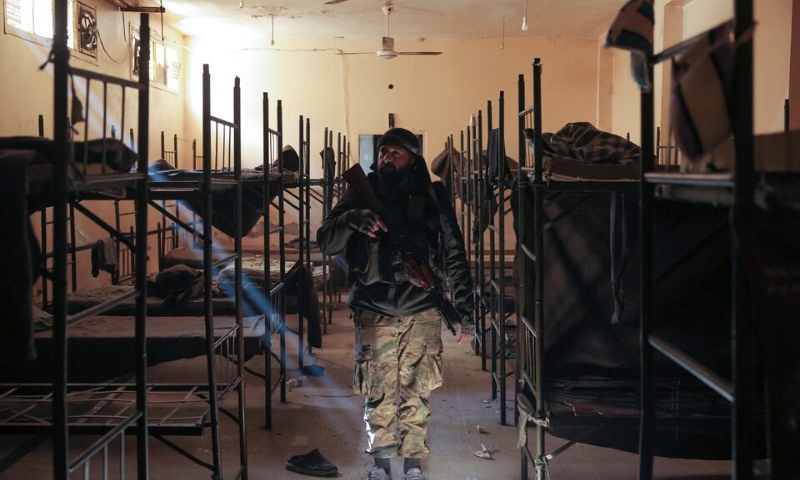
A security officer walks among empty beds in Homs Prison, December 21, 2024 (Reuters)
Between Structural Reform and Legal Reality
The testimonies collected by Enab Baladi reveal a gap between the procedures that are supposed to govern arrest and interrogation and the experiences former detainees describe inside some police stations.
As the discussion moves from individual cases to the mechanisms of arrest and detention, a central question emerges: Does addressing violations require rebuilding the legal and institutional system, or do existing laws already provide the necessary safeguards, with the problem lying instead in their implementation and the ability of institutions to enforce them?
Two different approaches emerge in diagnosing the causes of the problem. Bassam al-Ahmad, co-founder and executive director of Syrians for Truth and Justice, believes a fundamental part of the problem is the absence of a centralized national system documenting a detainee’s movement from the moment of arrest. Lawyer and human rights activist Abdalnasir Alomar Houshan, by contrast, believes the basic legal procedures have become “established principles” and that the main challenge is the shortage of personnel and implementation capacity in the face of the volume of cases.
A Centralized System or Dual Oversight?
For al-Ahmad, addressing arbitrary detention begins with knowing the detainee’s location and recording relevant information from the first moment. He therefore proposes creating a unified national platform shared by all authorities responsible for detention, with the law requiring the registration of every detainee’s information, including the date and time of arrest, the authority that carried it out, the legal justification and the place of detention.
Al-Ahmad believes protecting detainees begins by ensuring they are not kept outside official records, requiring the authority carrying out an arrest to provide a clear legal basis for it, informing the family of the detainee’s location, documenting the detainee’s health condition and guaranteeing the right to legal representation.
Houshan, by contrast, said that under applicable legal procedures detention takes place under the supervision of the public prosecution and pursuant to specific judicial warrants, including a summons warrant, detention warrant, and arrest and transfer warrant.
He added that under this framework, police do not have the authority to make detention decisions independently. Instead, they submit reports and the findings of investigations to the competent public prosecution, which decides whether to detain the person or release them.
The difference between the two views becomes clearer in cases where information about an arrest does not reach the family or official procedures are not clear to the detainee.
While Houshan denies the existence of secret prisons and believes current procedures have become clearer, al-Ahmad argues that failing to issue official documents confirming the presence of certain detainees, or preventing their relatives from visiting them, can reproduce a form of secret detention.
He cites the United Nations Standard Minimum Rules for the Treatment of Prisoners, known as the Nelson Mandela Rules, and Article 9 of the International Covenant on Civil and Political Rights to argue that protecting detainees from arbitrary detention and guaranteeing their ability to challenge the legality of their detention and contact a lawyer are fundamental safeguards that should not depend on the nature of the authority holding them.
Al-Ahmad stressed that addressing the prison issue cannot be separated from the transitional justice process. He argued that restricting the mandates of bodies concerned with missing persons and transitional justice to violations committed by the former government leaves room for new violations by different parties without clear mechanisms for accountability and reparations.
“Addressing the prison issue cannot be separated from the transitional justice process. Restricting the mandates of bodies concerned with missing persons and transitional justice to violations committed by the former government leaves room for new violations.”
Bassam al-Ahmad
Executive director of Syrians for Truth and Justice
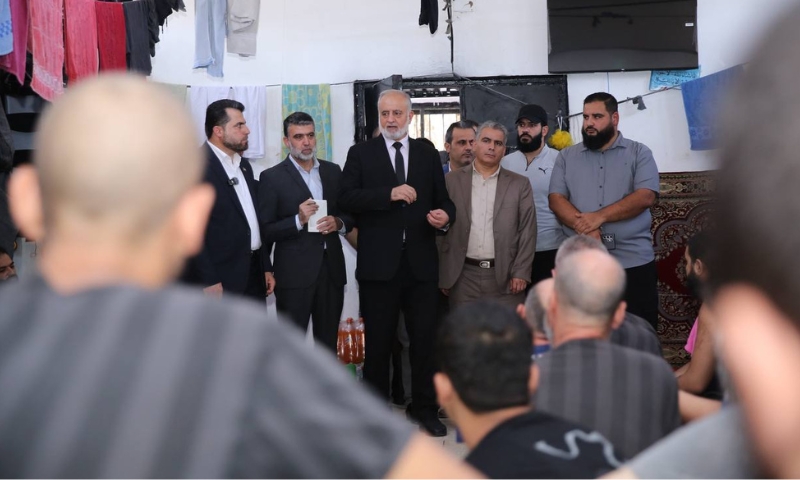
Damascus Attorney General Hossam Khattab conducts a field visit to Damascus Central Prison, August 8, 2026 (Ministry of Justice)
What Remains of the Former Government’s Legacy?
The disagreement also extends to the laws governing Syria’s criminal justice system. Houshan believes the basic laws, including the Penal Code and Code of Criminal Procedure, already contain fundamental legal principles and safeguards over which there is no substantive disagreement. Al-Ahmad, meanwhile, believes addressing violations requires a broader legislative review, bringing domestic laws into line with international obligations, and joining the Optional Protocol to the Convention against Torture.
At the same time, Houshan acknowledges that Syria’s penal system underwent transformations beginning in the 1960s, when the powers of security agencies expanded and exceptional legislation and courts emerged, culminating in Anti-Terrorism Law No. 19 of 2012 and the Terrorism Cases Court established under Law No. 22 of 2012.
He believes overcoming this legacy begins with repealing exceptional legislation and stripping security agencies of judicial police powers, while retaining the basic rules of criminal law and applying them correctly.
Al-Ahmad, however, believes changing the legal texts alone is insufficient. He argues that the real test is whether there is political will and whether institutions are capable of preventing violations and holding those responsible accountable, rather than relying solely on committees or procedures that produce no concrete results.
“The real test lies in the existence of political will and institutions capable of preventing violations and holding those responsible accountable, rather than relying solely on committees or procedures that produce no concrete results.”
Bassam al-Ahmad
Executive director of Syrians for Truth and Justice
Between Staff Shortages and Rebuilding the System
The difficulty of implementing these procedures is also evident in the volume of cases facing judicial and security institutions. Houshan said the number of cases and detainees referred to the judiciary had reached, according to his estimate, around 10,000 files and detainees, while the number of investigators and judges remains insufficient, slowing the handling of investigations.
He said files continue to be reviewed and groups of detainees whose guilt has not been established are released periodically, with each group numbering between 50 and 100 people. He added that work is underway to appoint new judges to speed up the processing of cases.
“The number of cases and detainees referred to the judiciary has reached around 10,000 files and detainees, while a shortage of investigators and judges has slowed the handling of investigations.”
Abdul Nasser Houshan
Lawyer and human rights activist
Al-Ahmad, by contrast, believes addressing these challenges should not be limited to increasing the number of judges and investigators. He argues that it requires restructuring the penal system and establishing independent oversight mechanisms with the authority to conduct unannounced inspections of places of detention.
He stressed that the prohibition of torture and inhumane treatment must apply to all detainees without discrimination, and that committing a crime or being under suspicion does not eliminate a person’s right to a fair trial and humane treatment.
“The prohibition of torture and inhumane treatment must apply to all detainees without discrimination.”
Bassam al-Ahmad
Executive director of Syrians for Truth and Justice
Reform Begins at the Moment of Arrest
The two approaches place the prison issue on different tracks when identifying the source of the problem. Houshan focuses on enforcing existing laws, eliminating exceptions, and increasing human and institutional capacity to implement them. Al-Ahmad advocates broader reform encompassing legislation, documentation, oversight and accountability.
Between these two approaches, the moment of arrest emerges as a central test for any future reform. Who has the authority to order an arrest? Where is the arrest recorded? Does the detainee know why they have been deprived of liberty? When can they seek the assistance of a lawyer? When does their family learn where they are and what has happened to them? And who monitors how they are treated inside the place of detention?
These questions extend beyond prison conditions themselves to the ability of the legal and institutional system to ensure that powers of arrest and interrogation do not become an area beyond oversight and accountability. This makes prison reform inseparable from reforming the justice system and the institutions responsible for law enforcement as a whole.
if you think the article contain wrong information or you have additional details Send Correction
النسخة العربية من المقال
-
Follow us :






 More In-Depth