


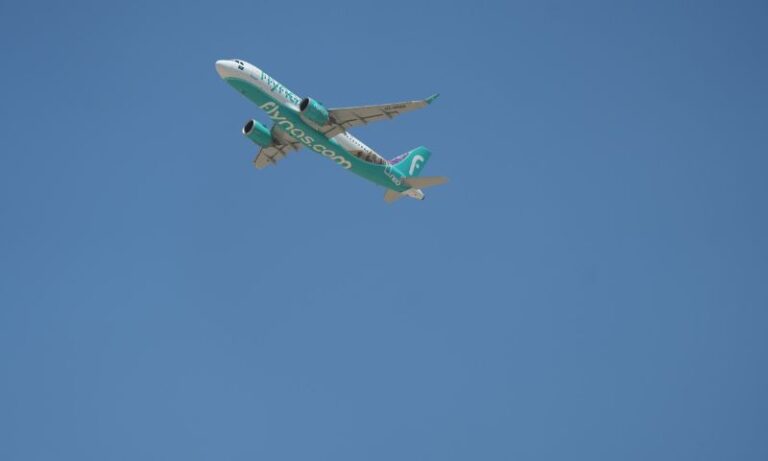
 A Flynas aircraft over Damascus, July 28, 2026. (Syrian General Authority of Civil Aviation)
A Flynas aircraft over Damascus, July 28, 2026. (Syrian General Authority of Civil Aviation)


 A
A
A
A
A
A
The General Authority of Civil Aviation and Air Transport announced on Monday, August 3, that Syrian airspace recorded 20,315 aircraft crossings in July, indicating continued rapid growth in air navigation and transit traffic through the country’s airspace.
The figure represents a major jump compared with May, when 11,801 aircraft crossed Syrian airspace, meaning transit traffic rose by about 72% in just two months. The pace reflects growing reliance by international airlines on Syrian air corridors.
The figures show a rapid surge in overflight traffic. In May 2025, only 2,468 flights crossed Syrian airspace, rising to 11,801 in May 2026, an increase of more than 378%, General Authority chair Omar al-Husari previously told Enab Baladi.
Traffic continued to rise, reaching 20,315 flights in July 2026, an additional increase of about 72% compared with May of the same year and an overall rise of more than 720% from one year earlier. The pace underscores the transformation of Syrian airspace into a major international corridor.
Al-Husari previously said the final days of May saw a further increase in traffic after several international flights were redirected to alternative routes passing through Syrian airspace, “reflecting growing confidence in Syrian airspace and the efficiency of the air navigation services provided there.”
He added that the increase was concentrated on air routes linking Europe with the Gulf states and Europe with Asia, in addition to several flights bound for the Middle East.
The increase was not limited to overflights, as air traffic indicators at Syrian airports show broader growth in operational activity.
In May, Damascus International Airport handled 1,532 flights carrying 148,305 passengers, while Aleppo International Airport handled 412 flights carrying 40,451 passengers. The figures reflect the continued recovery of international and domestic air transport alongside growth in transit traffic.
A report published by Reuters said the reopening of Syrian airspace following the latest ceasefire had significantly altered international flight routes, generating direct financial returns for Syria.
According to the report, Syrian authorities charge a fixed fee of $499 for every flight crossing the country’s airspace, comprising a $430 overflight fee and a $69 communications fee, regardless of the aircraft’s type or size.
Based on these estimates, the transit traffic recorded in July could generate monthly revenue approaching $10 million, compared with about $5.9 million in May, representing a sharp increase in state revenue from the civil aviation sector.
The Reuters report noted that most flights traveling from Dubai and Doha, two of the world’s largest aviation hubs, to Europe now pass through Syrian airspace instead of Iraqi airspace. The finding was based on flight tracking data provided by platforms including Flightradar24 and AirNav Systems.
The new route reduces flight times and fuel consumption as airlines seek to limit the effects of higher oil prices caused by disruptions linked to regional tensions.
Under the former regime, Syria charged $75 for smaller aircraft, or about $1 to $1.25 per metric ton for larger aircraft, according to OPSGroup, which specializes in monitoring aviation risks.
Official documents also included special exemptions, including a 50% reduction for domestic flights and locally registered aircraft, and full exemptions for aircraft carrying heads of state and official delegations, as well as search and rescue operations.
Economist Majdi al-Jamous told Enab Baladi that Syria is currently seeking to revive its aviation sector amid regional, Arab, and international engagement after years of decline during the war. He said recent regional developments had increased the use of Syrian airspace as an aviation corridor because flight routes had changed, estimating that overflight traffic had risen by about 400% compared with last year.
Al-Jamous, however, played down the current economic impact of the increase, saying estimated monthly revenue of about $6 million to $7 million “remains limited and does not have a major effect on the national economy,” especially compared with countries that have extensive aviation infrastructure.
He warned that overflight traffic remains directly tied to political and regional conditions, noting that any understandings between the United States and Iran could lead flights to return to Iranian airspace, reducing traffic over Syria.
He said developing the sector requires advanced infrastructure, expanded agreements with international airlines, improved fleets and airports, and regional and security stability to turn Syria into an attractive and sustainable air corridor.
The figures reflect the continued recovery of Syria’s civil aviation sector and reinforce the country’s position as a vital aerial gateway connecting regional and global air routes, amid expectations of further growth in the coming months as stability continues to return to the region.
if you think the article contain wrong information or you have additional details Send Correction





 More Economic Reports