


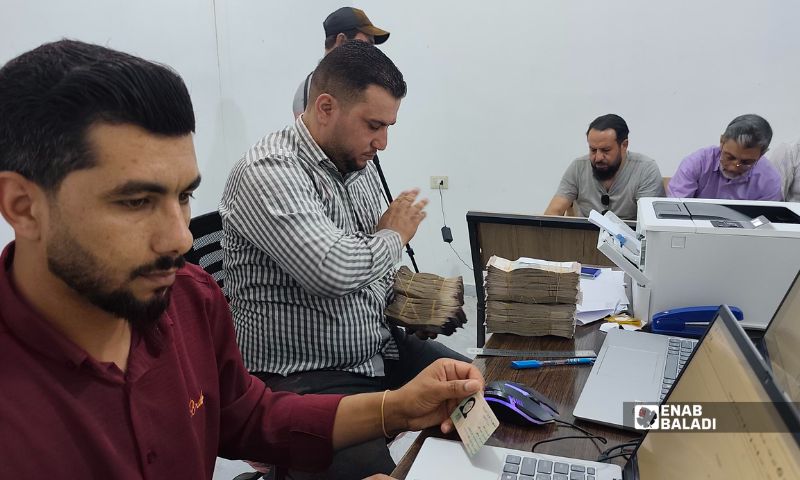
 Employees at the Raqqa Postal Directorate exchange old Syrian currency on July 16, 2026. (Enab Baladi/Ahmed al-Hamdi)
Employees at the Raqqa Postal Directorate exchange old Syrian currency on July 16, 2026. (Enab Baladi/Ahmed al-Hamdi)
Exchange rates for the old Syrian currency against the US dollar are fluctuating in Raqqa governorate (northeastern Syria), amid a shortage of authorized currency exchange centers. The lack of exchange services is making it more difficult for residents to replace their money and disrupting activity in local markets.
The US dollar traded at around 20,000 old Syrian pounds, while the exchange rate for the new Syrian pound stood at approximately 130 pounds to the dollar, equivalent to around 13,000 old pounds.
The disruption has fueled frustration in Raqqa’s markets because the new currency remains scarce, slowing sales and purchases and reducing commercial activity across the governorate.
Central Bank of Syria Governor Mohammad Safwat Raslan announced that the deadline for withdrawing the old Syrian currency in Deir Ezzor, Raqqa, and Hasakah governorates had been extended until August 20. Withdrawals are being conducted through Central Bank branches and authorized Syrian Postal Corporation outlets.
Some residents have been forced to go to al-Mansour Street in Raqqa city to exchange their old currency for US dollars after losing hope of completing the process at the Raqqa postal branch because of severe overcrowding and their inability to secure a place in line.
Resident Ahmed al-Khalil said he went to al-Mansour Street, which is known for its currency exchange and money transfer shops, to exchange his old currency for dollars. He was surprised by the rate offered, with one exchange dealer demanding 2 million old Syrian pounds for $100.
Al-Khalil told Enab Baladi that he had gone to the Raqqa Postal Directorate after the currency exchange deadline was extended, but was unable even to register for a place in line. He described the situation as “bad.”
The number of currency exchange centers recently opened in Raqqa governorate is insufficient, according to al-Khalil.
“We have been unable to get rid of the old currency, and Raqqa governorate is now facing a suffocating crisis,” he said, noting that market activity had almost completely stopped.
He added that dozens of Raqqa residents and shopkeepers interviewed by Enab Baladi said buying and selling had nearly ground to a halt because the new currency was unavailable and most sellers were refusing to accept the old currency.
Raqqa’s markets are experiencing confusion and growing public anger, according to Enab Baladi’s observations, as several traders and shopkeepers refuse to accept the old currency in daily transactions. The situation has been compounded by the steep discount imposed on the old currency when it is exchanged for US dollars.
The city of al-Sabkha, in the eastern Raqqa countryside, witnessed a protest outside its postal center because currency exchange services were unavailable, despite a decision to open the center and begin exchange operations there.
Resident Hilal al-Saleh said Raqqa governorate was facing a major financial crisis and that the shortage of the new currency had brought market activity to a halt. He stressed that the government must find a solution, regulate the markets, and prevent currency exchange shops from exploiting residents.
Al-Saleh described the exploitation of residents during the crisis as a “crime,” noting that the US dollar exchange rate against the old Syrian pound had risen by more than 50%.
He called on the relevant authorities in Raqqa governorate to regulate exchange rates, strengthen oversight of currency exchange shops, open additional currency exchange centers, and further extend the exchange deadline.
The Criminal Investigation Branch also carried out a security campaign targeting currency exchange and money transfer offices in Raqqa city to address violations related to the currency exchange process.
The campaign led to the arrest of three exchange dealers accused of exploiting residents and manipulating exchange rates through transactions involving the old currency.
Security authorities are continuing to monitor the markets, document similar violations, and refer those involved to the judiciary, according to a report by Syria’s al-Ikhbariya on the evening of Tuesday, August 4.
if you think the article contain wrong information or you have additional details Send Correction


 A
A
A
A
A
A



 More Economic Reports