


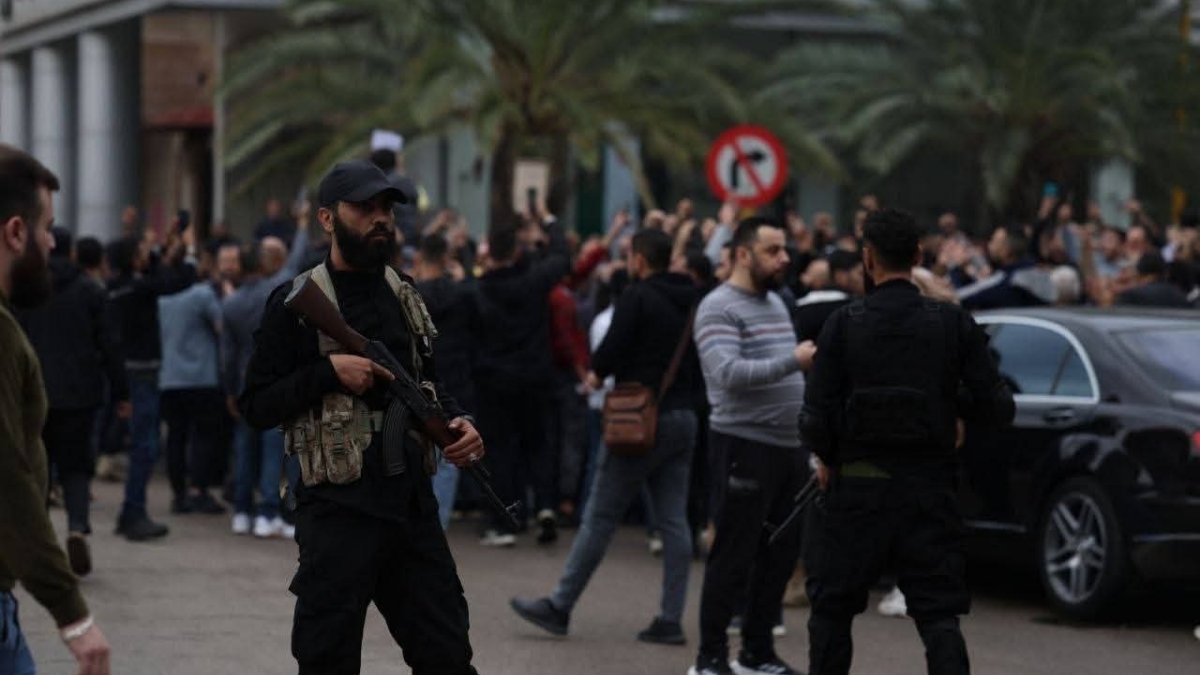
 Wide deployment of Internal Security Forces at main protest sites in Tartus, 25 November 2025 (Tartus Governorate/Facebook)
Wide deployment of Internal Security Forces at main protest sites in Tartus, 25 November 2025 (Tartus Governorate/Facebook)
Cities and rural areas in the provinces of Latakia and Tartus, parts of the western Hama countryside, and al-Ghab Plain (in northwestern Hama in central Syria) saw demonstrations in main squares and gathering points at noon today, Tuesday, 25 November.
Protesters raised slogans calling for an end to killing and for “federalism,” along with demands to release detainees arrested after the fall of the former regime. They carried placards with demands and slogans such as “administrative decentralization,” “no to terrorism,” and “no to uncontrolled weapons,” according to widely circulated video footage.
The Syrian Interior Ministry said that Internal Security units worked to secure the protest gatherings in the Syrian coastal areas, in order to prevent any incidents “that could be exploited by actors who promote chaos,” as it put it.
The demonstrations came in response to a call issued by Sheikh Ghazal Ghazal, head of what is known as the “Supreme Alawite Islamic Council in Syria and the Diaspora,” on Monday, 24 November.
One demonstration set out from the Agriculture Roundabout in the city of Latakia, with another at al-Azhari Roundabout and al-Hammam Square, amid strict security measures, in addition to sit-ins in the al-Qusur neighborhood in the city of Baniyas (on the Syrian coast in Tartus province), which witnessed deadly events last March.
The cities of Jableh (south of Latakia), Qardaha (in the Latakia countryside), Safita (in the eastern countryside of Tartus), Dreikish, Sheikh Badr (both in Tartus countryside), and their surrounding rural areas also saw sit-ins denouncing “the killing of Alawites” and calling for “the human right to live in safety and dignity,” according to the chants. Protesters additionally called for the withdrawal of uncontrolled weapons from some groups and for all arms to be restricted to the government, as they put it.
The number of demonstrators gradually declined about two hours after the protests began at noon on Tuesday, due to the weather conditions and heavy rain in these areas.
Meanwhile, government supporters in Jableh and Baniyas held demonstrations backing Syria’s transitional president Ahmed al-Sharaa and his government. Internal Security forces, which were present in large numbers, cordoned off all protest sites, in what was said to be a step aimed at “protecting the demonstrators and the public.”
Authorities in Tartus province issued a statement denying reports circulating on some social media platforms that the statue of Sheikh Saleh al-Ali had been removed or toppled in the wake of tensions linked to the recent protests. They confirmed that the statue remains in place without any change, and called on people to verify information before publishing it and not to contribute to spreading rumors.
The Syrian Interior Ministry appealed to residents of the coastal region not to be drawn into what it called “schemes whose only aim is to drag the region into a spiral of instability,” in its words.
Ministry spokesperson Nour al-Din al-Baba told the state-run al-Ikhbariya TV channel that “the Interior Ministry safeguards everyone’s right to express their opinion, provided that expression takes place within the framework of the law and without disturbing civil peace.”
He added that “the actors who promote and market chaos in the coastal areas are all based abroad and detached from the living reality of people on the coast.”
Al-Baba continued, “The chanting of sectarian slogans in some gatherings reveals the purpose on which the calls were based, and it does not reflect the real demands that our people on the coast are seeking.”
He stressed that the Syrian state is the only guarantor of the demands of all Syrians, and that these demands cannot be addressed through scenarios of chaos and calls whose motives the people of the coast are well aware of.
In February, a group of members of the Alawite community in Syria and the diaspora announced the formation of the “Supreme Alawite Islamic Council.” According to its founding statement, the Council is made up of two main bodies:
if you think the article contain wrong information or you have additional details Send Correction


 A
A
A
A
A
A


 More Politics