


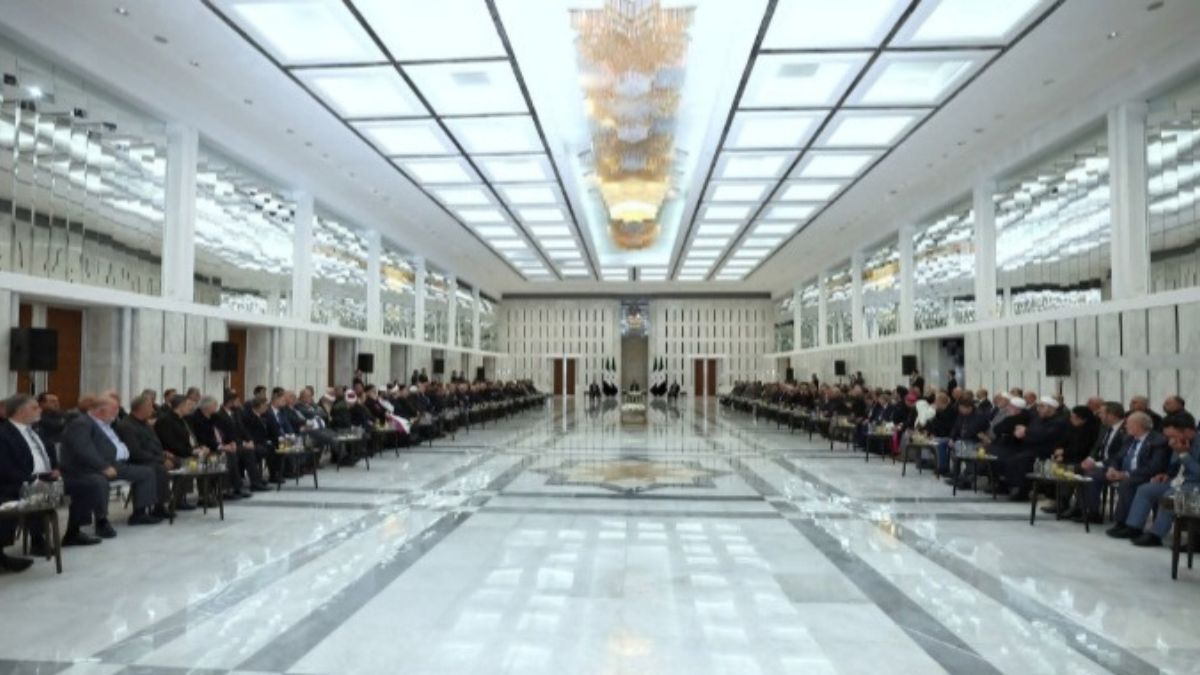
 From the meeting of transitional president Ahmed al-Sharaa with representatives from Latakia and Tartus governorates at the People’s Palace, 13 December 2025 (Syrian Arab Republic Presidency).
From the meeting of transitional president Ahmed al-Sharaa with representatives from Latakia and Tartus governorates at the People’s Palace, 13 December 2025 (Syrian Arab Republic Presidency).
Syrian transitional president Ahmed al-Sharaa met on Saturday, 13 December, at the People’s Palace in Damascus with local notables and community leaders from Latakia and Tartus (on Syria’s Mediterranean coast), in the presence of Latakia Governor Mohammad Othman and Tartus Governor Ahmed al-Shami, according to a statement by the Syrian Arab Republic Presidency.
During the meeting, al-Sharaa said that “Syria is entering a new phase of rebuilding the state on the basis of stability and popular participation,” stressing that “the state harbors no exclusionary or retaliatory tendencies toward any component,” and that Syria is a state of citizenship that guarantees justice and safeguards the rights of all Syrians.
Attendees, for their part, underscored the importance of strengthening civil peace and the rule of law. They also raised the need to prepare an investment map for the coastal region to support development and create job opportunities, according to the presidency.
The Syrian president had chosen Latakia as his first visit after the first anniversary of “liberation” and following the lifting of Caesar Act sanctions, to meet local residents, hear their demands, and clarify several issues.
Multiple informed sources familiar with the meeting said it was “positive, advanced, and marked by bold proposals and demands,” lasting around two hours.
According to the sources, those present rejected remarks previously made by Interior Ministry spokesperson Nour al-Din al-Baba about Sheikh Saleh al-Ali. The remarks, the sources said, had been made before the current authorities arrived in Damascus, and were recently leaked on social media.
Representatives of residents also condemned the government’s recent narrative on the case of abducted women, including describing them as “mistresses,” stressing that cases of women being abducted have occurred along Syria’s coast.
The sources also said there were calls to release military personnel held in prisons in Hama (central Syria), Harim (northwestern Idlib province), and Afrin (northwestern Aleppo countryside), as well as those who returned from Iraq after the fall of the former regime.
Participants raised what they described as severe economic hardship affecting members of the Alawite community on the coast, and called for halting job terminations they say have targeted them. They said dismissals have continued in various forms for public-sector employees and contractors, urging the reinstatement of those removed from their jobs.
The sources said al-Sharaa promised to release large groups of detainees whose hands “are not stained with blood,” adding that the number could reach 1,200 officers and soldiers within the next ten days, or before the end of this year. The release of the remaining detainees whose hands “are not stained with blood,” would then continue in batches.
On job terminations, the sources said al-Sharaa pointed to a restructuring of public employment and government labor, adding that those dismissed could file objections if they believe they were wronged, expressing hope that no one would be treated unjustly.
The sources also said the president raised the issue of federalism and decentralization, saying that while some are making such demands, work is underway on a major project for Syria’s coastal region that would link east and west, under European Union supervision. He called on all components of society to unite and cooperate to ensure the project’s success.
A delegation representing the city of Jableh (a coastal city south of Latakia) and its countryside also presented a paper containing residents’ demands on various issues.
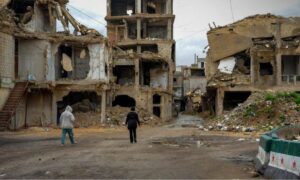
Al-Sharaa also spoke about the reconstruction phase, rehabilitating areas damaged by bombing by the former regime, facilitating the return of displaced people from camps, and improving infrastructure in the Kurdish Mountain and the Turkmen Mountain (in northern Latakia countryside).
On 25 November, cities and rural areas in Latakia and Tartus, along with parts of western Hama countryside and the al-Ghab Plain (in western Hama), saw peaceful demonstrations in main squares and gathering points.
Protesters chanted slogans calling for an end to killing and for “federalism,” alongside demands to release detainees arrested after the fall of the former regime. Signs and banners carried messages such as “administrative decentralization,” “no to terrorism,” and “no to uncontrolled weapons,” according to circulated videos.
At the time, Syria’s Interior Ministry said internal security units worked to secure the protest gatherings in the coastal region to prevent any incidents that “could be exploited by parties promoting chaos,” as it put it.
The demonstrations came in response to a call by Sheikh Ghazal Ghazal, head of the so-called “Alawite Islamic Supreme Council in Syria and the diaspora.”
if you think the article contain wrong information or you have additional details Send Correction


 A
A
A
A
A
A


 More Politics