


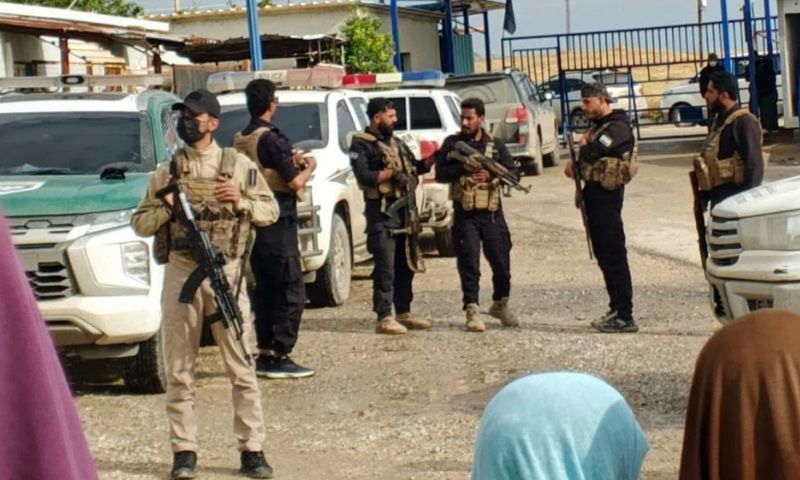
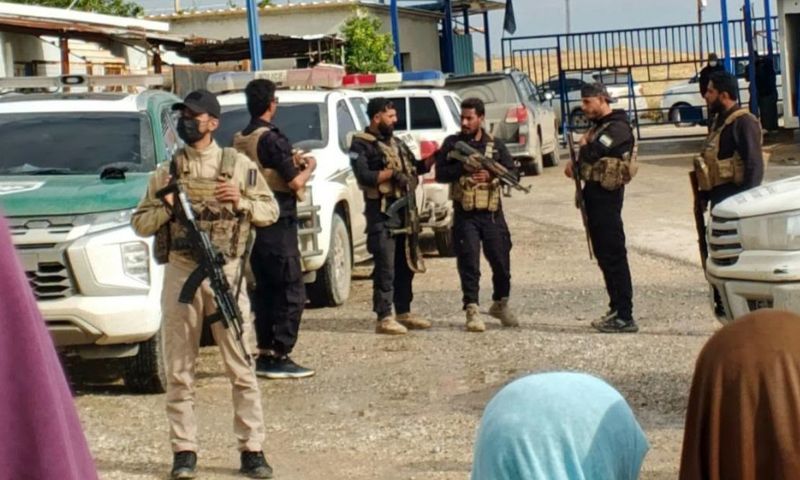
 Syrian Internal Security Forces inside Roj camp, November 7, 2026 (al-Hasakah FM)


 A
A
A
Syrian Internal Security Forces entered Roj camp near al-Malikiyah in northeastern al-Hasakah governorate (northeastern Syria) and began moving a group of Somali and Sudanese women and children out ahead of their repatriation, in coordination with their countries’ embassies in Damascus.
The move comes amid calls to resolve the situation at the camp, which houses family members of Islamic State fighters, and growing reports of escapes and smuggling operations in recent weeks.
Ibrahim Haji al-Halabi, a media activist from al-Hasakah, told Enab Baladi that Internal Security Forces had moved a group of Somali and Sudanese women and children out of the camp under Syrian government supervision, in preparation for their return to their countries.
Haji added that the operation was coordinated with the relevant embassies in Damascus. He said a government Internal Security delegation had met several women living in the camp on Saturday, November 7, learned about their conditions and listened to their demands.
Syrian Internal Security Forces entered Roj camp on November 7, marking a development concerning its administration. The camp had been administered for years by the Syrian Democratic Forces (SDF), before the group’s dissolution as part of the restructuring of military and security institutions in northeastern Syria.
Roj camp houses around 2,200 people from approximately 729 families, according to figures reported by Agence France-Presse (AFP) in October, citing camp official Hakmieh Ibrahim.
Residents hold more than 50 nationalities. Russians make up the largest group, alongside French, German and Turkish nationals, as well as citizens of Arab countries including Tunisia and Morocco. The camp also houses women and children of other nationalities.
Roj is one of the main sites housing family members of Islamic State fighters in northeastern Syria, after al-Hol camp, which previously held larger numbers of families linked to the group. Women and children make up the main population at Roj, while their legal circumstances vary according to their nationalities and individual cases, particularly as some countries have not repatriated their citizens despite their years in detention.
In July, the camp administration announced the transfer of two Tunisian families comprising four women and children to Damascus and Idlib (northwestern Syria), after completing the legal and administrative procedures. The administration said at the time that the operation did not mark the start of a broader plan to repatriate foreign nationals. This reflected how departures and returns were being handled separately, depending on the arrangements available for each nationality.
The latest government moves coincide with recent security developments at the camp, most notably the escape of Norwegian national Aisha Kausar, 35, who had been living there with her son.
Norwegian media reported on November 3 that Kausar had managed to leave the camp in October with the help of smugglers, according to information the Norwegian Broadcasting Corporation (NRK) obtained from the camp administration.
Kausar faces charges of involvement in the armed attack that targeted an LGBTQ district in the Norwegian capital, Oslo, on the night of June 25, 2022, killing two people and injuring 21 others.
She left Norway for Syria in 2014 and was later detained in Roj camp. Available information did not establish whether her son had left with her.
Her escape carries additional significance given the nature of the charges against her and the camp administration’s account that she left through smuggling networks rather than official repatriation procedures. The incident also renews questions about the authorities’ ability to monitor residents’ movements and prevent unauthorized departures.
Concerns extend beyond this incident. The camp has recently witnessed tensions, protests and confrontations between some female residents and guards, amid competing accounts of the causes. Some accounts describe escape attempts and acts of vandalism, while others accuse guards of mistreating women and children.
In September, reports documented rising tensions inside the camp, conflicting accounts of events and accusations exchanged between activists and the camp administration. Claims also circulated that phones were being smuggled into the camp in exchange for money. These claims appeared in activists’ accounts and could not be independently verified.
Lawyer Youssef Khalaf told Enab Baladi that resolving the situation at Roj camp had become necessary, given the presence of hundreds of family members of Islamic State fighters, most of them foreign nationals, and the security, legal and humanitarian challenges associated with their continued presence there.
Khalaf said the dissolved SDF’s continued administration of the camp, despite the changes in the region, raised questions about which authority bore legal and administrative responsibility for its residents. He noted that the camp housed people of different nationalities whose cases required an official authority capable of communicating with the countries concerned and taking responsibility for following up on procedures.
He added that the camp had witnessed several protests and confrontations in recent weeks, reflecting the complexity of its administration and making the continuation of the current situation without a comprehensive response a source of further problems. The presence of large numbers of women and children whose families were linked to Islamic State required an approach extending beyond routine security measures toward clear legal solutions governing their status and determining their future, he said.
Khalaf said reports of people being smuggled out of the camp had increased recently while it remained under the control of a force he described as “dissolved and lacking legal status.” He argued that the absence of a clearly designated official authority to administer the camp raised questions about responsibility for security and monitoring entry and exit.
The lawyer linked the need to resolve the issue to recent developments. Escapes from the camp, including that of a woman accused in a terrorism case outside Syria, highlighted the risks of persistent security gaps in its administration. The range of nationalities also made it difficult to address the issue through unilateral local measures without coordinating with residents’ countries of citizenship.
According to Khalaf, addressing the issue requires identifying the Syrian authority responsible for administering the camp and establishing a mechanism for handling residents’ cases, alongside contacting foreign embassies and governments about repatriating their nationals and completing the legal procedures for each case. This does not mean all residents can be repatriated at the same pace. Their circumstances differ, with return arrangements available for some, while others’ countries continue to refuse to receive them or have yet to decide whether to repatriate their citizens.
The entry of Internal Security Forces into the camp comes amid changes in northeastern Syria following agreements to integrate the Autonomous Administration’s civilian and military institutions into Syrian state institutions.
The region’s security and administrative institutions were among the issues addressed in the integration process. However, responsibilities have not been transferred simultaneously across all sectors because of differences in the nature of the institutions and the matters they handle.
Roj camp is a particularly sensitive issue because of its links to fighters’ families, the presence of foreign nationals and the resulting responsibilities that extend beyond local administration.
if you think the article contain wrong information or you have additional details Send Correction








 More Politics