


 Syrian Defense Minister Major General Murhaf Abu Qasra meets a military delegation from the Russian Federation headed by Deputy Defense Minister Yunus-Bek Yevkurov, 16 November 2025 (Syrian Defense Ministry / X)
Syrian Defense Minister Major General Murhaf Abu Qasra meets a military delegation from the Russian Federation headed by Deputy Defense Minister Yunus-Bek Yevkurov, 16 November 2025 (Syrian Defense Ministry / X)
A Syrian source close to the Syrian government told the Israeli Public Broadcasting Corporation (Kan) that Moscow has, over recent months, submitted a proposal to Damascus for Russian patrols to return to the border area, to act as a separation force between Syrian and Israeli troops.
According to the source, the Syrian government has so far not agreed to the Russian government’s request, and the proposal remains under discussion.
Another Syrian source indicated that including a Russian presence in southern Syria within any potential security understanding between Damascus and Tel Aviv is not unlikely, especially as political contacts between the Russian and Israeli sides have intensified.
Israeli Prime Minister Benjamin Netanyahu discussed ways to establish stability in Syria with Russian President Vladimir Putin, according to a report by the television channel Russia Today on 15 November.
Israel had previously not expressed objections to Moscow’s influence in Syria, and Russian forces had already been deployed at eight military points in the “disengagement zone” area, along the border between the occupied Syrian Golan Heights and Quneitra province (southern Syria) in October 2024.
A joint delegation from the Syrian and Russian defense ministries conducted a field tour on 17 November, which included several military positions and sites in southern Syria.
The visit aimed to review the situation on the ground as part of ongoing cooperation between the two sides, according to the state-run Syrian Arab News Agency (SANA).
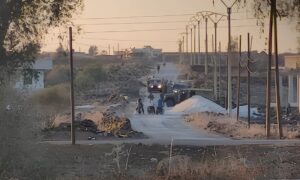
A source from Quneitra province (southern Syria), who preferred not to be named for security reasons, said that a convoy of about 30 vehicles, believed to be Syrian and Russian, arrived in Quneitra on 17 November.
According to the source, the convoy took the western road in Quneitra, a route that is usually almost closed due to the continuous Israeli military presence and constant surveillance of the area.
It passed through the villages of Beer Ajam, Bariqa, Ruwayhina, Umm al-Azam, al-Qahtaniyah, the al-Alam roundabout, and al-Hamidiyah in rural Quneitra province (southern Syria), areas into which Israeli forces carry out incursions on an almost daily basis.
The vehicles stopped at two locations considered among the most prominent sites that saw Russian deployment under the rule of ousted president Bashar al-Assad, namely the al-Nasiriya area (in rural Quneitra province, southern Syria), which once hosted a Russian base, and the al-Hiran area (in rural Quneitra province, southern Syria), where Russian officers had previously been stationed, the source added.
The al-Hiran area included several old military barracks belonging to the army of the deposed Assad regime, about three kilometers from the border line, “without any clear activity being carried out there.”
According to activists from Quneitra province contacted by Enab Baladi, the outlet previously documented a security alert on the Syrian side, as the Internal Security apparatus set up checkpoints and patrols in various towns, searching people and checking documents at the checkpoints.
Internal Security erected checkpoints in al-Hiran, Suwaysah, Naba Alsakher, Umm Batnah, Jabah, Khan Arnabeh, the city of Salam (formerly al-Baath city), and al-Koum in Quneitra province (southern Syria), according to the activists contacted by Enab Baladi.
Russian forces in Syria established eight military points in the “disengagement zone” area, along the border between the occupied Syrian Golan Heights and Quneitra province (southern Syria).
The Russian agency Sputnik said in a report on 9 November 2024 that the point located at the “Tal Ahmar” site, where the Russian flag was raised, aimed to “protect the area from any potential breaches amid high tension in the complex frontlines in Syria, Lebanon, Palestine, and Israel.”
The deputy commander of Russian forces operating in Syria, Alexander Rodionov, said in a press statement to the agency that with the Tal Ahmar point, Russia had opened eight observation points over a period of about two years.
Russia had previously resumed its patrols in southern Syria in early November 2023, after an absence of more than a year, when a Russian military patrol toured southern Quneitra between the town of al-Malaqa and Ghadeer al-Bustan (in rural Quneitra province, southern Syria), near the al-Safra company of the 90th Brigade affiliated with the former regime in the southern part of the province.
if you think the article contain wrong information or you have additional details Send Correction


 A
A
A
A
A
A




 More Politics