


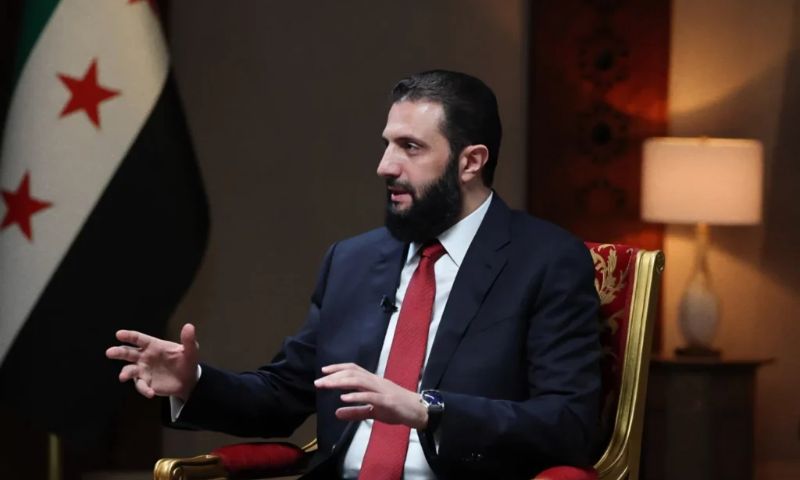
 Syrian President Ahmed al-Sharaa gives an interview to Iraq’s Dijlah TV, October 27, 2026 (Dijlah)
Syrian President Ahmed al-Sharaa said developments in the region had prompted greater attention to ties between Syria and Iraq and accelerated efforts to shape them. However, he said, agreement on those ties had existed from the outset in both Baghdad and Damascus.
In an interview published by Iraq’s Dijlah TV on Tuesday, October 27, Sharaa said transport and trade between the two countries had grown rapidly.
He said more than 100,000 transit trucks had traveled from Syria to Iraq, and from Iraq to other countries through Syria, over the past six or seven months. More than 40,000 trucks had also carried imports and exports between the two countries during that period.
Sharaa explained that the two governments were continuing work on an oil infrastructure project involving regional and US companies to build an integrated system encompassing oil pipelines, refining, and the rehabilitation of infrastructure and associated facilities.
Iraqi investment in Syria has also taken practical steps forward, according to Sharaa. He said cement was among the first sectors to attract Iraqi investment since the start of the new era, with opportunities for cooperation in other sectors as well.
Economic cooperation between the two countries has recently included opening border crossings and an agreement to transport Iraqi oil shipments through Syrian territory, as the Strait of Hormuz crisis continues against the backdrop of the US-Iran war.
Syrian President Ahmed al-Sharaa said water was one of the most important issues shared by Syria and Iraq and should be approached strategically, with the two countries’ agricultural lands viewed as a breadbasket for the entire region.
Water resources shared by Syria and Iraq should be used as efficiently as possible to maximize agricultural productivity, Sharaa said. Agricultural land in the two countries is estimated at between 80 million and 100 million dunams and could help meet the needs of between 100 million and 130 million people.
Sharaa added that using modern agricultural technologies, in cooperation with countries such as Denmark and the Netherlands, could reduce water consumption and increase agricultural output. Studies indicate that production could rise by about 70% in some areas, he said.
Sharaa stressed the need for cooperation between the two countries to find a way out of the region’s crises and establish normal conditions in which the state has strong institutions, allowing Iraq and Syria to regain their own strength and their active role in the region.
The Syrian president said he believed Iraqi Prime Minister Ali al-Zaidi’s program was sound, noting that Iraq had not experienced stability since 2003 and that Iraqi society had not enjoyed sufficient reassurance.
He expressed support for Zaidi’s efforts to place weapons exclusively under state control, saying political forces should help unite efforts toward that goal because a unified, strong army provides strength and protection for everyone.
The proliferation of military wings affiliated with political forces and factions weakens the state itself, according to Sharaa. Distributing military power among multiple actors makes them partners in state decision-making and places them outside the legal and institutional framework.
He noted that countries deal with clearly defined institutions, such as the army, border guards, police, and Interior Ministry, and that no country can now accommodate a large number of military organizations within its borders.
Decisions on war and peace must also remain the exclusive prerogative of the state, he said. This is one of the most important powers a state should never relinquish and is a principle on which states are built.
The Iraqi prime minister announced an anti-corruption program after taking office in April which included the arrest of several officials accused of accepting bribes outside legal channels.
Zaidi’s government also called on Iraqi factions to hand their weapons over to the state, setting a final deadline of June 2027.
Syrian President Ahmed al-Sharaa said Syria was very open to strengthening social ties and facilitating travel and movement between the two countries.
He added that visits to the Sayyida Zainab shrine were permitted and that Syria had no objection to them. However, it was keen to ensure that security conditions allowed for safe visits, particularly amid attempts by some parties to stir sectarian tensions. He noted that people who had tried to exploit the issue had been arrested.
He explained that Syria did not view its relationship with Iraq through a sectarian or ethnic lens, but rather through their shared history, economic interests, and deep ties.
The Sayyida Zainab shrine is in the Damascus countryside (southwestern Syria). It holds religious significance for Shiite Muslims and receives visitors from the community every year.
Regarding Syrian detainees transferred to Iraq, Sharaa pointed to bilateral talks to develop a plan to address the issue.
He said more than 3,000 Syrians were detained in Iraq, noting that some had no links to the organizations in question. Discussions were therefore underway on classifying them into categories, then considering Syria’s responsibility for them and the possibility of bringing them back.
Iraq previously received more than 4,000 detainees held in prisons run by the dissolved Syrian Democratic Forces (SDF), under an agreement with the international coalition.
Syrians account for the largest share, numbering more than 3,500 detainees. Human rights groups have called on their home countries to repatriate them amid fears that they could face torture or unfair trials in Iraq.
Sharaa concluded by saying that Syria and Iraq “have a historic opportunity to regain control over decision-making in the region and build a strong identity capable of expressing its will, free from the international and regional rivalries, occupation, and sectarian conflicts that have exhausted our peoples.”
if you think the article contain wrong information or you have additional details Send Correction


 A
A
A


 More Politics