


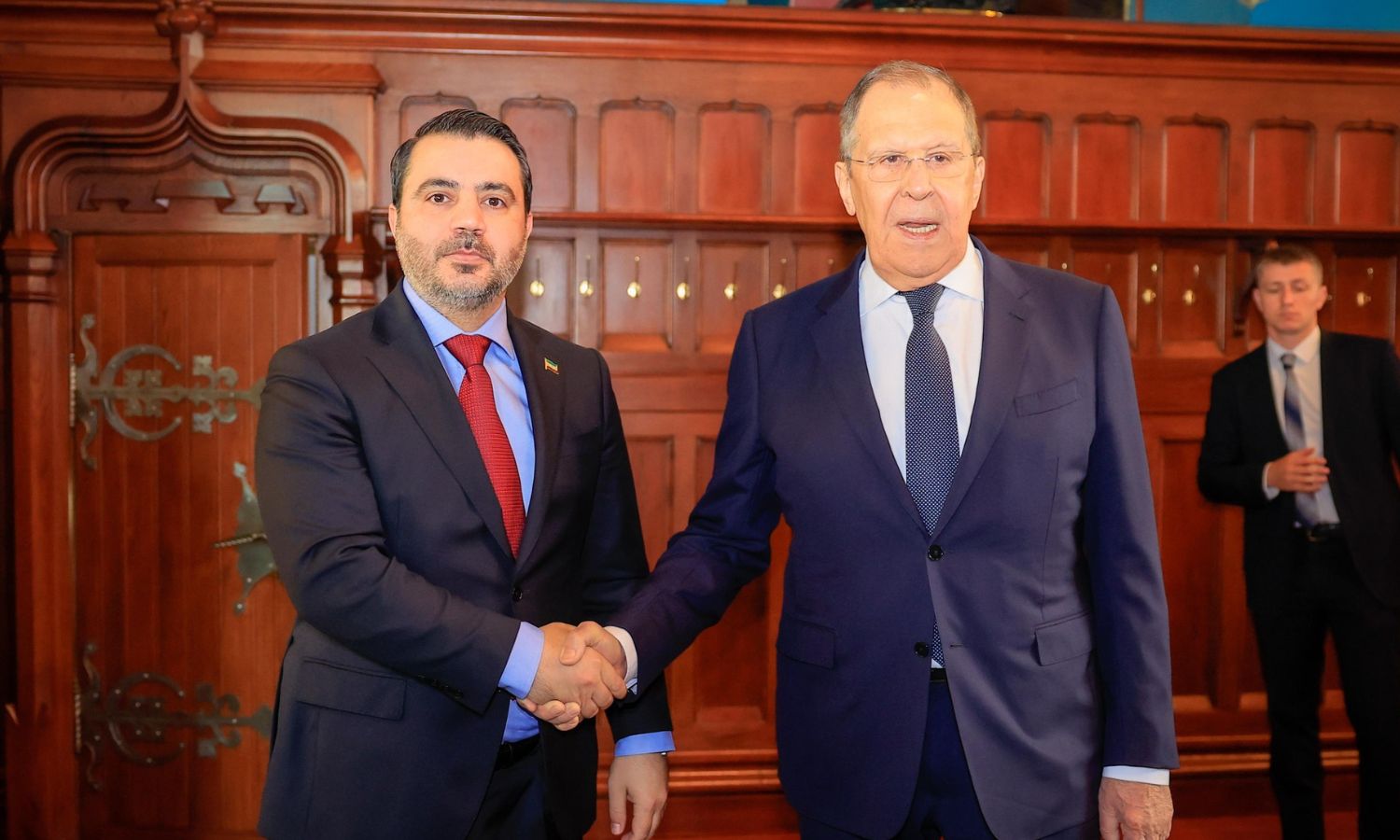
 Al-Shibani meets Russian Foreign Minister Sergey Lavrov during the first official visit by a Syrian official to Moscow since the fall of the Assad regime – July 31, 2025 (SANA)
Al-Shibani meets Russian Foreign Minister Sergey Lavrov during the first official visit by a Syrian official to Moscow since the fall of the Assad regime – July 31, 2025 (SANA)
Enab Baladi – Shaaban Shamieh
In recent weeks, Moscow has repeatedly emphasized that it is dealing with Syria’s new reality from the standpoint of safeguarding its interests, while avoiding the appearance of being a “strategic loser” after the fall of the Assad regime, of which it had been the strongest ally.
Russia now seeks to establish new balances in its relationship with the current government in Damascus, preserving at least the minimum of its previous gains, including its military presence on the Mediterranean coast.
Meanwhile, the transitional government in Damascus is attempting to shift the direction of its new partnerships with Moscow—unlike the Assad regime, which relied on Russia for armament, military operations against opposition forces, and the bombardment of cities, especially in northern Syria. The new relationship is instead taking the form of cooperation and security coordination.
Regarding the visit of Syrian Foreign Minister Asaad al-Shibani to Moscow on July 31, where he met Russian Foreign Minister Sergey Lavrov and later President Vladimir Putin, Dmitry Bridzhe, an expert with the Russian International Affairs Council, told Enab Baladi that the “confirmed outcome” was Damascus’ expression of interest in the return of Russian military police patrols to southern Syrian provinces, similar to their deployment prior to the fall of Bashar al-Assad in December 2024.
Bridzhe noted that recent Russian movements in Qamishli, northeastern Syria, took place without the participation of the Syrian Democratic Forces (SDF), reflecting the opening of a new chapter in military and security ties between Moscow and Damascus.
He explained that the decision to rely on the capabilities of the Russian military police was intended as a tool to curb Israeli incursions and to manage the southern frontlines.
The framework of this new phase was drafted by a joint Syrian-Russian team, but the most prominent role was played by Maher al-Sharaa, Secretary-General of the Syrian Presidency, who engineered the security communication channels and set the political “rules of engagement” with Moscow, according to Bridzhe.
Bridzhe added that the role played by al-Sharaa enabled the Syrian Foreign Ministry under Asaad al-Shibani and the Defense Ministry under Lt. Gen. Marhaf Abu Qasra to translate political understandings into disciplined field arrangements.
He described al-Sharaa as the “conductor between the security and diplomatic institutions,” providing political cover for operational plans and ensuring that the Russian channel remains part of Syria’s national security framework.
According to Bridzhe, Damascus sees the return of Russian patrols in the south as serving two key purposes: first, limiting Israeli military activity and preventing deeper infiltration into Syrian territory; and second, introducing a trusted external stabilizer along frontlines to prevent local or regional escalation.
He added that Moscow views the move as an opportunity to reassert its southern role, safeguard its strategic bases in Tartus and Hmeimim on the Mediterranean coast, and expand its mediating capacity when needed.
Bridzhe stressed that Russia’s broader Middle Eastern interests prevent it from relinquishing its military bases in Syria, as these installations form the cornerstone of its role and influence in the region.
Bridzhe said that Moscow’s insistence on holding onto its military bases in Tartus and Hmeimim is the real test of the future of the relationship.
For Russia, these facilities are strategic footholds on the Mediterranean. For Damascus, maintaining sovereignty requires reassessing the terms of their use.
He explained that Syria is seeking a model that guarantees security coordination without undermining the country’s strategic balance. This requires developing a new legal framework that would transform the Russian presence from an imposed reality into a regulated partnership, governed by transparency, timelines, and internal Syrian oversight mechanisms.
At the regional level, Bridzhe said Moscow has recently affirmed that it is committed to a policy of “balanced presence” in the Middle East, linking the defense of Syrian territorial unity with southern border security arrangements and measured coordination with influential capitals.
On the U.S. approach, Bridzhe predicted a “cautiously pragmatic” policy under the Trump administration—focused on protecting American forces in eastern Syria, preventing the expansion of Iranian influence in the south, and maintaining deconfliction channels with Russia.
He added that Washington may see the return of Russian patrols as a tool for tactical stability, provided that U.S. interests and freedom of action against ISIS are not restricted.
Israel, meanwhile, ties its assessment of the new Moscow–Damascus arrangements to the extent they succeed in limiting Iranian entrenchment, according to Bridzhe
Through this move, Bridzhe concluded, Moscow is signaling the continuation of its Middle Eastern strategy and its defense of Syrian territorial unity through security arrangements that combine deterrence with expanded mediation leverage.
Regarding the return of Russian military police patrols alongside Syrian Internal Security Forces in the coastal region, Bridzhe said the move is intended to “secure those areas and reinforce Russia’s security role.”
The Russian daily Kommersant reported, citing sources a few days ago, that the Syrian government had expressed interest in the return of Russian military police patrols to Syria’s southern provinces.
Damascus views this step as a means of curbing Israeli military activity, as Israel has controlled parts of southern Syria since late 2024 and established a buffer zone there under the pretext of protecting its northern border and the local Druze community, according to the newspaper.
Kommersant quoted a source who attended Syrian Foreign Minister Asaad al-Shibani’s meeting with the Syrian community in Moscow in early August as saying that Russia’s return to its former positions could “prevent Israel from interfering in Syrian affairs.”
The source also believed that Moscow could mediate between the Syrian transitional government and the Israelis.
The newspaper noted that after the change of power in Damascus and the rise of Ahmad al-Sharaa to the presidency, the Israeli army occupied parts of southern Syria, declaring the establishment of a buffer zone with the stated aim of ensuring Israel’s border security and protecting the Druze community. At the same time, Russia was forced to reduce its military presence in the area.
A Kommersant source attributed the growing Russian activity in Qamishli in northeastern Syria to increased cooperation between the Syrian government and Moscow, noting that the patrols were carried out without the participation of the Syrian Democratic Forces (SDF), which have not yet reached an agreement with the government regarding Kurdish-majority areas.
According to Russian experts, Russia’s presence in southern Syrian provinces prior to the change of power in Damascus “served Israeli interests,” since “the presence of Russian patrols was meant to prevent the deployment of Iran-aligned groups in the south, but this was difficult to achieve due to the absence of clear criteria for identifying forces linked to Iran.”
On July 31, Syrian Foreign Minister Asaad al-Shibani arrived in Moscow with an official delegation. He was later joined by Syrian Defense Minister Marhaf Abu Qasra, who held lengthy talks with his Russian counterpart Andrey Belousov.
Al-Shibani also met Russian Foreign Minister Sergey Lavrov, and later President Vladimir Putin at the Kremlin, where both sides affirmed the start of a new phase in Syrian-Russian partnership based on respect for sovereignty, support for territorial unity, and Moscow’s rejection of any Israeli interventions in Syria.
if you think the article contain wrong information or you have additional details Send Correction


 A
A
A
A
A
A




 More Politics