


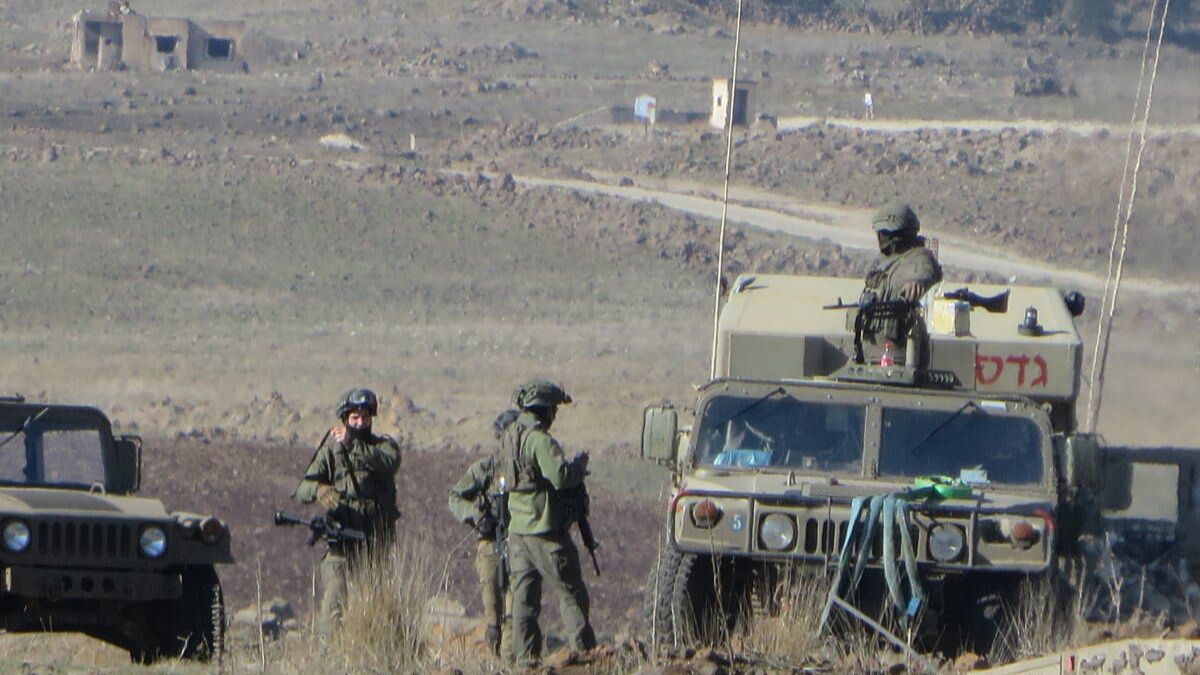
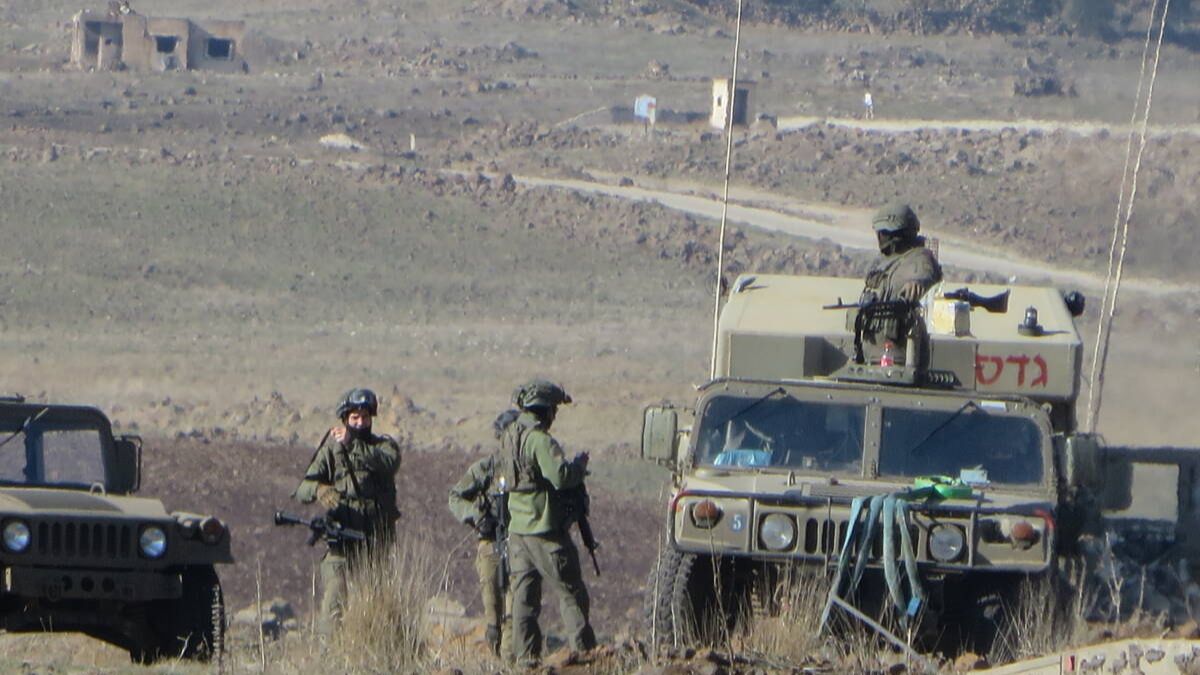
 Israeli soldiers and military vehicles in Quneitra – December 25, 2024 (Syria Direct/Imad al-Bassiri).
Israeli soldiers and military vehicles in Quneitra – December 25, 2024 (Syria Direct/Imad al-Bassiri).
Israeli forces on Tuesday, November 4, released two young men they had detained after laying an ambush for them inside the lands of the village of Maariya in the Yarmouk Basin (western Daraa countryside, southern Syria), according to Enab Baladi’s correspondent in Daraa.
A relative of the two young men told Enab Baladi that Israeli forces set up the ambush for them in the village square and detained them for about two to three hours, with no information on the reason for the detention or details of the questioning.
The Syrian Arab News Agency (SANA) reported that three Israeli military vehicles crossed a short distance into the village’s lands before withdrawing shortly afterward.
A local source from the area told SANA that the incursive force combed the vicinity of the southwestern border, while tension spread among residents who woke up to the sound of vehicle movement around the town.
This was the first incursion into the Yarmouk Basin in several months, an area that had seen relative calm compared to other parts of southern Syria.
Israeli army forces also advanced on Wednesday morning, November 5, into the town of Jubata al-Khashab (Quneitra province, southwest Syria on the Golan frontier).
SANA’s correspondent said an Israeli force consisting of two tanks and four military vehicles entered the town and set up a checkpoint at the entrance to the quarries on the road linking it to the village of Ain al-Bayda (northern Quneitra countryside, southwest Syria).
On October 31, the Israeli army installed a metal gate at the entrance to the village of al-Samadaniyah al-Gharbiyah (Quneitra countryside, southwest Syria), separating it from its surroundings as part of tighter control over the area adjacent to the ceasefire line. The next day, November 1, forces moved into the village’s eastern section with eight vehicles, two tanks, and an armored tracked vehicle.
State-run al-Ikhbariyah TV reported that the Israeli army also erected a metal gate between al-Samadaniyah al-Gharbiyah and the town of al-Hamidiyah (Quneitra countryside), separating residents from their farmland and cutting the road they use daily for travel and work.
Residents told al-Ikhbariyah that this step is part of a series of measures taken by the occupation forces in villages near the ceasefire line, including closing vital roads, in an effort to restrict civilians’ movement and isolate them from their surroundings.
According to al-Ikhbariyah, Quneitra residents view the installation of the metal gate as a new form of Israeli violations aimed at imposing a new situation on the border and deepening the suffering of people living in frontline areas already subject to security restrictions and constant tightening.
Syria’s Permanent Representative to the United Nations, Ibrahim Olabi, said he does not believe there is any state in the Security Council that has not spoken about Israeli violations, adding that Syria will not be a source of threat and wants a return to the 1974 Agreement, as it is the starting point for any talks related to the security track.
In his address to the UN General Assembly’s First Committee on Disarmament and International Security in New York on Monday, November 3, he stressed that the Golan is Syrian Arab land and that this issue is non-negotiable. He added that at every Security Council meeting the Syrian delegation affirms that the Syrian government has fulfilled its obligations toward its people and the region.
if you think the article contain wrong information or you have additional details Send Correction


 A
A
A
A
A
A





 More Politics