


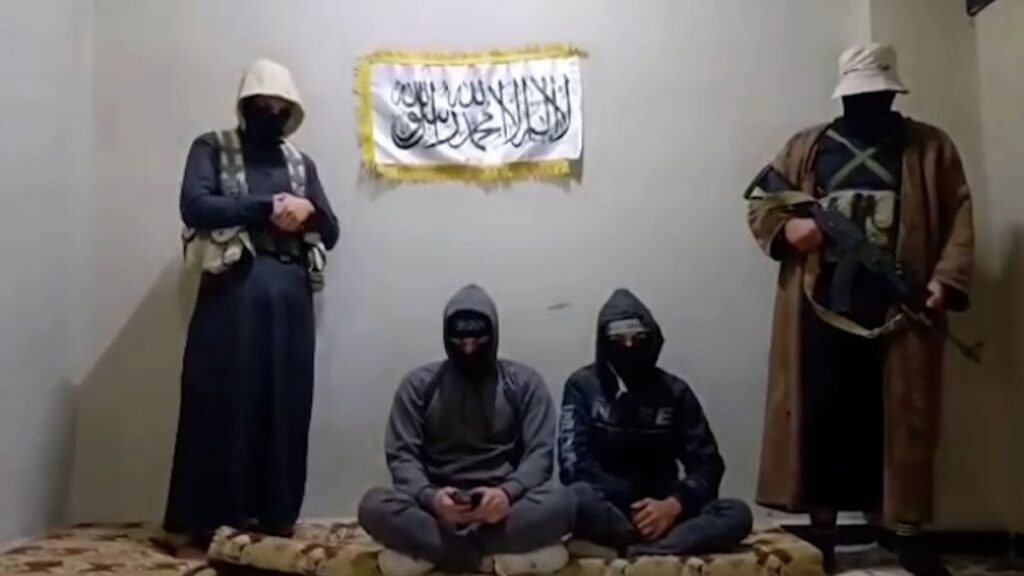
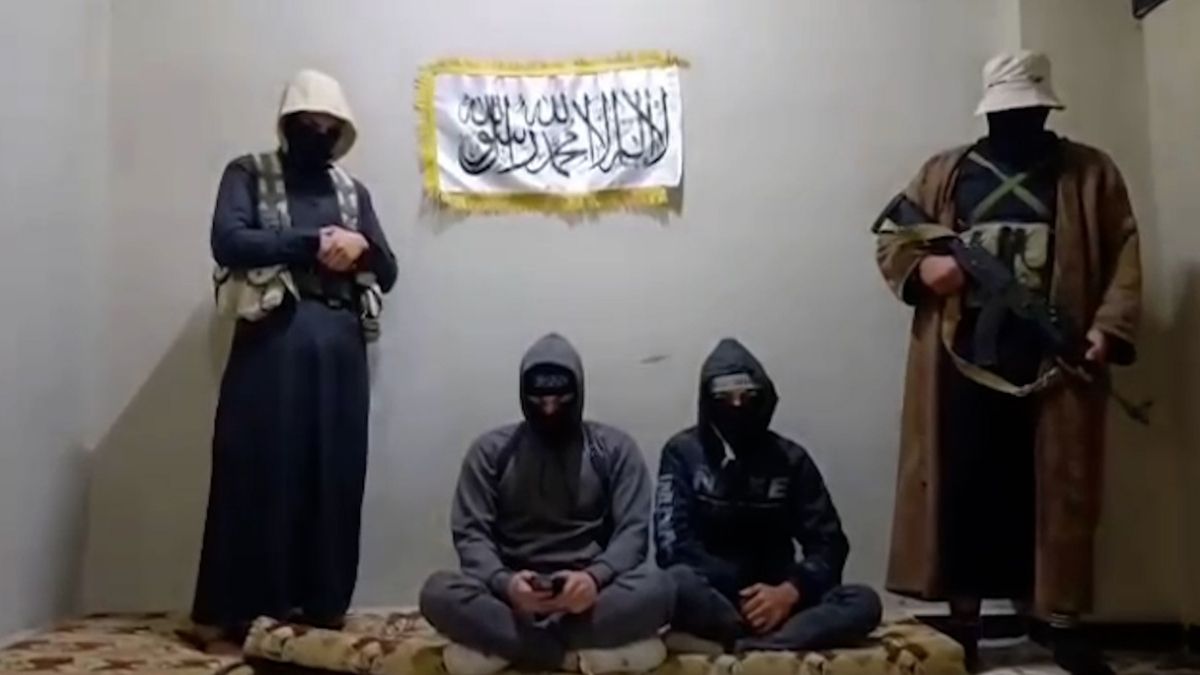
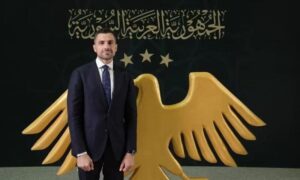
 A still from the latest video released by “Ansar al-Sunna” on Telegram – October 15, 2025 (screenshot)
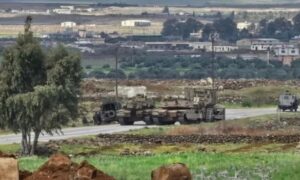
A still from the latest video released by “Ansar al-Sunna” on Telegram – October 15, 2025 (screenshot)
A faction calling itself “Saraya Ansar al-Sunna” has renewed threats to attack churches and religious shrines in several Syrian provinces.
On 15 October, a Telegram channel under the faction’s name posted a video, viewed by Enab Baladi, showing four masked individuals announcing the start of operations targeting gatherings and sites of the “Alawite community,” as well as Christian churches and schools, in the provinces of Homs, Hama, Tartous, and Latakia (western Syria).
The video, which circulated on social media, sparked fears among civilians in those provinces that the faction might act on its threats.
Earlier, “Saraya Ansar al-Sunna” claimed responsibility for bombing the St. Elias Church in Dweila neighborhood (Damascus) contrary to the Syrian government’s accusation that the Islamic State (ISIS) was behind it, raising questions about whether this faction actually exists and what role it may have in such security incidents.
The suicide bombing at the church on 22 June killed 25 people and wounded 63 others, according to figures the Syrian Ministry of Health gave to the Syrian Arab News Agency (SANA).
Researcher on “jihadist” movements Abdulrahman al-Haj told Enab Baladi that what is known as “Ansar al-Sunna” is difficult to verify, noting that all the supposed military operations the “group” has claimed were not accurate.
Al-Haj assessed that “Ansar al-Sunna” is a phantom outfit run by remnants of the former regime and has no presence on the ground. To understand the significance of such statements, he said, one must consider the group’s status and the doubts surrounding it.
Regarding the recently released video, al-Haj explained that it coincided with the visit of Syria’s transitional-phase president, Ahmed al-Sharaa, to Moscow.
In his view, the intent was to send Russia a message that “minorities” in Syria are under threat under al-Sharaa’s leadership and that extremist groups are active.
Al-Haj described it as a “desperate” message that reflects the frustration among regime remnants over ongoing shifts and Russia’s stance toward the Syrian government.
President al-Sharaa paid an official visit to Russia, where he held talks with Vladimir Putin on bilateral relations and regional and international developments of mutual concern.
Enab Baladi attempted to contact the media office at the Syrian Ministry of Interior to ask whether security services would take precautionary measures in the provinces threatened by the faction. The response was, “There is no information about them,” with no further clarification.
The faction’s periodic communiqués show a lack of coherence in form, phrasing, and orthography, an inconsistency that draws criticism from researchers on Islamist movements.
Researcher Abbas Sharifa told Enab Baladi in a previous comment that jihadist-salafi groups have an established lexicon and key phrases they consistently use regarding “fighting the tyrant,” “implementing sharia,” and “combating apostates.”
He believes the statements published by the so-called “Saraya Ansar al-Sunna” are not written by a mind steeped in jihadist-salafi thought, but rather are an attempt to exploit that lexicon, hence the clumsy, contradictory wording that does not align with the ideological identity of salafi-jihadist factions.
|
“The statements issued by the so-called ‘Saraya Ansar al-Sunna’ are not written by a mind rooted in jihadist-Salafi ideology. This explains their clumsy, incoherent wording, which does not reflect the intellectual identity of Salafi-jihadist factions.” Abbas Sharifa, researcher specializing in Islamic thought |
On the other hand, researcher on regional security and terrorism Ahmad Sultan linked the faction’s clumsy statements and formatting inconsistencies to the likelihood that its members are very young and inexperienced, lacking both religious training and organizational know-how.
Since the faction’s emergence and the spread of its Telegram channels, observers have noted persistent ambiguity about its background and undeclared goals.
On 6 August, the Syrian Ministry of Interior announced the arrest of a cell that had planned to bomb a church in Tartous (western Syria).
Tartous Internal Security Commander Col. Abdel Aal Mohammad Abdel Aal said the force detained two individuals tied to the former Syrian regime who planned to detonate an explosive device at the St. Elias Maronite Church in the village of al-Khraybat, in the Safita district of rural Tartus.
He added that officers seized a ready-to-use explosive device, papers bearing threats to local residents, and a black flag.
The operation, he said, was based on intelligence and “precise, intensive” surveillance that prevented the plot from being carried out.
if you think the article contain wrong information or you have additional details Send Correction


 A
A
A
A
A
A



 More Politics