


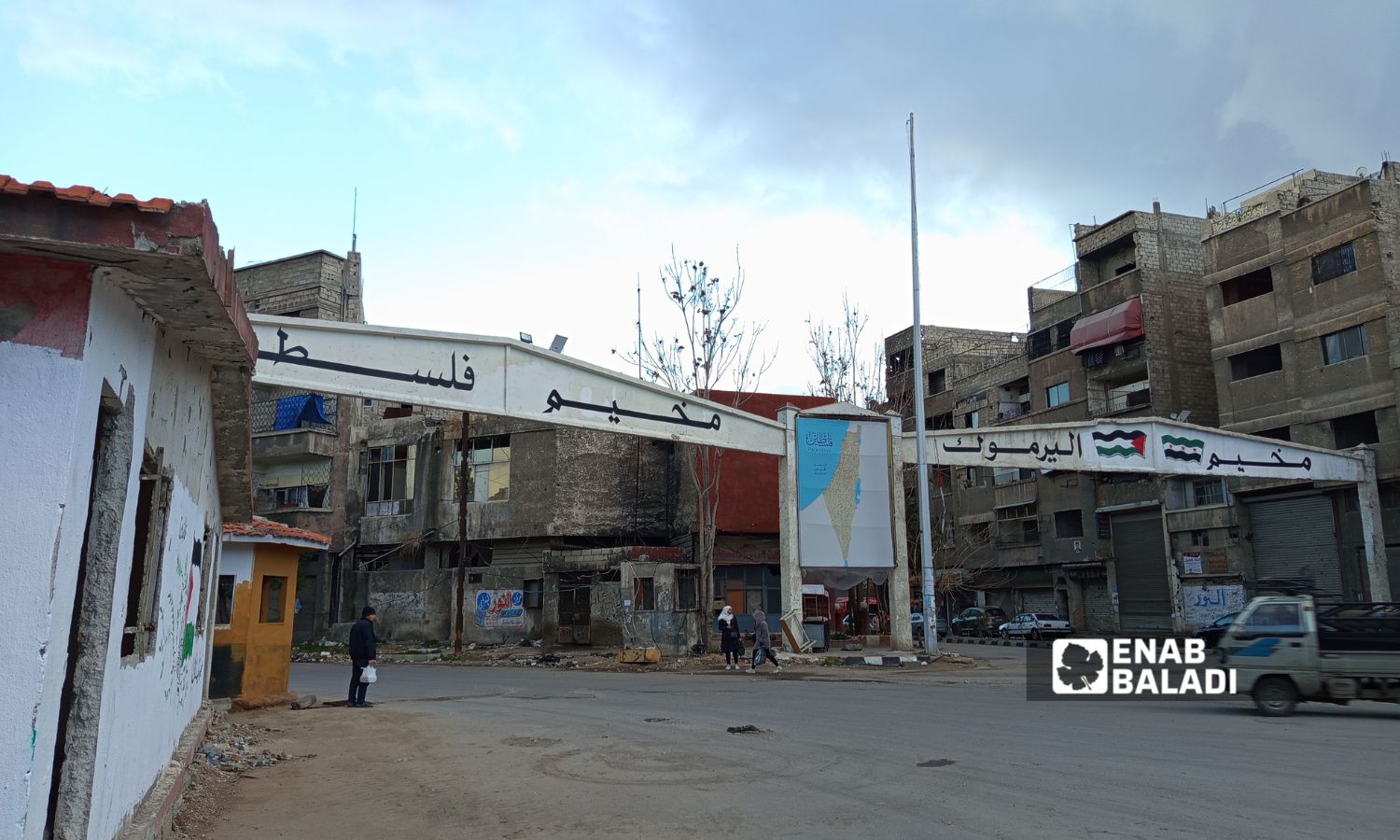
 Entrance to the Yarmouk Camp in Damascus - February 10 (Enab Baladi/Besan Khalaf)
Entrance to the Yarmouk Camp in Damascus - February 10 (Enab Baladi/Besan Khalaf)
Enab Baladi – Besan Khalaf
“From displacement to displacement, this is how the Palestinians are destined to live. I returned to the Yarmouk Camp after the fall of the regime to repair my home because I got tired of paying rent,” said Samir Amouri (40 years old) to Enab Baladi.
He added, “The situation in Yarmouk is very bad, there is no electricity, no water, no services, and destruction around us everywhere, in addition to piles of garbage and the remnants of war.”
The Yarmouk Camp for Palestinian refugees, south of the Syrian capital Damascus, witnessed the return of residents after the fall of the Assad regime on December 8, 2024, after they were prevented from moving within some areas of the camp without prior security approval from the previous regime.
Samir Amouri’s situation is not different from that of Samih Hamid, who returned to inspect his home to see if he could return to it and repair it, after having been a refugee in Turkey since 2014.
Hamid (50 years old) narrated to Enab Baladi his story of returning to the Yarmouk Camp, stating, “We heard about the destruction of the camp, but I did not expect this level of ruin, destruction, and systematic theft.”
He added that he was not encouraged to return due to the lack of basic services and the difficulty of vehicle movement in the area, “in addition to the fact that my house needs debris removal and land leveling to establish infrastructure anew.”
For his part, Abdullah al-Salim, who fled to Turkey in 2015, spoke to Enab Baladi about his return to the Yarmouk Camp, saying, “The camp’s landmarks have disappeared, and I couldn’t recognize the location of my house except after great effort. Al-Assad has succeeded in destroying Palestinian people, starting from their homes and ending with killing them from the inside.”
Al-Salim worked in Saudi Arabia for 14 years until he was able to buy this house, but he returned to find it “rubble and stones.”
As for Hasna al-Faour, who returned to the Yarmouk Camp last year and repaired her home, she and her family suffer from a lack of water and rely on drawing an unlicensed water line to meet their needs.
Due to the absence of a bakery in the Yarmouk Camp area, she goes to the bakeries in the neighborhoods of al-Tadamon or al-Zahira to secure bread.

Some renovated houses in the Yarmouk Camp – February 10 (Enab Baladi/Besan Khalaf)
Nael Hamid, a member of the Yarmouk Relief Committee, told Enab Baladi that the situation in the camp is very bad, and the meager services provided are only “personal efforts.”
The reason for the lack of electricity in the Yarmouk Camp is the presence of only one electrical transformer on al-Jaouna Street, which feeds Street 15 and al-Jaouna.
Regarding the water situation, Hamid noted that the services committee and Yarmouk Relief Committee have contacted some engineers and contractors to provide water systematically to citizens’ homes there.
The Palestine Liberation Organization (PLO), in cooperation with some donors in the Yarmouk Camp, has worked on removing rubble from al-Arouba Street to Palestine Hospital, using modest equipment and fuel provided by the donors, according to Hamid.
Hamid hopes that the governorate, in cooperation with the committees in the Yarmouk Camp, will activate a mechanical bakery due to the difficulty of citizens’ movement between the Yarmouk Camp and al-Tadamon to secure bread.
“Most of those who returned to the Yarmouk Camp are poor, and the committees have made promises in coordination with the Damascus governorate, but these promises need monitoring to see what will be implemented,” according to Hamid.
Enab Baladi tried to contact the Damascus governorate to ask what it would provide for the Yarmouk Camp and whether it had abandoned providing services there, relying on the efforts of committees and organizations, but received no response by the time of writing this report.
Tarik Hamoud from the Action Group for Palestinians of Syria (AGPS) explained to Enab Baladi that there is currently no specific project for reconstructing the camp, and the initiatives in this regard do not stop from Palestinian or international parties concerned with this file, such as UNRWA, but they are renovation initiatives that do not rise to a reconstruction project.
He pointed out that there are objective conditions governing this file, including that all of Syria needs a reconstruction project, which has not yet been agreed upon internationally.
He noted other reasons related to the shortcomings of representative Palestinian bodies, primarily the Palestine Liberation Organization, and the failure to give this file the necessary importance.
In light of these challenges, the file for the reconstruction of the Yarmouk Camp will remain contingent on these circumstances and their fluctuations, and the proposed solutions on the ground will remain partial, and sometimes individual, and do not address the comprehensive problem, according to Hamoud.
Residents of the Yarmouk Camp have been complaining since the previous regime allowed them to return in 2019 about the lack of basic services and the absence of qualified facilities, and the neglect of streets and roads despite the beginning of their return to their homes, while operations of looting and theft of public and private property in the camp have continued until the fall of the regime.
Before the fall of the Assad regime, the AGPS conducted an electronic survey to gauge the opinions of Yarmouk Camp residents in southern Damascus regarding the Syrian regime’s talk of reconstructing the camp.
The group published the results of the survey, which showed that 51% of camp residents do not trust the regime’s calls for reconstruction, while 18.6% of participants expressed trust in these calls, and 29.5% denied knowledge of the answer to the question.
The Syrian regime had been stalling in allowing residents to return to the camp and was delaying the start of infrastructure repair work in the area, according to what the AGPS mentioned, putting Palestinians in Syria in a state of insecurity, exacerbating the suffering of their displaced individuals, and threatening Palestinian refugee communities.
The report revealed that 46% of participants in the “Yarmouk Camp and Reconstruction” survey affirmed that the camp would not return to its former state, while 30% said that the camp might return to how it was, and 23.5% expressed that they did not have an accurate opinion on the matter.
In July 2020, the group issued its annual report, in which it discussed the Syrian regime’s inability to allow for the reconstruction of the Yarmouk Camp and the return of its displaced residents, “who are suffering from difficult humanitarian conditions amid the economic deterioration witnessed in Syria.”
The report confirmed that camp residents are unable to secure alternative housing, especially as the camp continues to be subjected to looting and plundering of public and private properties and the destruction of the remains of the infrastructure of electricity, water, and communications in full view of the Syrian security forces.
According to the group, the incidents of looting and thievery, including the theft of furniture, doors, windows, electrical wires, and more, affected 93.2% of the camp’s homes.
The camp previously witnessed battles between Free Syrian Army factions and the previous regime’s forces, amidst the division of Palestinian factions between both sides, before the Islamic State controlled two-thirds of the camp in 2015.
However, the previous regime’s forces completely controlled the al-Hajar al-Aswad area and the Yarmouk Camp in May 2018, after a military operation that lasted a month, during which the Islamic State group was expelled from the camp following an unofficial evacuation agreement, through which the group’s elements were transferred to the Badia of As-Suwayda.
if you think the article contain wrong information or you have additional details Send Correction


 A
A
A
A
A
A



 More Society