


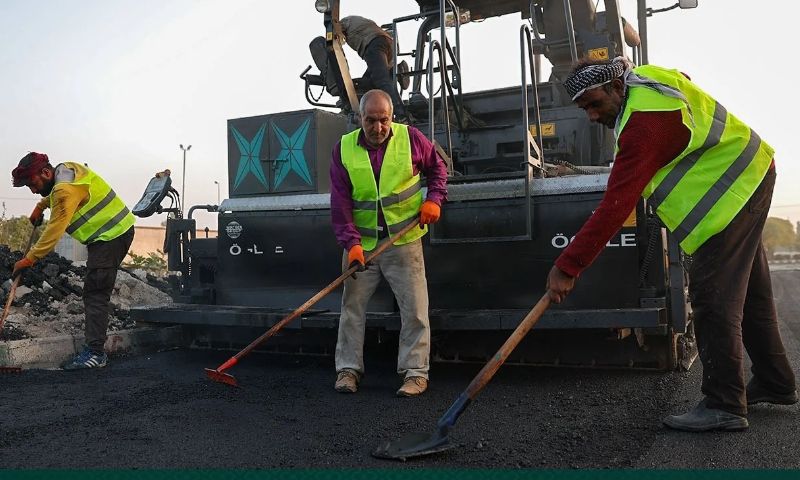
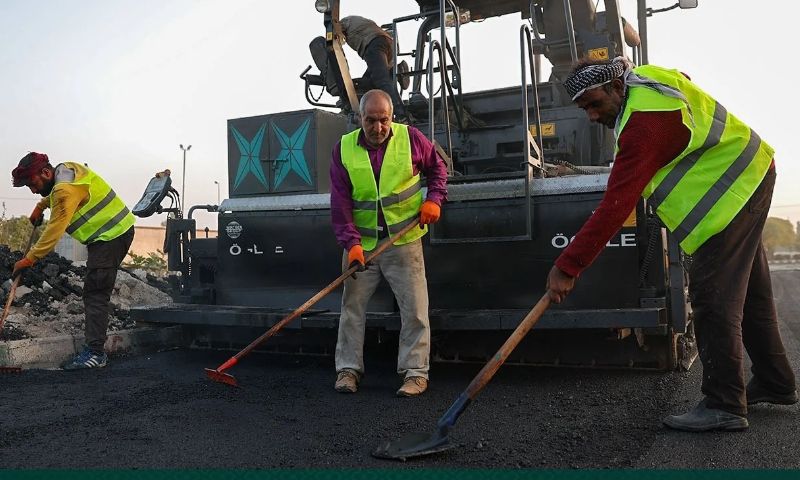
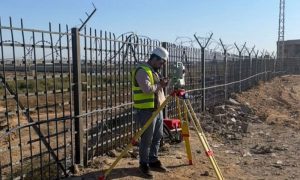
 Road and yard paving works at the Tal Abyad border crossing as part of its rehabilitation and development project, November 18, 2026 (General Authority for Border Crossings and Customs).
Most of Syria’s border crossings are undergoing renovation, rehabilitation, expansion, and technical and service upgrades as part of a comprehensive modernization plan by the General Authority for Border Crossings and Customs to improve infrastructure and increase operational efficiency.
Mazen Alloush, director of the International Relations and Cooperation Department at the General Authority for Border Crossings and Customs, told Enab Baladi that rehabilitation work covers the Bab al-Hawa, Bab al-Salama, Tal Abyad, Qamishli-Nusaybin, Nassib, al-Tanf, and al-Bukamal border crossings. Work is also being accelerated at the al-Arida crossing in preparation for its official reopening and operation in accordance with the highest standards.
Alloush explained that the authority determines its rehabilitation and expansion priorities based on a set of specific technical and economic criteria. These include daily passenger and commercial truck traffic, the geographical and strategic importance of each crossing as a vital route for transit and trade with neighboring countries, the current structural condition of facilities, and the need for expansion to eliminate congestion and improve working conditions and services provided to citizens.
According to Alloush, border crossing development projects are particularly important at this stage, as these facilities serve as Syria’s primary gateways for national sovereignty and economic activity. Modernizing them helps expedite border crossing procedures, facilitate the return of Syrian citizens, stimulate regional trade and transit traffic, strengthen border controls, and combat smuggling through the introduction of modern systems. These improvements contribute to supporting the national economy and promoting development in border areas.
Regarding funding, Alloush confirmed that all ongoing rehabilitation and expansion projects at border crossings are financed directly by the government through the state budget and the authority’s own resources. The projects are supervised by specialized engineering and technical teams from the authority’s Facilities and Maintenance Directorate, without relying on the private sector or investors.
He attributed this approach to the authority’s commitment to fully preserving national sovereignty and the independence of the management of these vital facilities, while ensuring that citizens receive services that meet the highest standards of quality and operational discipline.
Syria’s border crossings recorded more than 21.9 million passenger crossings between the fall of the former Assad regime on December 8, 2024, and the end of October 2026, including both arrivals and departures, according to Alloush.
Speaking to the state-run Syrian Arab News Agency (SANA) on Wednesday, November 25, Alloush said that Syrian passenger traffic in 2025 totaled 10,854,511 crossings, including 6,298,390 arrivals and 4,556,121 departures.
From the beginning of 2026 through the end of October, border crossings recorded 11,054,771 passenger crossings, including 5,975,586 arrivals and 5,079,185 departures.
Alloush noted that the largest share of voluntary returns takes place through the Jousieh, Bab al-Salama, and Bab al-Hawa border crossings.
He added that the authority is implementing comprehensive expansion and rehabilitation projects at several border crossings to increase their capacity and reduce congestion, aiming to accommodate the continued rise in the number of returnees and ensure the smooth flow of passenger traffic.
if you think the article contain wrong information or you have additional details Send Correction


 A
A
A




 More Society