


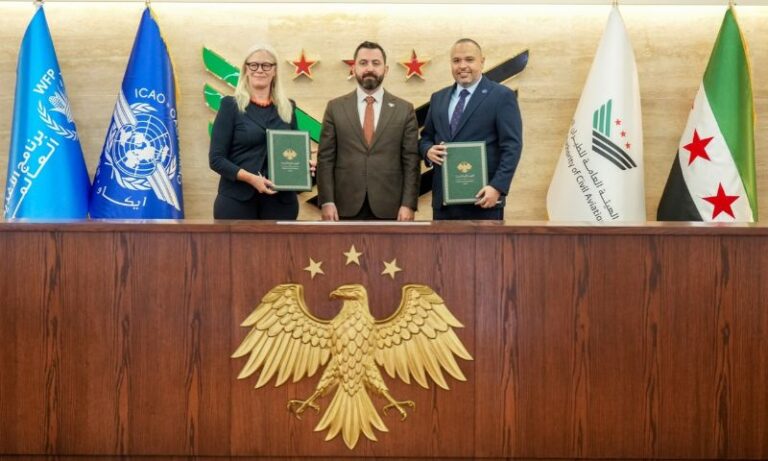
 The International Civil Aviation Organization and the World Food Programme sign a cooperation agreement to upgrade Syria’s air navigation infrastructure, November 23, 2026. (General Authority of Civil Aviation and Air Transport)
Syria’s General Authority of Civil Aviation and Air Transport announced on Monday, November 23, that the International Civil Aviation Organization (ICAO) and the World Food Programme (WFP) had signed a $1.05 million cooperation agreement to upgrade Syria’s air navigation infrastructure, with a focus on Deir Ezzor International Airport (eastern Syria).
In a post on its official Facebook page, the authority said it had led coordination with the two organizations throughout the process, from developing the project and identifying its technical priorities to completing the arrangements for implementation.
The agreement covers upgrades to navigation equipment and systems and improvements to air navigation, approach, and landing procedures. The upgrades aim to improve safety and operational efficiency and prepare Deir Ezzor International Airport to handle expected air traffic.
Omar Hosari, head of the authority, told the state-run Syrian Arab News Agency (SANA) that Deir Ezzor International Airport was a priority under the authority’s current plans because of its strategic importance in eastern Syria.
Hosari said the authority was also completing preparations to reopen Qamishli Airport (northeastern Syria) in December 2026 and Latakia Airport (western Syria) in 2027. The efforts are part of a program to rehabilitate Syrian airports and gradually return them to service.
Hosari said reopening airports and resuming flights were part of a broader strategy to rebuild a national air transport network that connects Syrian governorates to one another, improves links to regional and international destinations, and supports economic and commercial activity across the country.
He said the authority would continue working with international organizations and technical partners to secure the funding and expertise needed to modernize civil aviation infrastructure and keep it operating in line with international standards.
In October, ICAO withdrew its advisory on Syrian airspace, which had been in place for more than 13 years. The move marked a step toward reintegrating Syrian airspace into the international air navigation network.
Hosari said the decision allows countries, civil aviation authorities, and international airlines to reassess their use of Syrian airspace for overflights and for flights arriving at or departing from Syrian airports. He said this could increase overflight traffic and encourage more airlines to consider resuming flights to Syria.
Hosari said some operational restrictions imposed by individual countries and regulators still apply. He added that ICAO’s decision supports technical and diplomatic efforts to address those restrictions through internationally recognized aviation safety and security assessments.
He said the authority was continuing to coordinate with ICAO and foreign civil aviation authorities to build confidence in the safety of operations in Syrian airspace and meet the technical and operational requirements for expanding air links with regional and international markets.
Hosari said restoring Syrian airspace’s role in international air navigation was a strategic priority for the authority. He said it would improve air links, increase air transport and overflight traffic, and support economic activity and investment in Syria’s civil aviation sector.
if you think the article contain wrong information or you have additional details Send Correction


 A
A
A







 More Society