
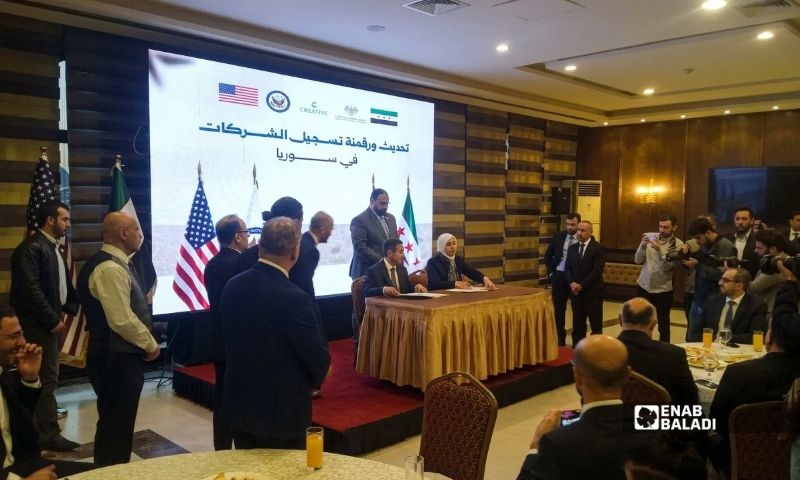

Syria’s Ministry of Industry and Internal Trade signed a memorandum of understanding and an implementation contract with the US company Creative Associates International on Sunday, November 1, to launch a project to digitize commercial and property records across Syria, with support from the US Department of State.
The agreement, signed at the Dama Rose Hotel in Damascus, aims to launch a project to modernize and digitize company registration in Syria and bring about a comprehensive digital transformation of the Syrian economy through:
- Digitizing and archiving commercial and property records.
- Building modern databases to replace outdated paper-based procedures.
- Establishing a transparent and reliable investment environment that meets international standards.
The project is expected to benefit 500,000 investors and companies and will be implemented over six months, starting from the signing date, Mohammad Hmeish, executive director of the Syrian branch of the US company Code Creative, told Enab Baladi.
Digitizing 500,000 Property Records
The project, whose plans have direct backing from the US Department of State, has an estimated cost of $1 million and covers two strategic sectors considered vital to investment:
- Property and ownership records: Establishing five digital transformation centers to digitize and archive approximately 500,000 property records in cooperation with the Ministry of Local Administration and Environment.
- Commercial and company records: Building a comprehensive data center to archive more than five million commercial documents and connect Syria’s 14 governorates through a unified system.
Muhannad al-Nasser, director of technology and digital transformation at the Ministry of Industry and Internal Trade, said the ministry is working to strengthen consumer protection systems, complaint handling and regulatory oversight, alongside digitizing archives, organizing data and connecting services between the central administration and provincial directorates.
He noted that the project represents an important step toward modernizing government services, improving efficiency and meeting the needs of citizens and businesses. He said developing the digital system would help:
- Reduce the time and effort required to complete procedures.
- Improve record preservation and retrieval.
- Provide more reliable and transparent services for investors and business owners.
Toward a More Attractive Investment Environment
In a recorded video message, US Deputy Assistant Secretary of State for Near Eastern Affairs Jacob McGee said property and commercial records are not merely administrative documents but the “fundamental foundation for economic recovery, the country’s future, and the protection of family homes and private-sector investments.”
McGee explained that digitizing these systems would create a “predictable” investment environment capable of attracting international and American companies seeking transparency and reliable institutions.
He said these measures send a “clear signal that Syria is open for business,” emphasizing that the process should be entirely “Syrian-led,” with technology and knowledge transferred to enable local personnel to manage the system independently.
Speaking to Enab Baladi, Hussam al-Omar, director of planning at the Ministry of Industry and Internal Trade, explained that the project goes beyond conventional archiving to establish a digital platform allowing businesses to be registered and commercial registrations to be issued online, without visiting the Companies Directorate.
Al-Omar confirmed that implementation had already begun under the signed contract, with tenders issued for the procurement of equipment and supplies. More than 50 employees will also be trained during the first phase at the ministry’s central administration, ahead of a comprehensive launch in the coming months.
According to al-Omar, the main economic benefits of digital transformation include:
- Moving to electronic transactions and one-stop-shop services, reducing reliance on direct, paper-based procedures and improving government administrative efficiency.
- Protecting citizens’ and investors’ rights and property ownership documents through secure databases that prevent loss or forgery.
- Creating a reliable business environment based on transparency and faster procedures, encouraging domestic, expatriate and foreign capital to invest in long-term projects.
Unified Standards to Ensure Security and Integration
Regarding technical coordination, Minister of Communications and Information Technology Abdulsalam Heikal told Enab Baladi that major national registries, including civil, property, company and vehicle records, are at the heart of Syria’s digital transformation.
Heikal explained that the National Information Technology Services Authority is responsible for establishing technical and security standards and ensuring database integration across ministries and institutions. He emphasized that digitization has become the standard approach to records management.
He added that the system would allow citizens and investors to access information and services quickly and smoothly, while each ministry would retain responsibility for managing its own records and data centers in accordance with unified national standards.
The minister confirmed that the approach to data centers is moving toward an integrated model that balances centralization with the transitional needs of ministries and major institutions.
“In principle, we are moving toward establishing centralized data centers. However, we recognize the requirements of the transitional phase, which may necessitate dedicated data centers for certain government entities, particularly major institutions managing extensive national registries. These records require data centers directly affiliated with the entities responsible for overseeing and managing them,” Heikal said.
The Ministry of Communications’ responsibilities focus on:
- Providing comprehensive oversight of the digital transformation process.
- Establishing technical standards and regulatory procedures.
- Ensuring database integration across government entities.
- Implementing the highest cybersecurity standards.
- Ensuring that systems are connected efficiently and securely to the national network infrastructure.
Ending Administrative Uncertainty
These measures are particularly significant for Syria’s business sector. Abdul Rahim Ziyada, chairman of the Damascus Countryside Chamber of Commerce, believes that digitizing records and simplifying property ownership and company establishment procedures will end the administrative and legal “uncertainty” previously faced by expatriates and Arab and foreign investors.
Ziyada told Enab Baladi that positive indicators point to significant investor interest. He said the Damascus Countryside Chamber of Commerce currently has approximately 82,000 registered companies and has recently witnessed considerable business activity:
- 2025: Approximately 11,000 company registrations were renewed, while 5,500 new companies were established.
- First half of 2026: More than 3,000 new companies were established, while approximately 10,000 others renewed their registrations.
Ziyada noted that simplifying administrative procedures and clarifying property ownership mechanisms for commercial establishments through the digital property registration system would significantly stimulate investment and improve the business environment.
Creative Associates International
Creative Associates International is an American consulting and development organization specializing in international development, digital transformation, institutional development, governance, reconstruction in crisis-affected areas and economic recovery worldwide.
Founded in the United States in 1977, the company is headquartered in Maryland, in the Washington, DC, area.
It is a major prime contractor for US government-funded projects, including those supported by the US Agency for International Development (USAID) and the US Department of State.