

Enab Baladi, Wasim al-Adawi
Syria’s currency exchange and money transfer market is undergoing comprehensive restructuring and regulation led by the Central Bank of Syria, in coordination with the Interior Ministry, to curb unauthorized transactions and control the exchange rate.
The central bank recently conducted extensive inspections in cooperation with the Interior Ministry and judicial police across most governorates: Damascus, Damascus countryside (southwestern Syria), Aleppo (northern Syria), Homs and Hama (central Syria), Latakia and Tartus (western Syria), Daraa (southern Syria), Deir Ezzor (eastern Syria), and Raqqa and Idlib (northern Syria). It issued 755 warnings to businesses conducting currency exchange or money transfers without licenses, or exceeding the activities permitted by their licenses, under Article 25 of Law No. 24 of 2006 and its amendments.
Among the central bank’s new measures, according to Enab Baladi’s monitoring, are financial penalties and warnings against exchange companies and offices operating after their designated closing time of 5 p.m. A manager at an exchange company in Damascus, who asked not to be named, told Enab Baladi that this contributes to:
– Increased parallel-market activity after closing hours, a major cause of exchange-rate fluctuations.
– Crowding and a backlog of customers during official business hours, delaying the circulation of cash and the purchases needed to supply markets each day.
– Uncertainty among traders when pricing goods and essential commodities because exchange rates differ before and after closing time.
Around 40 officially licensed currency exchange companies and offices are registered with the central bank. These include approximately 11 to 14 major joint-stock companies and a number of offices operating as general partnerships.
The Central Bank of Syria’s current focus on regulating the exchange market and prohibiting unlicensed activities, as well as the activities of licensed businesses refusing to regularize their status, including 26 companies and offices originating in northern Syria, reflects a combination of international pressures and conditions and domestic economic needs associated with reintegrating Syria into the global financial system.
A review of overseas visits, statements and meetings involving Syrian financial officials and central bank representatives indicates that:
– International institutions, such as the International Monetary Fund (IMF) and World Bank, or the US Federal Reserve, will not approve steps to end Syria’s financial isolation or activate correspondent banking relationships without strict implementation of anti-money laundering and counterterrorism financing standards.
– For Syrian banks to reconnect freely and smoothly to Swift and the international banking system, the US Treasury’s Office of Foreign Assets Control (OFAC) and the Federal Reserve require assurances that Syria’s currency exchange and international transfer market contains no parallel financial channels or unregulated shadow networks.
– IMF recommendations, delivered through consultations and technical assessments of Syria’s fiscal and monetary conditions, consistently emphasize eliminating the unauthorized parallel market and restricting transactions to the approved formal banking system.
The Central Bank and Exchange Companies in Eastern Syria
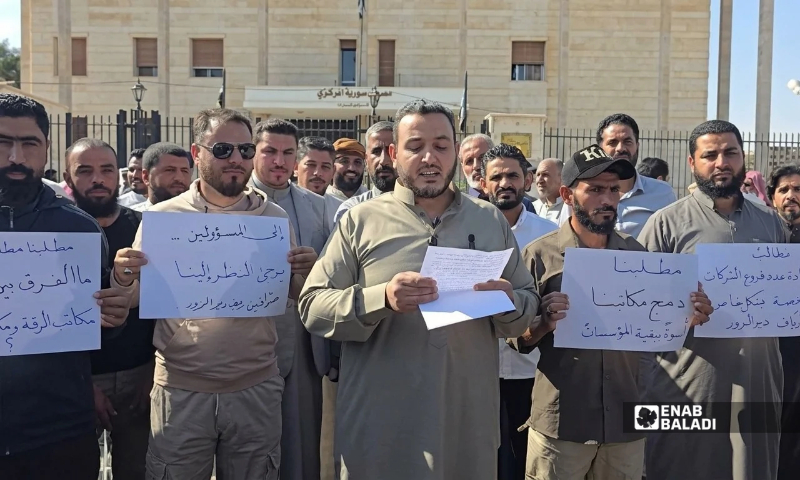
The central bank has set deadlines for all currency exchange and money transfer companies and offices operating in Raqqa governorate and eastern and northeastern Syria to regularize their legal status, disclose their partners’ identities and bring their financial activities into the approved national system.
Following a protest by the owners of these businesses, an agreement was reached with the central bank and the Raqqa governorate administration, which Enab Baladi exclusively disclosed, providing for:
– Restricting money transfers and foreign currency exchange in the area to offices and companies that obtain proper central bank approval.
– Closing unlicensed shops and offices to prevent money laundering and fraud.
– Requiring businesses seeking to regularize their status to submit documents disclosing the source of their funds and lodge the legally required foreign currency deposit with the Central Bank of Syria to guarantee their operations.
Owners of companies and offices in Raqqa hold official licenses and previously paid financial deposits to the former financial administration affiliated with the dissolved Syrian Democratic Forces (SDF), according to their accounts to Enab Baladi’s correspondent. Raqqa governorate alone has 26 operating exchange companies and around 40 offices.
Central bank Decision No. 199 L.A., concerning licensing requirements for companies originating in northern Syria, sets out several conditions alongside the required documents and supporting records. Chief among these is providing proof that the company has deposited at least $1.25 million into an account opened in its name at the central bank. Enab Baladi previously obtained a copy of the decision.
Under the decision, this amount is considered part of the company’s paid-up capital.
Regulating Operators, Not Setting the Exchange Rate
The management of Syria’s currency market is approaching a turning point, according to Syrian economic and financial expert Dr. Ibrahim Nafea Koshaji. “Regulating the currency exchange and money transfer sector means overseeing its operators, not imposing a rate,” he said. This distinction is more than a technicality: it is essential to understanding the aims of the Central Bank of Syria’s anticipated monetary oversight.
Regulation and administrative oversight are not intended to intervene directly in setting or directing exchange rates. Setting the rate is a matter for macroeconomic monetary policy tools alone. Regulation, by contrast, establishes a financial supervisory framework to ensure safe and sound operations, regardless of whether a transaction is conducted by a bank, an exchange company, an office or an intermediary.
The new phase aims to establish effective, direct oversight of everyone conducting currency exchange and money transfers within Syria and across its borders, including:
– Licensed institutions and companies violating compliance rules and supervisory instructions.
– Unlicensed entities and individuals operating outside the law.
– Informal, unregulated money transfer networks that supply the parallel market.
– Undocumented financial intermediation lacking even basic oversight.
The central bank’s primary objective in supervising the exchange market is to clean up the monetary environment, rather than strengthen the pound against the dollar. But this offers no magic tool for directly changing or managing the exchange rate, according to Koshaji.
The Syrian expert described regulation of the currency exchange market as a process of rebuilding based on:
– Strengthening compliance with governing laws.
– Protecting transactions from irregularities and ensuring transparency in their documentation.
– Curbing unauthorized activities to limit the black market.
– Establishing a clear, regulated relationship between the market and the central bank.
$12 Million in Damascus and $6 Million in Aleppo Daily
Based on commercial activity, liquidity levels and money transfers in circulation, Koshaji estimates daily foreign currency trading volumes in major cities as follows:
– Damascus: Daily trading ranges from $8 million to $12 million and can reach $15 million during periods of peak commercial and seasonal activity.
– Aleppo: Daily trading ranges from $4 million to $6 million, depending on activity at industrial and commercial businesses.
These figures cover all transactions in both the formal and informal markets, including the approximately 40 licensed exchange companies and offices registered with the Central Bank of Syria, as well as unlicensed businesses and informal money transfer networks.
Although the illicit market does not completely dominate the formal market, it is a strong competitor, relying on speed and the absence of controls. This makes regulating foreign currency market operators essential to restoring balance.
Why Regulating Exchange Businesses Does Not Control the Pound’s Rate
Discussing the relationship between official and black-market exchange rates and the regulation of exchange companies and offices, the Syrian economist explained that the exchange rate reflects macroeconomic balances and imbalances, regardless of who conducts the transactions. These depend on several key indicators:
– The central bank’s available foreign currency reserves.
– Domestic production levels and the volume of foreign trade, including exports and imports.
– Inflation, public confidence in the economy and market expectations.
Regulating banking operators in the Syrian market is therefore a structural prerequisite for the success of any monetary policy, but it is not a tool for directly changing or managing the exchange rate.
The supervisory measures are not a temporary security or administrative campaign. According to Koshaji, they represent a comprehensive rebuilding of the financial sector based on:
– Ensuring full compliance with governing laws and legislation.
– Protecting commercial transactions from irregularities and establishing transparent documentation.
– Curbing unauthorized activities and limiting the expansion of the black market.
– Establishing a regulated, transparent relationship between market operators and the central bank.
Taken together, the central bank’s measures, whether prompted by international and US recommendations or efforts to control the pound’s exchange rate, represent a structural step requiring improvements to Syria’s financial and monetary infrastructure. The aim is to make the market more stable and less vulnerable to speculation, while preparing the way for more effective monetary policies once the necessary economic conditions are in place.