


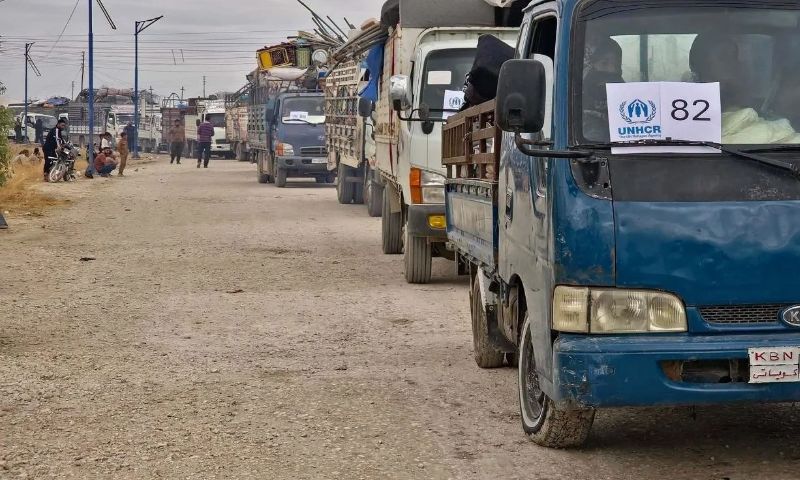
 Families return to Ras al-Ain (northern al-Hasakah) with support from UNHCR, in cooperation with the government and UN agencies, October 5, 2026 (UNHCR Syria).
The United Nations High Commissioner for Refugees (UNHCR) has placed protection, voluntary return, and reintegration at the forefront of its response priorities for Syria in 2027, while continuing to support Syrian refugees in host countries.
In its report under the 2027 Global Appeal, UNHCR said its plan aims to reduce dependence on humanitarian assistance by strengthening refugees’ self-reliance, facilitating their access to national systems and services, and addressing the legal, social, and economic barriers they face.
Inside Syria, UNHCR plans to adopt a response that combines protection, legal assistance, access to civil documentation, shelter and livelihood support, and the rehabilitation of community infrastructure, prioritizing areas receiving large numbers of returnees.
Under this plan, UNHCR aims to provide cash assistance to about 380,000 people, shelter assistance to 352,000 people, and legal assistance to 653,000 people, including 500,000 returnees.
In refugee-hosting countries, the plan focuses on maintaining essential services for refugees and expanding the range of solutions available to them, including voluntary return, local integration, and resettlement.
UNHCR plans to provide cash assistance to about 1.3 million people, legal support to 138,000 people, and shelter assistance to more than 300,000 people in host countries.
It also intends to provide counseling and information on voluntary return to about 532,000 people to help them make informed decisions about returning to Syria.
In Turkey, UNHCR will support the national protection framework and pursue multiple solutions for refugees, including local integration, voluntary return, resettlement, and complementary pathways.
In Jordan, efforts will focus on documentation, cash assistance, and facilitating refugees’ access to national services, while supporting those wishing to return voluntarily.
In Lebanon, UNHCR will prioritize legal assistance and protection services for refugees most at risk, strengthen their access to national services and social protection mechanisms, and maintain preparedness for potential new waves of displacement.
In Egypt, UNHCR will support the transition to a protection-centered national asylum system and promote refugees’ inclusion in national services and livelihood opportunities, while continuing registration and documentation activities and facilitating voluntary return.
In Iraq, UNHCR will continue to support government-led registration efforts and facilitate refugees’ access to essential services, while supporting voluntary return to Syria.
UNHCR estimated its total 2027 budget for the Syria situation at approximately $1.204 billion, allocated as follows:
UNHCR expects Syrian refugees and internally displaced people to continue returning to their areas of origin throughout 2027.
In its report, UNHCR said about 1.8 million Syrian refugees had returned from neighboring countries since the fall of the former Assad regime in December 2024, alongside more than two million internally displaced people who had returned to their areas of origin.
Despite these returns, about 5.5 million people remain internally displaced in Syria, while 15.6 million people need humanitarian assistance, including 14.7 million who require protection support.
According to the report, about 6.2 million people need repairs to their homes, while 4.1 million people, particularly returnees, face challenges related to civil documentation and housing, land, and property issues.
Regarding Syrian refugees abroad, UNHCR noted that about 3.8 million refugees remained registered in Egypt, Iraq, Jordan, Lebanon, and Turkey as of mid-October 2026 and continued to need protection and support.
UNHCR data showed that the pace of refugee returns slowed in 2026 compared with the previous year. More than 341,000 refugees returned between January and August 2026, compared with about 1.3 million refugees who returned throughout 2025.
UNHCR linked decisions to return to conditions in areas of origin, including the security situation, the availability of housing, basic services, and livelihood opportunities, as well as civil documentation and family circumstances.
It expects some Syrian refugees to remain in host countries throughout 2027 amid declining assistance, deteriorating socioeconomic conditions, and growing pressure on public services in host communities.
if you think the article contain wrong information or you have additional details Send Correction


 A
A
A




 More Politics