


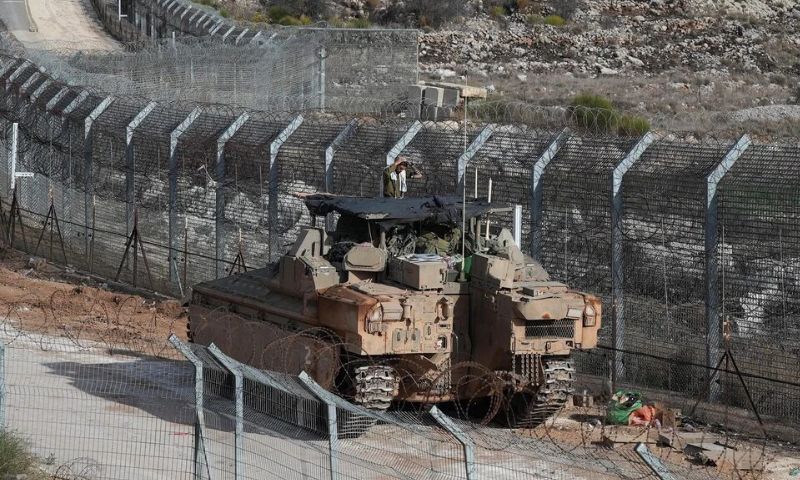
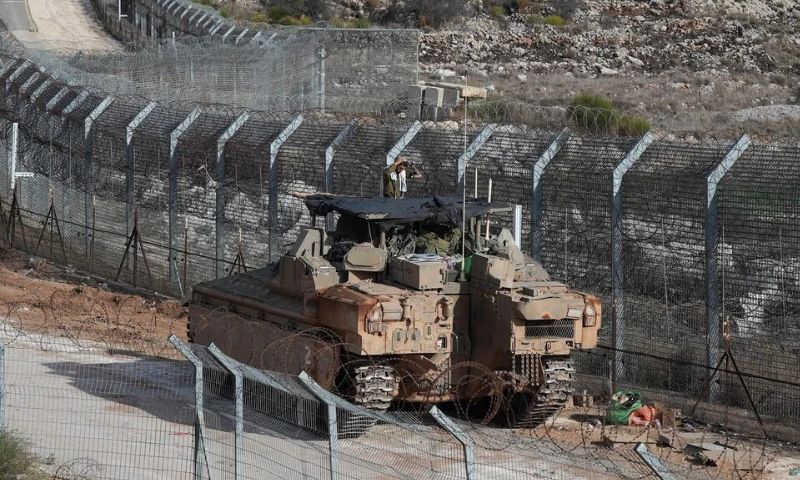
 An Israeli tank at the ceasefire line between the occupied Syrian Golan Heights and the buffer zone, December 10, 2024 (Reuters)
The Israeli army blocked the road leading to al-Mantara Dam in central Quneitra countryside with barbed wire on Saturday, November 28, amid continued harassment of residents in the southwestern Syrian governorate bordering the occupied Golan Heights.
The state-run Syrian Arab News Agency (SANA) reported that an Israeli military patrol advanced into the area surrounding the dam and installed barbed wire along the vital road connecting the dam to agricultural land and nearby villages, completely blocking access for residents and agricultural vehicles.
Enab Baladi’s correspondent in Quneitra reported that the road runs along the top of the dam at an elevation overlooking the surrounding area, suggesting that the Israeli army seeks to prevent anyone from accessing the location, particularly given the presence of a nearby Israeli military base.
The correspondent added that the Israeli army has arrested numerous young men from the area near the dam since its incursion into southern Syria on December 8, 2024.
Al-Mantara Dam is the largest dam in Quneitra governorate in southern Syria, with a storage capacity of approximately 40 million cubic meters. It is a key component of water and agricultural security in the governorate and neighboring areas.
The Israeli move comes amid continued escalation and increasing restrictions on residents’ access to their agricultural land and sources of livelihood, which depend primarily on farming and livestock breeding.
As part of its daily incursions into southern Syria, the Israeli army carried out an incursion involving eight military vehicles on the outskirts of Wadi al-Ruqad in western Daraa countryside (southern Syria) on Friday, November 27.
The Sijil Center documented 11 violations committed by Israeli forces that day across Quneitra, Daraa, and Damascus countryside governorates. These included four incursions, three military aircraft overflights, one shelling incident, one checkpoint, and two other violations.
The Sijil Center documented 395 Israeli violations in Syria in October, the highest monthly total recorded in 2026, surpassing the 321 violations recorded in March.
Adding October’s figures to those recorded since the beginning of the year brought the cumulative number of violations to 2,427.
The center also documented two incidents in which Israeli occupation forces killed Syrian civilians in October, noting that these were the first incidents of their kind since April. It was also the first time Israeli forces had killed more than one Syrian civilian in a single month since the Beit Jinn incident on November 28, 2025.
The center reported that the number of Syrian civilians killed by the Israeli army since December 8, 2024, had risen to at least 38.
Regarding detentions, the center recorded 30 cases in October, including 29 in Quneitra and one in Daraa. These involved people detained during raids or at checkpoints, as well as the targeting of shepherds while they were on farmland and grazing land, particularly around Jubata al-Khashab in northern Quneitra countryside and Saida al-Hanout in southern Quneitra countryside.
According to the Sijil Center’s documentation, 287 people have been detained since December 8, 2024, of whom 36 remain in custody. Including five Syrians detained by Israeli forces before the fall of the Assad regime, the total number of Syrians whose whereabouts remain unknown in Israeli prisons stood at 41 as of the end of October.
Syrian Activists in Quneitra Call for Concrete Action to Support Southern Syria
if you think the article contain wrong information or you have additional details Send Correction


 A
A
A







 More Politics