


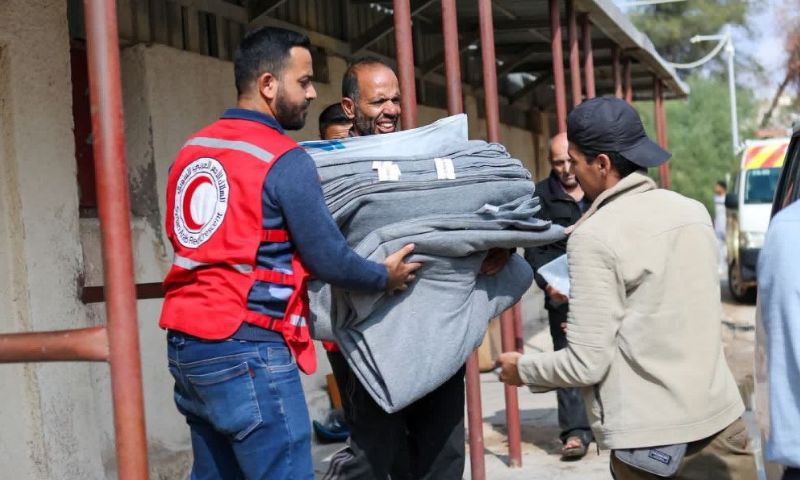
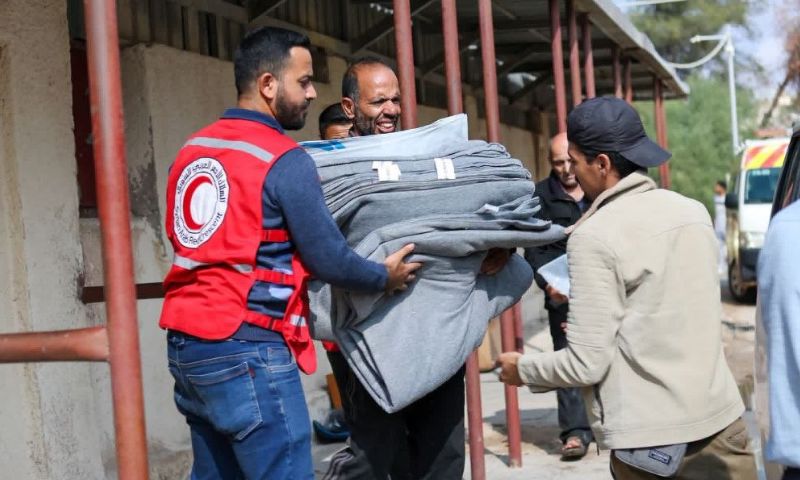
 Distribution of humanitarian aid in Daraa (southern Syria) as winter approaches, November 10, 2026 (Syrian Arab Red Crescent).
As winter approaches, concerns are growing over worsening humanitarian conditions in Syria, amid an increased risk of flooding and heavy rainfall that have damaged homes, agricultural land and infrastructure in several governorates.
Recent floods have damaged homes, agricultural land and infrastructure in Deir Ezzor (eastern Syria) and Latakia (western Syria), prompting UN warnings of mounting risks as winter begins. More than two million people across Syria need winter assistance, according to the United Nations Office for the Coordination of Humanitarian Affairs (OCHA).
OCHA said heavy rainfall in eastern and western Syria had damaged homes, agricultural land and critical infrastructure, following flooding in late October.
In Deir Ezzor governorate, flooding inundated approximately 115 homes in the al-Bukamal subdistrict and damaged around 130 hectares of agricultural land and fodder crops. One person remains missing.
The al-Suwayiyah crossing and bridge were also damaged, cutting off connections between local communities, while commercial truck traffic remains suspended at the al-Bukamal border crossing.
According to OCHA, humanitarian partners are preparing to provide food assistance, essential supplies, health services and hygiene kits to approximately 70 affected families.
In northern Latakia, the collapse of a bridge connecting the villages of al-Durra and al-Shahrura cut off road access for 277 families, including families returning to their villages. At least 18 homes and shops were also damaged, along with agricultural land and other facilities, according to OCHA’s report.
The damage comes as winter-related humanitarian needs continue to grow. The United Nations Office for the Coordination of Humanitarian Affairs stressed the need to assist, including winter shelter, improvements to living conditions at displacement sites, access to clean water, sanitation services and healthcare support.
According to the report, humanitarian partners require $456 million to fund this year’s winter response, but have received only $178 million.
OCHA called for urgent resources to help families prepare for winter, reduce flood risks and repair critical infrastructure, particularly at displacement sites and in communities most vulnerable to seasonal disasters.
In an earlier report, OCHA identified internally displaced people, returnees, particularly those returning to difficult living conditions, and host communities as among the groups most vulnerable to winter’s effects. Many lack effective ways to cope with severe weather.
Citing the World Meteorological Organization (WMO), OCHA warned that rainfall and flood risks are expected to increase, with above-average precipitation forecast during the autumn and winter of 2026-2027.
According to the 2026-2027 Winter Vulnerability Analysis, more than 2.4 million people in Syria need winter assistance. Of these, 972,493 people facing severe needs have been identified to receive assistance across multiple humanitarian sectors.
Displacement sites remain exposed to severe weather conditions, including heavy rainfall, snowstorms, flooding, subzero temperatures, and strong winds.
According to the Camp Coordination and Camp Management sector, all 1,074 displacement sites across Syria face varying levels of winter-related risks.
Of these sites, 975 are at risk of flooding, with 687 facing very high or higher risks, including two sites at catastrophic risk, according to OCHA.
if you think the article contain wrong information or you have additional details Send Correction


 A
A
A




 More Politics