


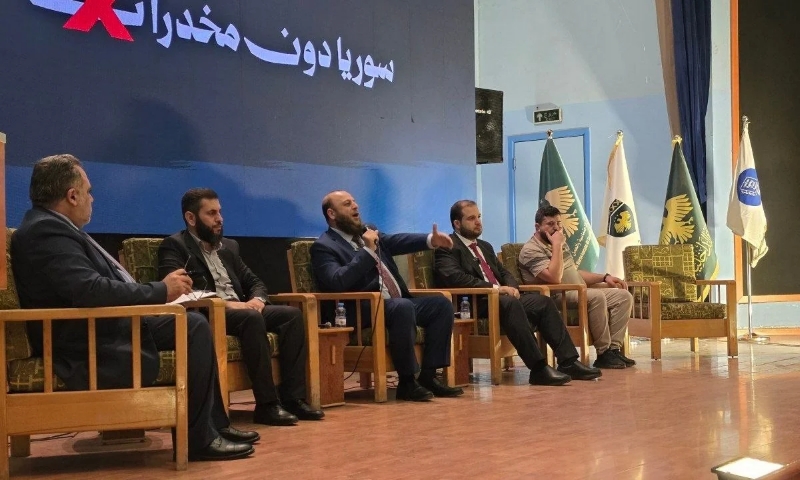
 An awareness seminar on the risks of drugs and drug prevention, titled “Syria Without Drugs,” held at Hama University with the participation of officials and representatives of relevant authorities, November 4, 2026 (Hama Judicial Authority).
The Criminal Court in Hama governorate (central Syria) announced on Tuesday, November 24, that it had carried out a death sentence against a man convicted of drug trafficking, marking the first execution of a drug trafficker in the governorate. The sentence was carried out after judicial and legal procedures were completed and the defendant was found to have repeatedly committed the same offense.
Hama Public Prosecutor Muhammad Ahmad al-Na’san said in remarks published by the Hama Judicial Authority that the penalty imposed on the defendant, Maher Ali al-Rifai, was life imprisonment. However, the multiple sentences handed down against him required the enforcement of the most severe penalty, death, after he was found to have repeatedly committed the crime of drug trafficking.
Al-Na’san explained that drug trafficking carries a sentence of life imprisonment, but the penalty is increased in specific circumstances, including when trafficking takes place in educational institutions or prisons, or in cases of repeat offenses. The latter applied to the case heard by Hama’s Second Criminal Court, which sentenced a repeat drug trafficking offender to death.
He said the harsher penalty was based on the legally defined aggravating circumstance of repeatedly committing the same drug trafficking offense under Article 39 of Law No. 2 of 1993, which makes the crime punishable by death. He noted that this issue had been repeatedly emphasized in lectures, seminars, and workshops, most notably during the “Syria Without Drugs” campaign.
Almoutassim al-Kilani, a specialist in international criminal law and human rights, called for a review of the ruling issued by Hama’s Second Criminal Court.
He said prosecuting drug trafficking networks and protecting society were duties of the state, but that the state was equally obliged to uphold safeguards protecting the right to life when determining penalties. He stressed that his objection concerned the imposition of the death penalty for drug trafficking, even when repeat offenses had been established.
He explained that determining the legal basis for the harsher penalty required reading Articles 39 and 40 of Syria’s Narcotics Law No. 2 of 1993 together. Article 40, paragraph (a), clause 1, punishes the sale or possession of narcotics with intent to traffic with life imprisonment and a fine.
Paragraph (b) of the same article, meanwhile, prescribes the death penalty in specific circumstances, including repeat offenses as stipulated in Article 39, paragraph (b), clause 1.
He noted that this distinction had implications for the burden of proof. A court may infer intent to traffic from the quantity of narcotics seized, whereas establishing a repeat offense requires identifying the previous conviction and verifying that it became final before the subsequent offense was committed.
Al-Kilani noted that the grounds for the ruling were particularly important when considering the possibility of reducing the sentence. Article 39 prohibits granting mitigating circumstances in the cases it lists, including repeat offenses, while clause 1 of Article 40 allows the court, where mitigating circumstances exist, to commute a death sentence to life imprisonment or a prison term of no less than 20 years, along with a fine.
In this context, he called for the publication of the court’s reasoning to clarify which previous conviction the court had relied on to establish the repeat offense and how it had interpreted the scope of the reference to Article 39 in light of the mitigation provisions contained in Article 40 itself.
From a constitutional and human rights perspective, al-Kilani noted that Article 12, paragraph 2, of Syria’s 2025 Constitutional Declaration makes the rights and freedoms stipulated in human rights treaties ratified by Syria an integral part of the declaration.
He added that Article 6 of the International Covenant on Civil and Political Rights (ICCPR) protects every person’s right to life, while paragraph 2 restricts the death penalty in countries that retain it to the most serious crimes.
He explained that the UN Human Rights Committee had clarified in paragraph 35 of its General Comment No. 36 that this classification was limited to crimes of extreme gravity involving intentional killing, explicitly excluding drug trafficking. In paragraph 25 of its 2024 concluding observations, the committee specifically recommended that Syria restrict the death penalty to crimes meeting this standard.
On this basis, al-Kilani argued that imposing the death penalty for drug trafficking was incompatible with Syria’s obligations under the covenant, even when domestic law allowed for harsher penalties in cases of repeat offenses.
Al-Kilani said Article 17 of the Constitutional Declaration safeguards the right to defense, the right to appeal, and the presumption of innocence until a final judgment is issued. Article 14(5) of the ICCPR guarantees the right to have a conviction and sentence reviewed by a higher court, while Article 340(c) of Syria’s Code of Criminal Procedure requires the public prosecution to refer a death sentence handed down in the defendant’s presence to the Court of Cassation, even if the convicted person does not appeal.
He noted that anyone sentenced to death has the right to seek a pardon or commutation of their sentence under Article 6(4) of the ICCPR. Articles 460 and 461 of the Code of Criminal Procedure regulate pardon applications and the referral of cases to the Pardons Committee for its opinion, while Article 43 of the Penal Code requires the approval of the head of state before an execution can be carried out.
Al-Kilani concluded by calling for clarification of the stage of judicial proceedings reached in the Hama case, a halt to executions for drug-related offenses, and amendments to the legal provisions authorizing them. Such measures, he said, would ensure that drug traffickers are held accountable through penalties proportionate to their offenses and consistent with the right to life.
if you think the article contain wrong information or you have additional details Send Correction


 A
A
A







 More Society