
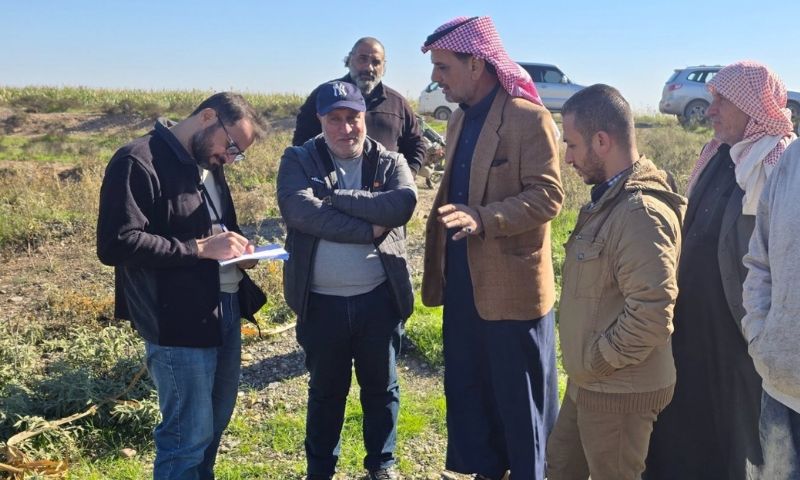

Syria’s General Establishment for Fodder has set the purchase price of dried yellow corn from farmers at 43,500 Syrian pounds (approximately $290) per ton, based on a moisture content of 14%, with adjustments to the price according to the moisture level at the time of delivery.
Hussein Shihab, director general of the establishment, said in a statement published by the Ministry of Agriculture on its official Facebook page on Sunday, November 15, that the establishment would begin receiving yellow corn from all farmers for the 2026 agricultural season on Monday, November 16.
The crop will be received at approved drying centers, depending on the processing capacity of the dryers.
Shihab explained that the establishment had rehabilitated and maintained yellow corn dryers in Raqqa (northern Syria), which had been out of service for 14 years, making them ready to receive and dry the crop.
The purchase price was announced at a time when yellow corn farmers, particularly in Raqqa governorate, are concerned about declining agricultural revenues following a sharp drop in crop prices over a short period, alongside rising production costs and continued corn imports.
Farmer Mustafa al-Mahmoud previously told Enab Baladi that the price of yellow corn had fallen from $310 to $265 per ton in a single day, with the dollar trading at approximately 150 Syrian pounds ($1), causing sudden losses for farmers as market prices failed to cover production costs.
He added that agricultural yields had declined compared with last year, with average production per dunum (1,000 square meters) not exceeding 600 kilograms this season, a level he described as low compared with previous seasons.
Al-Mahmoud said the cost of cultivating one dunum had reached approximately $135, including seeds, fertilizers, irrigation, fuel and labor.
As prices continued to decline, some farmers opted to delay selling their crops and store their harvests in the hope that market prices would improve.
Yellow corn is cultivated across large areas of Raqqa governorate and requires sufficient water, fertilizers, and fertile soil to achieve good yields.
Production can reach approximately one ton per dunum when adequate agricultural inputs and irrigation water are available, a level farmers consider good and economically viable, provided crop prices are sufficient to cover cultivation costs.
Local Production Covers Half of Demand
The Syrian Ministry of Agriculture announced that yellow corn production in Syria had risen to 475,232 tons this year, compared with 332,573 tons last year, an increase of 42%. Domestic production now covers approximately 50% of Syria’s demand for the crop.
Maher al-Daj, director of plant production at the Ministry of Agriculture, told the official Syrian Arab News Agency (SANA) that the area cultivated with yellow corn had reached 84,381 hectares, with hybrid varieties producing an average yield of approximately six tons per hectare.
He added that Raqqa governorate accounted for the largest share of production at 35% of the total, followed by Aleppo (northern Syria) at 27% and al-Hasakah (northeastern Syria) at 13%.
Meanwhile, Mohammed al-Naji, director of agricultural economics and planning at the ministry, said the planned area for yellow corn cultivation this season was 97,000 hectares, with expected production of 551,000 tons and an average yield of 5,680 kilograms per hectare.
He explained that the crop is grown in two planting cycles, a main cycle and an intensive cycle, with the latter alone accounting for 90% of the total planned cultivation area.
Raqqa ranked first in terms of its share of the planned cultivation area at 35%, followed by Aleppo at 34% and Deir Ezzor (eastern Syria) at 16%.