


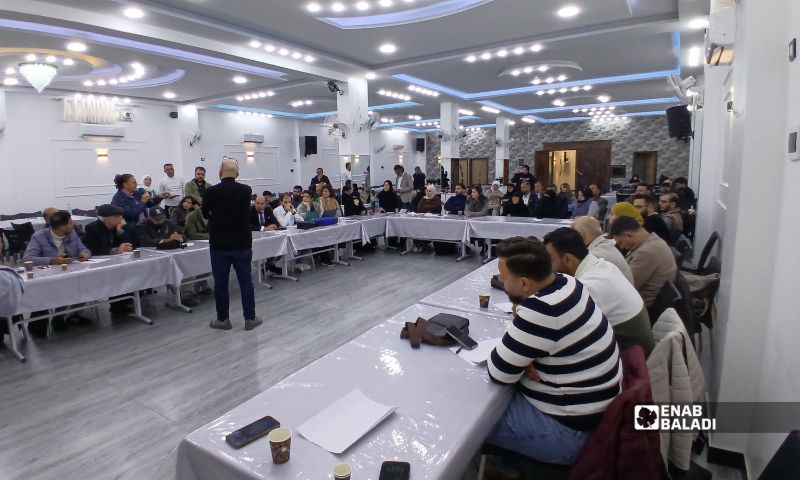
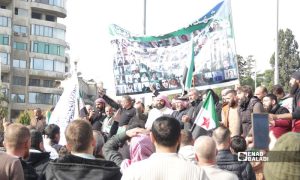
 Syrian activists hold a workshop in Quneitra to support residents of southern Syria facing Israeli incursions, November 14, 2026 (Enab Baladi/Abdullah Alwanny)
Syrian activists called for solidarity with residents of areas facing Israeli attacks, urging practical steps and initiatives that serve people and protect their dignity.
During a workshop held in Quneitra (southwestern Syria) on Saturday, November 14, the activists focused on supporting southern Syria and Quneitra governorate in the face of Israeli incursions.
The workshop addressed several issues, including inadequate coverage of Israeli violations in southern Syria by local, Arab and international media.
Participants attributed the weak coverage to misplaced priorities, a failure to recognize the scale of the issue, the current authorities’ handling of negotiations to stop Israeli attacks, and a lack of transparency surrounding the issue under both the former regime and the current government.
They stressed the need to protect journalists and provide support without restricting their freedom, ensure timely access to information, maintain ongoing media and security analysis, and issue regular diplomatic statements so that Quneitra is not forgotten. They also called for financial support to strengthen communities’ resilience, the return of the Syrian army to areas entered by Israeli forces on December 8, 2024, stronger social cohesion, opposition to hate speech, and support enabling residents to remain on their land.
The workshop’s recommendations included improving security and safety, protecting civilians, reducing violations, clearing remnants of war, rehabilitating infrastructure and main and secondary roads, providing transportation, improving water and sewage networks, and supporting telecommunications networks and street lighting.
Participants emphasized the importance of rehabilitating medical facilities and health centers, providing ambulances for emergency response, ensuring access to healthcare across all areas, supporting mental health services for war survivors, repairing damaged schools, and providing heating and transportation for students.
They also highlighted the need to create jobs, establish income-generating projects, support the provision of animal feed and the marketing of agricultural products, and compensate those affected for losses to their crops and livestock.
Participants called for a time-bound action plan to train people in advocacy and documentation, including efforts to secure the release of abducted people and clarify the fate of the forcibly disappeared.
They called for a stronger role for civil society, given organizations’ limited engagement in conflict hotspots, as well as channels of communication with local communities and a shared platform to inform local and international audiences and the government about developments in Quneitra.
Held in Khan Arnabeh, in the Quneitra countryside, the workshop provided a space for dialogue, the exchange of ideas and experience, and discussion of ways to strengthen solidarity and cooperation among civil society groups. Participants also developed proposals and practical initiatives to meet the needs of residents in Quneitra and villages in the Yarmouk Basin in the Daraa countryside (southern Syria).
One of the workshop’s coordinators, Dalia Homsi, from the Masyaf area in the Hama countryside (central Syria), told Enab Baladi that the gathering sought to affirm that southern Syria is a shared national cause that calls for unity despite disagreements and differences of opinion.
Homsi called for attention to every aspect of developments in the south, including the pain and concerns of families of forcibly disappeared people. She said the suffering was immense and residents’ pressing needs demanded a united response.
She pointed to the neglect of these conditions, stressing that people needed to know the full details and that discouraging messages should be countered with more public awareness efforts.
Homsi described the Syrian people as a powerful force and urged others to stand with them by embracing their causes. She stressed the importance of Syrians supporting one another, saying their division was something the Israeli occupation wished to see.
For her part, freelance journalist Nisreen Alaa al-Din, who is originally from the occupied Golan Heights, said the activists taking part in the workshop had chosen to come to Quneitra to affirm their support for residents of the south against the actions of the Israeli occupation, and to show that others understood their concerns and suffering.
Alaa al-Din added that, through those present, she would convey messages to the Syrian government, civil society and community groups about the need to stand together in support of Quneitra and southern Syria more broadly.
Jaafar Khaddour, a legal professional and journalist from Homs (central Syria), said his participation carried the message that all Syrian governorates stood with the south. He explained that accounts of conditions on the ground in Quneitra tended to focus on incursions, but closer examination revealed a broader picture of full-scale aggression.
Khaddour added that a central question during the workshop was whether anyone would inform residents when borders changed, or whether the accumulation of events on the ground was itself changing reality. The most important message, he said, was not to report what had happened or why, but to determine what could be done, which was what participants were trying to establish.
More importantly, in Khaddour’s view, Syrians needed to recognize that they faced a dangerous settlement plan and aggression expanding day by day. He noted that this did not necessarily require changing geographical borders, because change could begin with the population itself. Efforts therefore needed to start with people, by supporting their resilience and ability to remain on their land.
Since December 8, 2024, the Israeli army has carried out daily incursions into southern Syria, including Quneitra governorate, the western Daraa countryside and parts of the Damascus countryside (southwestern Syria).
These incursions involve violations including arrest campaigns, house searches, harassment of residents as they pursue their livelihoods, and checkpoints that sever connections between villages.
While the Syrian government calls for Israel to withdraw from Syrian territory and resume compliance with the 1974 disengagement agreement signed by the two sides, Israel refuses to withdraw, citing security concerns about a possible attack from Syrian territory similar to the October 7 attacks.
if you think the article contain wrong information or you have additional details Send Correction


 A
A
A


 More Politics