


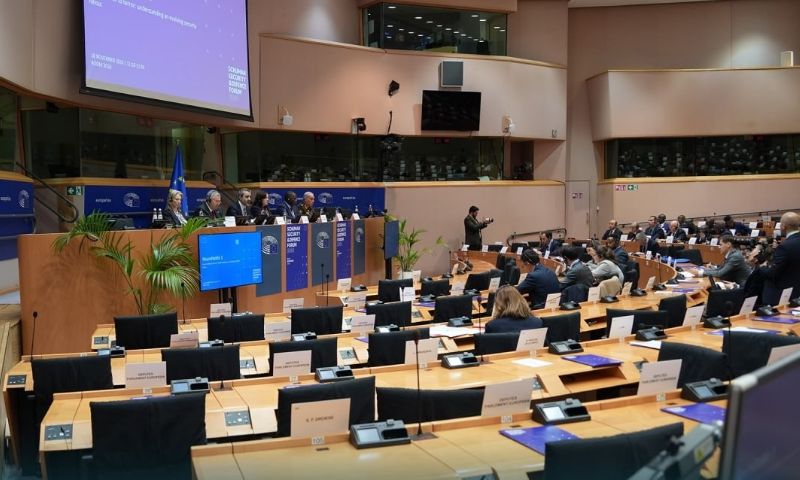
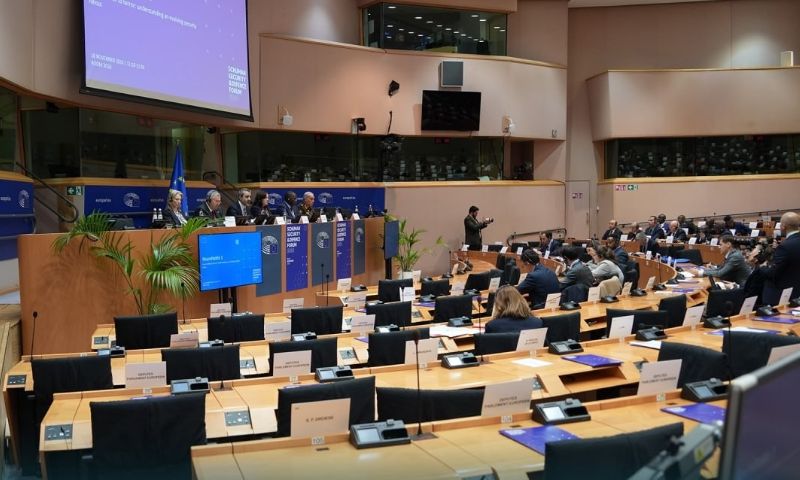
 The EU-Mediterranean Peace and Security Forum in Brussels, November 18, 2026 (Al-Thawra newspaper)


 A
A
A
Syrian Foreign Minister Asaad al-Shaibani said in Brussels on Wednesday, November 18, that Syria needs substantial international support to continue its recovery and reconstruction. He said the immediate priority was to create favorable conditions for investment and economic cooperation and remove restrictions that limit Syria’s engagement with international partners.
At the EU-Mediterranean Peace and Security Forum in the Belgian capital, al-Shaibani said conditions in Syria were gradually improving and the economy was growing as international partners began taking steps to support the Syrian government. He said broader international support was still needed to improve conditions and strengthen stability.
During the forum’s opening session, titled “Fostering Peace and Security in the Mediterranean,” al-Shaibani said lasting stability was essential for Syria to recover fully. He cited the return of about three million Syrians to the country over the past two years as a sign of progress.
Al-Shaibani said Syria had become a key partner on migration, security and efforts to combat drug trafficking and other illegal activities, and that it had a role in strengthening stability. He said the government was working to reach a partnership agreement with the European Union that would help Syria become a reliable partner and a destination for investment and business from EU member states and the Middle East.
He said Damascus aimed to move beyond individual requests in its talks with the EU by building mutual trust and starting substantive discussions on shared goals. He said the proposed partnership would be based on mutual interests and take into account the challenges facing both sides.
Al-Shaibani said European engagement with Syria had moved in a positive direction since December 8, 2024, particularly after sanctions were lifted. He called for moving away from conventional approaches and bureaucratic procedures and making use of the opportunities available.
Al-Shaibani said the government was rebuilding institutions and strengthening their capacity while facing the need to rebuild infrastructure destroyed by the war. He said both efforts would require making it easier for Syria to take part in economic and investment cooperation.
He said Syria placed greater emphasis on creating favorable conditions for engagement than on securing dedicated budgets or direct financial assistance. He called for giving the country room to engage with partners and lifting restrictions and laws that hinder economic and investment cooperation.
Al-Shaibani added that the Syrian government was working to meet its commitments and address immediate challenges. He said those efforts needed broad international backing for the country’s recovery to continue.
The minister said he hoped Syria and the EU would finalize the partnership agreement and settle its details as soon as possible so they could act on the opportunities available. He said Syrians had the will and ability to rebuild their country and that the current period offered a chance to restore hope and draw on available resources and capabilities to begin a new phase of recovery and reconstruction.
Al-Shaibani took part in the first EU-Mediterranean Peace and Security Forum, held in Brussels on Wednesday, November 18. It brought together representatives of EU member states and southern Mediterranean partner countries, along with think tanks and experts.
The forum grew out of the third pillar of the Pact for the Mediterranean, which focuses on security, preparedness and migration management. It gives the EU and its regional partners a venue to discuss shared security challenges, exchange views and improve coordination.
Alongside the high-level session on fostering peace and security in the Mediterranean, the program included discussions on maritime security and Euro-Mediterranean cooperation on counterterrorism. The discussions aimed to deepen participants’ understanding of shared security challenges and help them coordinate their positions and responses.
The forum is part of the implementation of the Pact for the Mediterranean, which the EU and its southern Mediterranean partners launched in November 2025. The pact includes an action plan covering economic cooperation, energy, education, security and migration management. The forum is part of the EU’s efforts to strengthen regional coordination on security and stability and address cross-border threats.
if you think the article contain wrong information or you have additional details Send Correction




 More Politics