


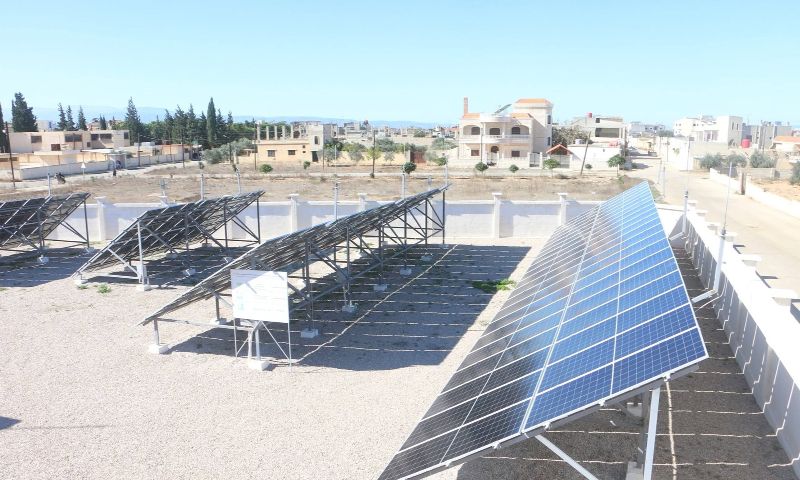
 Solar panels at a water station in Homs governorate (central Syria), November 11, 2026 (General Company for Drinking Water and Sanitation in Homs Governorate)
Syria’s Ministry of Energy has launched a Renewable Energy Master Plan in partnership with the Norwegian government and the United Nations Development Programme (UNDP). Announced in Damascus on November 23, the plan aims to establish a framework for sector development, identify priorities for expanding renewable energy projects, and guide future investments.
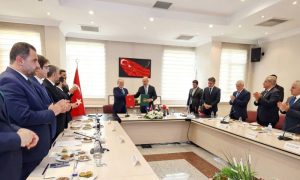
The plan was launched at an event in Damascus attended by Deputy Minister of Energy for Planning and Institutional Excellence Ibrahim al-Adhan, Norwegian Ambassador to Syria Hilde Haraldstad, and UNDP Resident Representative Melanie Hauenstein. Also attending were Talal Kanaan, adviser on energy and environmental affairs at the Ministry of Foreign Affairs and Expatriates, and Firas Kardoush, director of international cooperation at the Ministry of Energy.
The event featured a joint presentation by the Ministry of Energy and the consulting firm MRC, covering the current state of the energy sector, the challenges facing its development, the plan’s key findings and recommendations, and priorities for expanding renewable energy projects.
According to the ministry’s announcement on Monday, November 23, implementation requirements focus on establishing a unified national energy database, developing the technical skills of national personnel, and strengthening planning tools and technical cooperation to facilitate updates to the plan and guide future investments in line with the sector’s needs.
The plan identified several priorities for moving from planning to the implementation of programs and projects. Chief among them are launching a national program to establish a unified energy data platform and strengthening the capacity of national institutions in planning and technical analysis.
National institutions will be responsible for periodically updating the plan and translating its recommendations into actionable programs and projects, making continuous planning and data availability integral to the management of the energy sector in the coming period.
The database is important for assessing the sector’s current conditions and needs, providing reliable information for evaluating renewable energy potential and selecting suitable projects, and monitoring progress toward established targets. This also requires developing technical expertise within the relevant institutions and strengthening their ability to prepare plans, analyze available options, and evaluate projects.
When announcing the agreement to develop the plan in May 2025, UNDP explained that it would examine projections for Syria’s future energy demand, determine the share that renewable energy sources could meet, and review relevant regulatory and legislative frameworks in line with international best practices.
The plan includes an assessment of Syria’s renewable energy potential, particularly solar, wind, and biomass energy. It also establishes a strategic framework for expanding their use while identifying priority programs and implementation requirements.
It addresses the requirements for integrating renewable energy projects into electricity transmission and distribution networks, ensuring that the expansion of renewable electricity generation is consistent with the grid’s capacity to absorb and deliver it to consumers.
The plan’s objectives include establishing indicators and benchmarks to monitor progress toward renewable energy targets, identifying the technical and institutional requirements for developing long-term policies, and building partnerships with academic institutions to train specialists in the field.
According to UNDP, the plan seeks to improve the reliability and accessibility of energy supplies across different regions, reduce dependence on energy imports, strengthen energy security, and promote the sustainable and efficient use of resources over the long term.
Its objectives also include supporting employment opportunities and local institution development, improving environmental sustainability, reducing greenhouse gas emissions, and considering different sectors’ needs when planning renewable energy use.
The plan also addresses the need to avoid unnecessary investments in aging infrastructure that may not be suitable for the transition to renewable energy sources and to capitalize on modern technologies to develop new sectors and industries.
Work on the plan began under a framework agreement signed by the Norwegian government and UNDP on May 22, 2025, to develop a Renewable Energy Master Plan for Syria over 12 months.
UNDP explained at the time that the plan would be integrated into Syria’s Electricity Master Plan to coordinate policies on energy security and efficiency, assess the financial requirements and investment options needed to meet projected demand, and identify renewable energy potential and priority programs.
The agreement also included support for building technical capacity in renewable energy technologies and project management, as well as developing partnerships with academic institutions to train personnel capable of working in the sector.
The plan provides a framework for identifying Syria’s renewable energy development priorities. However, translating it into projects on the ground depends on subsequent steps, including securing data, technical expertise, and financing, and determining which programs the relevant institutions will begin implementing.
In its statement announcing the launch of the plan, the Ministry of Energy did not specify generation capacity targets or a timetable for implementing specific projects.
if you think the article contain wrong information or you have additional details Send Correction


 A
A
A




 More Society