Enab Baladi, Rkkan Al-Khder
Agreements signed by the Syrian and Jordanian governments during the third session of their Higher Coordination Council, held in Damascus on November 9, raise questions about the reasons and factors driving this high level of coordination between Damascus and Amman.
The two sides announced the signing of 11 documents, including memorandums of understanding, executive programs and protocols. These covered transportation, border crossings, cloud seeding in the Yarmouk basin, food security and supplies, civil aviation, scholarships and academic exchanges, modernization of the free zone, and other areas.
The understandings were announced days after Jordanian aircraft struck southern Syria on October 27, raising questions about how the two sides overcame a crisis of trust so quickly and what allowed them to continue cooperating without escalating the dispute.
Reasons for Coordination
Dr. Amer Fakhoury, a professor of international law and researcher in international relations, believes the high level of coordination between Syria and Jordan stems from their shared conviction that neither country’s security and stability can be separated from the other’s.
Speaking to Enab Baladi, Fakhoury said the two countries share a border and have intertwined economic and social interests. Any security disturbance in southern Syria could therefore have direct repercussions for Jordan, and vice versa.
Fakhoury highlighted an important shift in the relationship, noting that Jordan recognizes that Syria’s stability and the rebuilding of its institutions could create significant economic and commercial opportunities in road transport, trade and reconstruction. Damascus, meanwhile, sees Jordan as an important economic partner and a gateway to regional markets.
The relationship therefore extends beyond border control to building long-term economic interests that make stability a shared priority for both sides.
A third dimension, in Fakhoury’s view, concerns regional affairs, as both countries face similar challenges involving terrorism, drug and weapons smuggling, and security developments in southern Syria.
Political researcher Firas Allawi told Enab Baladi that several factors have contributed to the high level of coordination between Syria and Jordan, including geography, as their shared border requires cooperation at various levels.
The second factor, according to Allawi, concerns demographics and the ties between communities in Jordan and southern Syria, alongside a long shared history encompassing years of both agreement and disagreement.
Allawi identified another factor behind coordination: Israeli activities in southern Syria, which require a common position condemning these incursions because of the danger they pose to both countries.
Significance of the Agreements
Allawi believes the agreements carry particular political significance given Jordan’s support for the Syrian government since its formation and regional escalation that poses shared risks to both sides.
The agreements also have strategic importance, according to Allawi, covering economic and water issues that offer mutual benefits, alongside border coordination and efforts to combat drug smuggling, which harmed Jordan during the years of Assad’s rule.
Fakhoury believes the significance of the 11 agreements lies less in their number than in the areas they cover.
He explained that cooperation in investment, transportation, railways, water, agriculture, food security, education and public administration concerns sectors directly linked to the future of both countries’ economies, rather than secondary issues.
Agreements on rail connectivity or the development of international roads open up the possibility of making Jordan and Syria part of a broader regional network for trade and the movement of goods, benefiting both economies, he said.
The signing of agreements involving a broad range of ministers also indicates an effort to move the relationship from general political understandings toward cooperation between state institutions.
Overcoming the Crisis of Trust
Allawi believes Syria and Jordan prioritized diplomatic solutions following the Jordanian airstrikes on southern Syria because their close ties and economic interests outweighed their differences. He noted that a diplomatic solution was a shared necessity, given bilateral interests that require high levels of coordination and cooperation, while avoiding escalation that would serve neither side’s interests.
Fakhoury, for his part, explained that signing these agreements after the Daraa incident (southern Syria) sends an important message: neither country wants to allow a security incident, however serious, to disrupt its strategic interests.
In Fakhoury’s view, this reflects a degree of political maturity. Countries can disagree over a particular incident and demand an investigation and accountability while maintaining their relationship and shared interests, he said.
Fakhoury added that what happened in Daraa was a real test of Syrian-Jordanian relations, particularly because it involved civilian deaths rather than simply a political or diplomatic dispute. There was also a clear discrepancy between the two accounts, especially over whether coordination had taken place before the operation. He credited both sides with preventing the disagreement from becoming an open political confrontation, instead moving quickly to direct dialogue and forming a joint committee to investigate the circumstances.
He noted that Jordan took steps that helped contain the crisis, particularly by expressing regret over the civilian deaths and offering condolences, alongside a willingness to address the incident’s consequences. The Syrian leadership, meanwhile, handled the matter in a way that combined upholding state sovereignty and victims’ rights with preserving the relationship with Jordan.
11 Agreements Across Several Sectors
Syrian Foreign Minister Asaad al-Shaibani said his government signed 11 documents with its Jordanian counterpart, comprising memorandums of understanding, executive programs and protocols. These included a memorandum on rail connectivity paving the way for a regional corridor linking Saudi Arabia, Jordan and Syria with Turkey, a memorandum on cloud seeding in the Yarmouk River basin, a protocol on food security and supplies, memorandums on investment and civil aviation, and an executive program for scholarships and academic exchanges.
Speaking at a joint press conference with his Jordanian counterpart, Ayman Safadi, on November 9, al-Shaibani added that the two sides had agreed to upgrade the Jaber-Nasib border crossing into a model gateway operating around the clock, with separate lanes for trucks and travelers and an electronic customs link.
He explained that, during the third session of the Syrian-Jordanian Higher Coordination Council in Damascus, the two sides approved rehabilitation of the international road connecting their countries at a cost of $47 million. They also agreed to study the establishment of a joint economic city on the border, modernize the free zone and activate the joint business council.
The Syrian minister said Damascus had confirmed its readiness to facilitate gas transit to Lebanon. The two sides also discussed supporting Jordan’s food security with surplus Syrian wheat and barley, preparations to launch the Darb al-Safa telecommunications project, and an agreement to train 1,450 Syrian employees in a second phase.
Al-Shaibani said Jordan had shown understanding and openness toward addressing what happened and accepting responsibility for the strike on Daraa.
He added that the joint security and technical committee investigating the incident had completed its work, explaining that efforts were underway to provide redress and compensate the families of those killed in the strike.
Syrian-Jordanian Relations “Stronger Than Any Challenge”
For his part, Jordanian Deputy Prime Minister and Minister of Foreign Affairs and Expatriates Ayman Safadi said Syrian-Jordanian relations were “stronger than any challenge,” noting that the ties between the two sides enabled them to confront all challenges.
Safadi added that the two sides had signed 11 agreements covering cooperation across different sectors, advancing cooperation and integration between them. He noted that bilateral relations were deeply rooted in the hearts of every Syrian and Jordanian.
He pledged that Jordan would continue to stand alongside Syria and help it confront challenges and rebuild the country. Syria’s security and stability are an extension of Jordan’s own, he said, reiterating his rejection of Israeli violations in Syria.
Safadi urged the world to act to stop Israeli attacks on Syria and prevent the region from sliding into a worse situation, affirming that Amman stood alongside Syria in all measures it takes to preserve its security and stability.
The Jordanian minister expressed regret over the civilians killed in the Daraa incident, saying Syrian lives were as precious as Jordanian lives.
He said the joint investigation committee had agreed on working mechanisms for counterterrorism coordination.


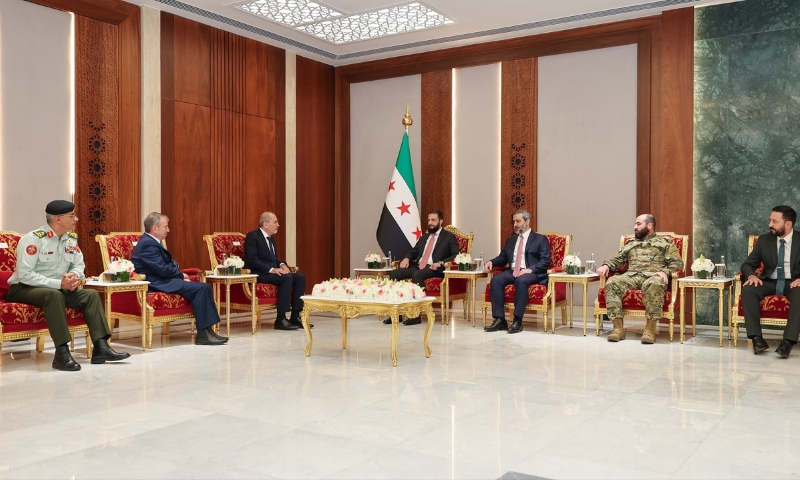
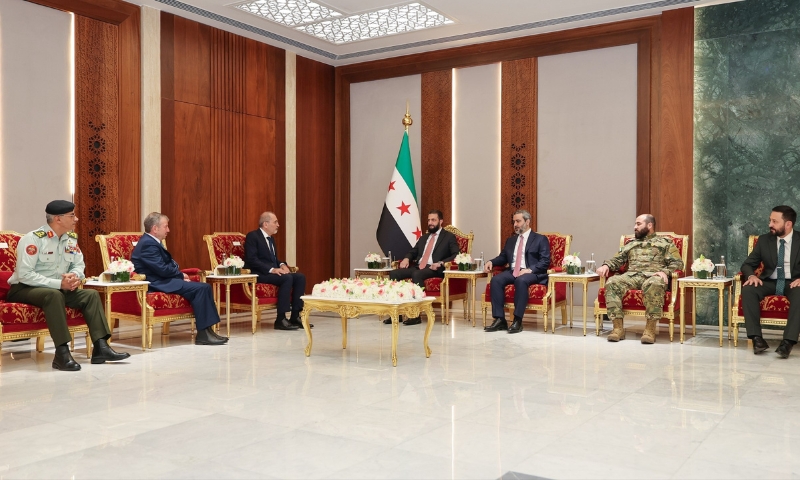
 Syrian President Ahmed al-Sharaa meets a Jordanian delegation headed by Foreign Minister Ayman Safadi to discuss the outcomes of the third session of the Higher Coordination Council between the two countries, November 9, 2026 (Presidency of the Syrian Arab Republic)


 A
A
A






 More Politics