


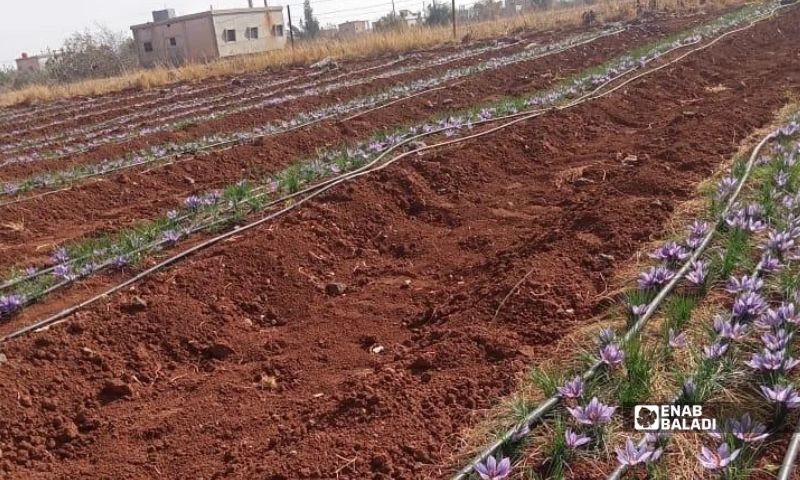
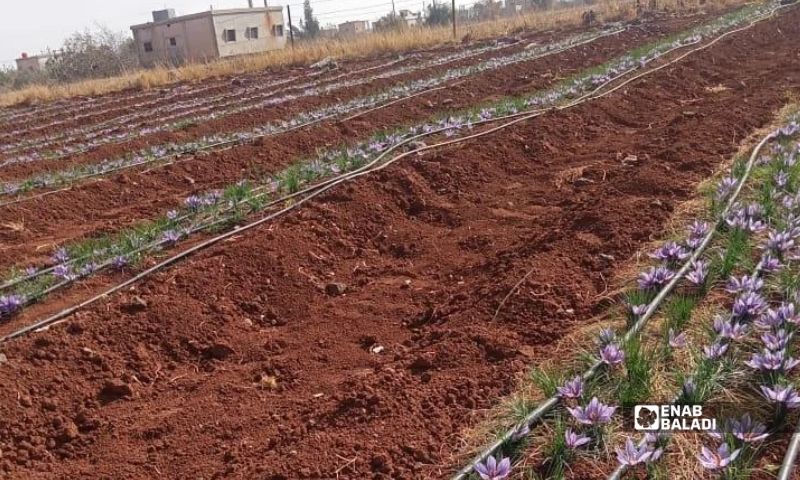
 A field planted with saffron in Suwayda, November 13, 2026 (Enab Baladi)
As water shortages and rising production costs challenge agriculture in Suwayda governorate (southern Syria), saffron is emerging as an alternative crop. The governorate’s climate suits its cultivation, and the crop requires limited water and chemical fertilizers while offering high economic value.
Despite existing cultivation projects in the governorate, saffron farming remains limited, with farmers hesitant to adopt alternative crops and facing difficulties marketing their produce and securing suitable prices.
Agricultural engineer Wasim Salha was among the first to try growing saffron in Suwayda governorate, beginning around five years ago with corms obtained from outside the governorate.
In al-Junaynah, a village in Suwayda’s eastern countryside, he established a project covering approximately three dunums, or 3,000 square meters.
Salha told Enab Baladi that Suwayda’s climate and soil are particularly suitable for saffron cultivation, as the governorate lies within the eastern Mediterranean basin, where the crop is grown. He noted that the plant does not require a particular soil type and can grow in different soils whose properties are improved with organic fertilizer.
Saffron is a winter crop that relies primarily on rainfall and requires relatively little water compared with other crops. It also does not require chemical fertilizers or pesticides, according to Salha.
He estimates that each dunum needs approximately 60 to 80 cubic meters of water annually. Where irrigation water is available, four to six watering sessions can provide part of that amount, although the crop can rely entirely on rainfall. Each dunum also requires around six metric tons of organic fertilizer annually.
Saffron is planted in September and October. Each dunum requires approximately 10,000 corms, with the total weight varying according to their size: around 40 kilograms for small corms, 60 kilograms for medium corms, and up to 100 kilograms for large ones.
Salha explained that corm size affects yields, which can range from one to two kilograms of dried saffron per dunum.
The corms begin producing in the first year after planting, although yields are initially limited. Production gradually increases as the corms grow and multiply underground.
According to Salha, yields begin increasing more substantially from the third year and continue rising until the eighth year, when the crop reaches good production levels. The corms then need to be lifted and replanted because they become overcrowded in the soil and compete for nutrients.
The crop’s economic benefits extend beyond producing saffron, the flower’s stigmas. The corms multiply underground, and their total weight can roughly triple, allowing farmers to earn income from selling both corms and the harvested spice.
The project’s main expense is purchasing corms, in addition to installing a drip irrigation system, which costs approximately $300 per dunum, and buying and transporting organic fertilizer.
Saffron begins flowering approximately 20 to 25 days after the start of the season. Flowering continues for around 25 days, during which flowers are picked daily in the early morning, preferably while still closed.
After the stigmas, the parts used to produce saffron, are harvested, they are dried to obtain the final product.
Salha noted that harvesting methods, stigma separation, and drying significantly affect saffron’s quality and value. He explained that there are two drying methods. The traditional method involves leaving the stigmas on a piece of cloth at room temperature for 24 to 36 hours, depending on humidity. The second uses ovens, takes approximately 20 minutes, and helps preserve the stigmas’ shape.
According to the agricultural engineer, traditional drying helps preserve saffron’s chemical properties. Once dried, the product is stored in a dark place to maintain its quality.
Saffron is known for its high value and multiple uses. It is used in food, desserts, and drinks, and is widely used as a valuable spice in Gulf cuisines.
It has also attracted medical research interest because it contains compounds such as crocin, crocetin, and safranal, which are being studied for their antioxidant properties and potential health effects.
Scientific research has examined whether saffron extracts could help alleviate symptoms of depression and anxiety and improve certain cognitive functions and memory. Studies have also explored their potential effects on some eye diseases.
Saffron is also used in some skincare products and cosmetics because of its compounds’ antioxidant properties.
Despite saffron’s agricultural and economic advantages, cultivation remains limited in Suwayda, with no precise statistics available on the area planted in the governorate.
Salha said cultivated areas remain small. Some new growers plant only one or two rows of corms, while others plant around half a dunum. He noted that several people had obtained corms from him, but only in small quantities for trial cultivation.
Salha attributes the limited uptake to farmers’ financial circumstances and their lack of sufficient confidence in alternative crops.
Razan, a woman from al-Qurayya in Suwayda’s southern countryside, said she had considered trying saffron cultivation but reconsidered after asking about the costs.
She told Enab Baladi that corms cost between $200 and $1,000, depending on their size, while the saffron selling price she had inquired about was approximately $6 per gram. She said the initial cost presents an obstacle to those interested in trying the crop.
Salha said the problem extends beyond Suwayda to other parts of Syria, where weak marketing and prices lower than those in neighboring countries hamper cultivation, despite saffron’s high value on international markets.
He believes developing the crop requires investors capable of supporting production and marketing, alongside government legislation to regulate the crop’s marketing and open new markets.
Meanwhile, he noted demand for saffron corms from farmers in other Syrian governorates.
Salha believes saffron has the qualities needed to become a promising alternative crop in the governorate. It does not require large amounts of water or consistently expensive agricultural inputs, and it allows farmers to earn income from selling both the spice and the corms.
However, turning that potential into widespread cultivation requires overcoming marketing obstacles and initial costs, while providing farmers with the confidence and support needed to try a crop that remains relatively new to Suwayda’s agricultural landscape.
if you think the article contain wrong information or you have additional details Send Correction


 A
A
A







 More Society