


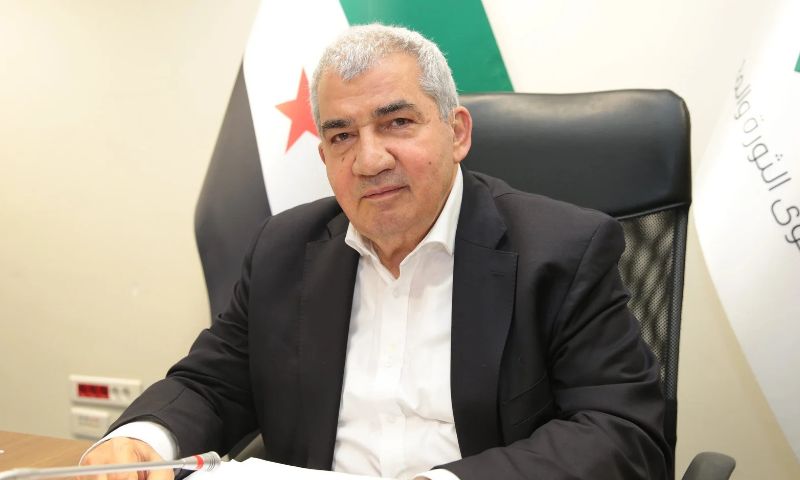
 Riad Seif during his tenure as president of the Syrian opposition coalition, 2017 (Riad Seif’s website)
Riad Seif, a former Syrian lawmaker and prominent opponent of the Assad regime, died on Wednesday, November 25, at about 80, according to tributes posted on social media by Syrian political figures, journalists, and activists.
Seif was one of the most prominent political opponents of the former Assad regime. His career spanned key moments in Syria’s opposition movement, from his work in parliament in the 1990s and his role in the Damascus Spring and the Damascus Declaration for National Democratic Change to his part in founding and later leading the National Coalition of Syrian Revolutionary and Opposition Forces.
Seif was born in Damascus in 1946 and built a successful career in the garment industry before entering politics. He was elected to Syria’s parliament, the People’s Assembly, in 1994 and reelected as an independent in 1998. In parliament, he became known for criticizing economic policies and raising concerns about corruption, including the monopoly in the mobile telecommunications sector.
During that period, Seif criticized the performance of government institutions and raised concerns about investment and economic stagnation. He also circulated a study criticizing how mobile phone operating contracts were awarded, prompting the former regime to restrict his business and political activities.
Seif emerged as a leading figure during the Damascus Spring, which followed Bashar al-Assad’s rise to power in 2000. He founded the National Dialogue Forum in his home, where he hosted political and intellectual discussions that called for political reform and greater civil liberties.
He took part in the movement calling for political and constitutional reforms and an end to the Baath Party’s monopoly on power. The former regime’s authorities arrested him in September 2001, stripped him of his parliamentary immunity, and sentenced him to five years in prison on a charge of “attacking the authority of the state” over his political activities and the meetings he hosted at home.
Seif was among the signatories of the Damascus Declaration, issued in October 2005. It called for peaceful democratic change in Syria and the establishment of a democratic state based on pluralism and the rule of law.
Seif was arrested again in 2008 and released in July 2010. When the Syrian uprising began in 2011, he joined peaceful demonstrations in Damascus, where regime security forces assaulted him during a protest.
After years of imprisonment and persecution by the security services, Seif left Syria for Germany in June 2012 to receive medical treatment. He settled in Berlin.
In November 2012, Seif proposed the Syrian National Initiative to reorganize the opposition and bring more groups under a single political umbrella. The initiative helped establish the Syrian National Coalition, whose formation was announced that same month in Doha, Qatar.
Seif was elected a vice president of the coalition when it was founded. On May 6, 2017, he was elected president, succeeding Anas al-Abdeh. He held the post until March 9, 2018, when he resigned because of deteriorating health.
As president, Seif proposed reforms to the coalition’s structure. They included reviewing membership and political representation, increasing transparency and accountability, and revitalizing the coalition’s affiliated institutions.
Following the fall of Bashar al-Assad’s regime on December 8, 2024, Seif returned to Syria after about 12 years in Germany. He settled in Damascus, resumed his public activities, and helped revive the forum he had founded during the Damascus Spring as the Democratic Dialogue Forum.
On April 23, 2025, Seif hosted a meeting of the Democratic Dialogue Forum at his home in the Qudsaya suburb (Damascus countryside, southwestern Syria). Political figures, human rights advocates, and activists discussed transitional justice and civil peace in the period following the regime’s fall.
The forum returned after a hiatus of about 24 years, reviving one of the most prominent forms of political and cultural activity in Syria at the turn of the millennium. The former regime’s authorities had shut down the forums and arrested several participants.
Seif’s memoir, Riad Seif: An Autobiography and Testimony for History, was launched in Damascus on Wednesday, November 4, 2026. The book covers milestones in his personal, professional, and political life, including his opposition to the Assad regime and the imprisonment and persecution he faced.
Seif’s health kept him from attending the launch. His daughter, Joumana Seif, delivered his remarks on his behalf under the title “In the Syria We Dream Of, the Law Prevails Over Tyranny.”
The memoir revisits Seif’s political career and key moments in the history of the Syrian opposition. Its launch followed his return to Damascus after the regime’s fall and his renewed work with the Democratic Dialogue Forum. Seif died on Wednesday.
if you think the article contain wrong information or you have additional details Send Correction


 A
A
A




 More Politics