


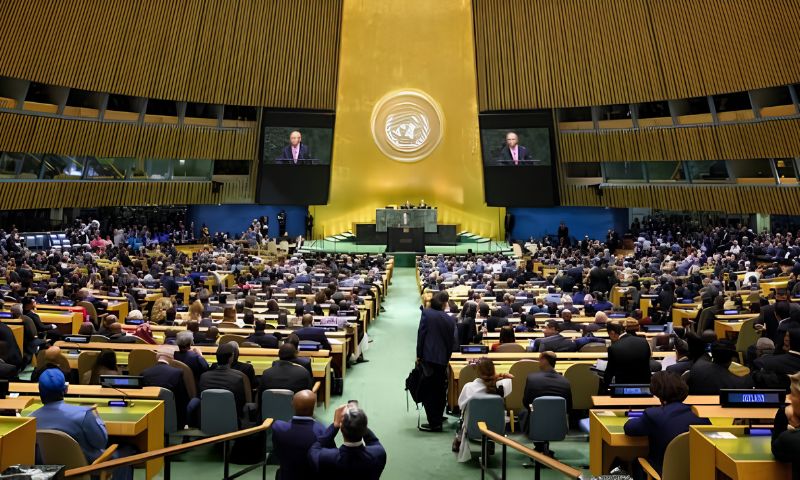
 A previous session of the United Nations General Assembly, September 28, 2026 (United Nations).


 A
A
A
A United Nations resolution reaffirming Syrian sovereignty over the occupied Golan Heights raises questions about its significance and potential impact, particularly as the UN adopts such resolutions annually without any change in the situation on the ground.
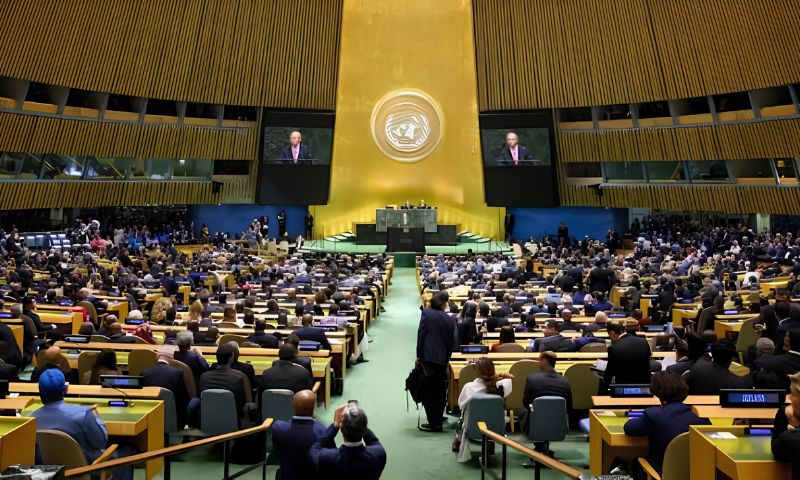
On November 18, the Fourth Committee of the United Nations General Assembly adopted a draft resolution titled “The Occupied Syrian Golan,” with 149 countries voting in favor, eight against, and 14 abstaining.
According to the text of the previous draft resolution and the explanation provided by Mauritania during the Fourth Committee session, the current draft includes several demands, most notably:
The current draft includes an update concerning follow-up on its implementation, requesting that the UN Secretary-General submit an annual report to the General Assembly, beginning with its 82st session, on the implementation of the resolution.
Enab Baladi examines the significance of the UN resolution, what Damascus stands to gain from it, how the Syrian government could leverage it, and the obstacles preventing it from producing tangible changes on the ground.
Amer Fakhoury, a professor of public international law and researcher in international affairs, believes that despite the recurring nature of the UN resolution on the occupied Syrian Golan, its new elements can be examined from three perspectives. The first is the increase in the number of countries supporting the resolution, from 146 to 149. Although three additional votes do not represent a substantial increase, Fakhoury said they reflect continued international support for Syria’s legal position despite the political transformations the region has undergone.
The second, according to Fakhoury, concerns the circumstances surrounding the adoption of the resolution, which differ significantly from previous years. A new Syrian government has emerged, and southern Syria faces a new security situation following Israeli military movements after the fall of the Assad regime in December 2024. Reaffirming Syrian sovereignty over the Golan therefore carries additional political significance at this stage.
Fakhoury also pointed to a procedural amendment in the UN resolution requesting an annual report from the secretary-general on its implementation, beginning with the General Assembly’s 82nd session. He noted that Mauritania’s representative had confirmed during the Fourth Committee session that this was the main update to the text.
Despite this positive development, Fakhoury cautioned against overstating its significance as a new enforcement mechanism, since periodic reporting had also existed previously.
Fakhoury believes the resolution’s most important political message is that military control over territory does not necessarily confer legal sovereignty over it.
He explained that there is a distinction between conditions imposed by military force and a legal status determined by the rules of international law. Neither the persistence of military control for many years nor the prolonged duration of an occupation transforms that control into legitimate sovereignty, he said.
The second implication, according to Fakhoury, is that the resolution places political limits on attempts to consolidate the status quo. The vote reflects the refusal of an overwhelming majority of participating countries to accept Israeli measures as a legitimate basis for altering the legal status of the Golan. This is an important message, particularly given the transformations underway in Syria.
Fakhoury identified a third implication: the issue remains on the international agenda, giving Damascus diplomatic room to assert its rights. However, this does not automatically mean that the countries supporting the resolution are prepared to take concrete action against Israel.
Political researcher and journalist Firas Alawi told Enab Baladi that UN resolutions reflect international policy and political will, noting that the resolution clearly rejected Israel’s policy of maintaining control over the Syrian Golan.
Alawi added that the UN move reinforces Security Council Resolution 497, adopted in 1981 concerning Syrian sovereignty over the Golan. He said it also carries political significance by demonstrating international support for Damascus’s demand to recover the territory.
Alawi attributed the absence of enforcement measures to the nature of General Assembly resolutions, which, unlike binding Security Council resolutions, are nonbinding. This makes them primarily political decisions rather than enforceable measures, he said, although they help reinforce international legal support for Syria’s rights to its occupied territory.
Alawi said translating resolutions into enforceable measures would require bringing the issue before the Security Council, where action would require agreement among its five permanent members, including the United States, which supports Israel. This would require a shift in the international political climate, as well as a change in Washington’s position on supporting Israel.
For his part, Fakhoury distinguishes between the legal value of the resolution and the ability to enforce it. He noted that General Assembly resolutions, which are legally recommendatory in nature, do not generally create binding obligations for states simply upon their adoption. Their significance lies in reaffirming existing legal principles, foremost among them the prohibition on acquiring another state’s territory by force and the nonrecognition of the annexation of occupied territories.
More importantly, according to Fakhouri, Security Council Resolution 497 of 1981 explicitly determined that Israel’s decision to impose its laws, jurisdiction, and administration on the Golan was null and void and without international legal effect, and demanded that Israel rescind the measure.
Fakhouri explained that the resolution therefore reflects not merely a new political position adopted by the General Assembly, but an established institutional legal position that has existed for decades.
From a political perspective, Fakhouri believes the resolution keeps the issue on the international agenda and reaffirms continued international opposition to the annexation. He stressed, however, that an overwhelming majority in favor of the resolution does not necessarily indicate an equivalent willingness among those countries to impose sanctions or exert tangible pressure.
Fakhouri noted that the failure to enforce the resolution does not invalidate the legal principle on which it rests. A state’s failure to comply with its obligations does not make its conduct lawful, but exposes a problem with the mechanisms for enforcing international law.
The main problem, according to Fakhouri, is that while international law can determine the legal status of a territory, changing the military situation requires additional political, diplomatic, and institutional tools.
According to Fakhouri, the problem with UN resolutions lies not in the absence of legal rules, but in the lack of political consensus on their implementation. He noted that the Security Council, which has the authority to adopt binding measures to maintain international peace and security, including those stipulated under Chapter VII of the UN Charter, is subject to the balance of power within the council, particularly the positions of its five permanent members and their veto power.
Fakhouri identified another factor related to countries’ strategic interests. Some governments may support the principle that territory cannot be annexed by force but may be unwilling to bear the political or economic costs associated with pressing for its implementation.
He noted that Israel regards the Golan as an area of considerable security and strategic importance. The question of withdrawal therefore depends not only on legal decisions but also on complex security and political calculations.
For this reason, Fakhouri said, adopting a resolution with the support of 149 countries is not enough. The real question is how many of those countries are willing to move beyond voting at the United Nations and take concrete diplomatic, economic, and legal measures.
Fakhouri believes the Syrian government has an opportunity to turn international support into a more structured diplomatic process, provided it treats the resolution not as a final achievement but as a starting point.
He added that Damascus could build on the support of 149 countries through bilateral and multilateral contacts to ensure the continuation of the policy of nonrecognition of the annexation of the Golan and encourage countries to adopt practical positions consistent with international law, particularly regarding settlement activities and measures aimed at altering the territory’s legal status.
According to Fakhouri, the Syrian government could also use UN reports to document developments related to settlements, natural resources, the conditions of residents, and changes imposed on the ground. Accurate documentation helps build legal and diplomatic cases and gives other countries a basis for adopting measures consistent with their international obligations.
Fakhouri stressed the need to carefully examine possible international judicial avenues. Simply declaring that Syria will take its case to the International Court of Justice (ICJ) is not sufficient, since the court’s jurisdiction over disputes between states requires a legal basis, such as acceptance of its jurisdiction by the states concerned.
As a final step, Fakhouri suggested exploring avenues for seeking advisory opinions through the relevant UN bodies, while recognizing that an advisory opinion does not in itself constitute a mechanism for compelling Israel to withdraw.
Alawi, meanwhile, believes Damascus can leverage the resolution politically and legally by capitalizing on the large number of countries that voted in favor compared with those that opposed it. This provides Damascus with support in any diplomatic measures or negotiations with Israel, as well as legal backing should the issue develop into a legal dispute within UN institutions.
if you think the article contain wrong information or you have additional details Send Correction






 More Politics