

Amir Hakouk | Enab Baladi
Reviving trade routes between Syria, Iraq and Lebanon is no longer simply a matter of reopening border crossings and resuming truck traffic. It raises a broader question about whether the three countries can turn their geographical position into an integrated economic network, amid deteriorating infrastructure, limited funding and complex trade and customs procedures.
Between the opportunities offered by an overland link connecting Iraq to the Mediterranean and the obstacles restricting trade, questions remain about whether governments and the private sector can turn a route shaped by regional circumstances into a sustainable economic corridor.
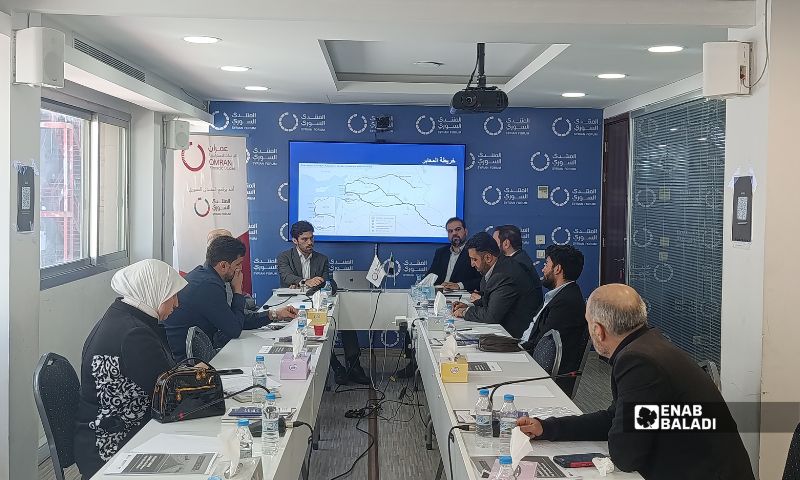
Against this backdrop, the Omran Center for Strategic Studies, a Syrian Forum program, held a roundtable at its Damascus headquarters on Monday, November 16, to discuss a research paper titled “The Levant Corridor: Rebuilding Trade Between Iraq, Syria and Lebanon.” Participants included government representatives, experts, researchers and private sector representatives.
The Levant Corridor: From Geography to Economic Integration
The Levant Corridor refers to the trade route linking Iraq with Syria and Lebanon and extending to Mediterranean ports, drawing on the three countries’ geographical position and existing road networks and border crossings.
These proposals come amid efforts to revive trade relations. On the Syrian-Iraqi front, the two countries’ federations of chambers of commerce have reached understandings to promote trade and investment, alongside Iraqi measures facilitating entry visas for Syrian traders.
On the Syrian-Lebanese front, overland transport is governed by a 1993 agreement regulating the movement of people and goods, along with subsequent understandings to facilitate truck and bus crossings and regulate transit traffic.
Corridor Bottlenecks and Development Priorities
The session opened with a presentation by Abdulla Al-Kalisy, a researcher who contributed to the study, outlining its main findings. The paper was prepared by the Institute of Regional and International Studies (IRIS) at the American University of Iraq, Sulaimani, and the Issam Fares Institute for Public Policy and International Affairs (IFI) at the American University of Beirut, in cooperation with the Omran Center.
The study drew on 71 interviews with government officials, border crossing officials, traders, truck drivers and customs brokers across the three countries. It documented damage to border crossing and road infrastructure, shortages of inspection equipment, storage facilities and logistics services, shipment delays and rising transport costs.
It examined three main crossings between Iraq and Syria: al-Waleed/al-Tanf, al-Qaim/al-Bukamal and Rabia/al-Yarubiyah. It identified al-Waleed/al-Tanf as the most direct route between Baghdad and Damascus, arguing that its development should be a shared priority for both countries, while also highlighting the importance of Rabia/al-Yarubiyah because of its connections to trade routes toward Turkey.
On the Syrian-Lebanese border, the study distinguished between the importance of the Masnaa/Jdeidet Yabous crossing for bilateral trade and the potential role of the northern route through al-Dabousiyah, al-Abboudiyah and al-Arida to the Port of Tripoli, if developed as part of a trade corridor spanning several countries.
It concluded that the three governments lack sufficient resources to develop all crossings simultaneously, making it necessary to prioritize investment according to economic feasibility and political and security considerations.
It also stressed that developing the corridor cannot depend on infrastructure alone. It requires trilateral coordination between Baghdad, Damascus and Beirut, along with harmonized customs procedures, documentation requirements, payment systems and data sharing.
Strategic Ambition and Economic Feasibility
Participants questioned the feasibility of projects associated with the corridor, given Syria’s limited financial resources, competing trade routes and differences in political and institutional stability across the three countries.
Some warned against launching large projects before completing technical and economic studies, calling for priorities to be established and funding directed toward the most viable projects. They also discussed the risks of trade relations being affected by political fluctuations and the possibility of expanding partnerships to include Turkey, Jordan and Egypt, alongside Iraq and Lebanon.
Speaking to Enab Baladi, economic researcher Dr. Ibrahim Othman described the route as an opportunity to restore Syrian-Iraqi trade relations to their historical course, in terms of both exports and imports. He said the two economies have a history of commercial ties that could provide a foundation for restoring trade flows.
Othman said normalizing trade relations could reactivate this economic artery, but would require improvements in technical, administrative and regulatory arrangements, as well as stronger security along roads and at crossings to reduce the risks facing trade.
He said the Syrian government’s intention to rehabilitate the road between Damascus and Deir Ezzor (eastern Syria) indicated an understanding of the importance of overland links with Iraq. He noted that Iraq has a large market in which competitive Syrian products could find buyers.
He argued that developing trade relations should extend beyond restoring traditional exports. At a later stage, the two countries could expand exports and make greater use of their available products and resources to strengthen bilateral trade.
The Private Sector and Syrian Products’ Competitiveness
Participants discussed the difficulties Syrian products face in entering the Iraqi market amid unstable economic policies, changing procedures and growing competition from Turkish, Iranian, Chinese and Egyptian goods.
They called for updated studies identifying Iraqi market needs and Syrian products capable of competing, as well as guarantees for producers and exporters, more trade fairs and direct contact between businesspeople.
Mohammed Orfali, an adviser to the Damascus and Damascus Countryside Chamber of Industry, discussed the experience of exporting to Iraq between 2001 and 2006. He said maintaining the quality of Syrian products had helped build a commercial reputation among Iraqi buyers. However, he noted that the market has since changed, with greater competition and higher production costs, particularly for energy, making updated information necessary on Iraqi consumer preferences and sectors offering export opportunities.
He also pointed to the growing burden of company and commercial registration, alongside reduced activity at a number of factories, as factors affecting Syrian industry’s ability to expand and export.
The discussions included calls for chambers of commerce and industry and economic attachés to play a more active role in gathering information about the Iraqi market, organizing trade fairs and expanding direct contact between businesspeople, instead of relying on outdated assumptions about Iraqi demand.
Financing and Infrastructure: Who Pays?
The cost of rehabilitating roads and crossings was a central topic, with participants discussing joint financing models, including public-private partnerships (PPP) and build-operate-transfer (BOT) arrangements, to develop roads, crossings, energy projects and logistics services.
In comments to Enab Baladi, Ayman Dasouki, a senior researcher at the Omran Center for Strategic Studies, said infrastructure, customs procedures and financial transfers all pose significant challenges to developing the corridor. However, he said work could begin according to priorities that allow some bottlenecks to be addressed without waiting for major projects.
Dasouki pointed to the possibility of rehabilitating infrastructure through jointly funded initiatives involving the three countries, alongside improvements to procedures that could help stimulate trade.
He said transforming the corridor from a trade route dependent on temporary circumstances into a sustainable economic project requires a shift from short-term solutions to strategic planning, through cross-border coordination and economic feasibility studies, with private sector involvement in developing and implementing projects.
A Transport Ministry representative discussed plans to develop roads and railways, including the Damascus-Deir Ezzor road project and a proposal to build an additional road in cooperation with a Saudi company, under plans extending through 2027. The representative also highlighted financing challenges and the need to establish implementation priorities.
Customs Procedures and Government Coordination
Participants discussed complex administrative and customs procedures and the need to simplify them by electronically linking commercial registration records, tax identification numbers and customs entry points, making it easier to verify company information and track shipments.
They also raised questions about the Foreign Trade Ministry’s role in setting trade policy, providing incentives and developing legislation, alongside the need to clarify government institutions’ responsibilities and strengthen coordination between them and chambers of commerce and industry.
The discussions concluded by emphasizing the importance of joint development solutions involving Syria, Iraq and Lebanon, based on documented feasibility studies that identify funding sources and the roles of government and the private sector, alongside infrastructure improvements and simpler trade procedures.
While the three countries have geographical and commercial advantages to build on, their governments’ ability to coordinate priorities and provide a stable environment for trade and investment will determine whether the Levant Corridor becomes a sustainable economic network or remains a route whose activity is dictated by political developments and unforeseen events.