
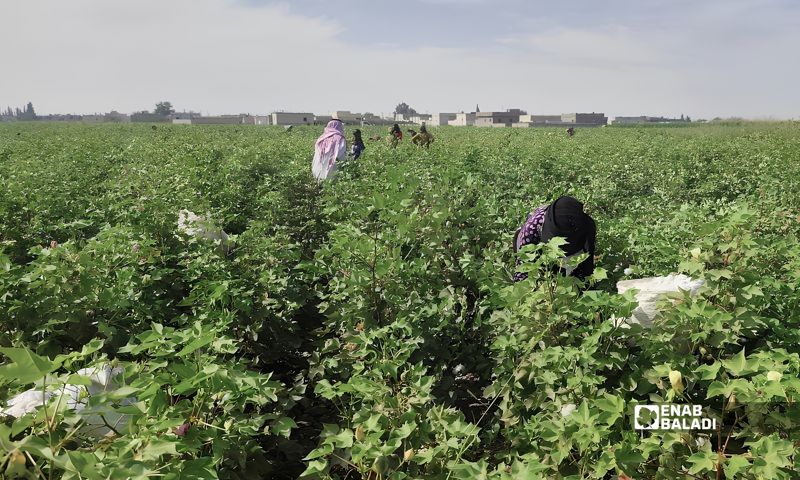

Syria’s Ministry of Agriculture has set the purchase price of cotton at 100 Syrian pounds (approximately $0.67) per kilogram for the 2026 agricultural season, with the cost divided between the General Establishment for Cotton Ginning and Marketing and the Agricultural Production Support Fund.
The ministry announced on Monday, November 16, that it would cover 20 Syrian pounds (approximately $0.13) per kilogram as part of its agricultural production support program, while the General Establishment for Cotton Ginning and Marketing would pay the remaining 80 Syrian pounds (approximately $0.53) for each kilogram of cotton delivered to it.
The ministry explained that the price was adopted to support cotton farmers and encourage domestic production, helping ensure the continued cultivation of the crop and strengthening support for the agricultural sector. It noted that the new pricing arrangement provides farmers with a 20% subsidy.
On August 4, the Agricultural Production Support Department had set the purchase price for the 2025 cotton harvest at 85 new Syrian pounds (approximately $0.57) per kilogram, requiring farmers to deliver their crops to collection centers operated by the General Establishment for Cotton Ginning and Marketing.
According to Mohamed Saad Suleiman, director of agricultural production support, production costs were assessed by a specialized committee comprising representatives from the Ministry of Agriculture and other institutions. The assessment drew on reports and cost estimates submitted by different governorates, covering agricultural inputs and farming services.
He explained that the objective was to ensure agricultural subsidies reached eligible farmers directly.
On November 12, the Ministry of Agriculture transferred 23 million Syrian pounds (approximately $153,000) to the Agricultural Cooperative Bank in preparation for disbursing cotton crop subsidies owed to farmers for the 2025 agricultural season.
Production Estimated at Around 100,000 Tons
Mohammed Maari, director of the Cotton Office at the Ministry of Agriculture, said the 2026 cotton season had recorded a relative improvement in cultivated areas and production compared with previous years.
In statements published by the official Syrian Arab News Agency (SANA) on October 7, Maari said approximately 33,000 hectares had been planted with cotton, with production estimated at around 100,000 tons.
He explained that cotton cultivation is concentrated in Raqqa, Deir Ezzor (eastern Syria) and al-Hasakah (northeastern Syria), alongside limited areas in Aleppo (northern Syria) and the al-Ghab region. He noted that cotton is not merely an agricultural crop but also a source of livelihood for millions of families worldwide.
Maari said the current season had faced several challenges, including low temperatures, rainfall continuing through May, declining irrigation water supplies and water resources, and rising production costs resulting from damage to infrastructure and irrigation canals.
He also noted that delays in setting cotton purchase prices and paying farmers their dues on time had posed additional challenges to production. Increasing cotton yields, he explained, requires providing agricultural inputs at affordable prices, repairing irrigation canals, adopting contract farming practices and supporting farmers in using modern agricultural technologies.